

Smarter campaign structure for stronger cyber sale results

SHARE:

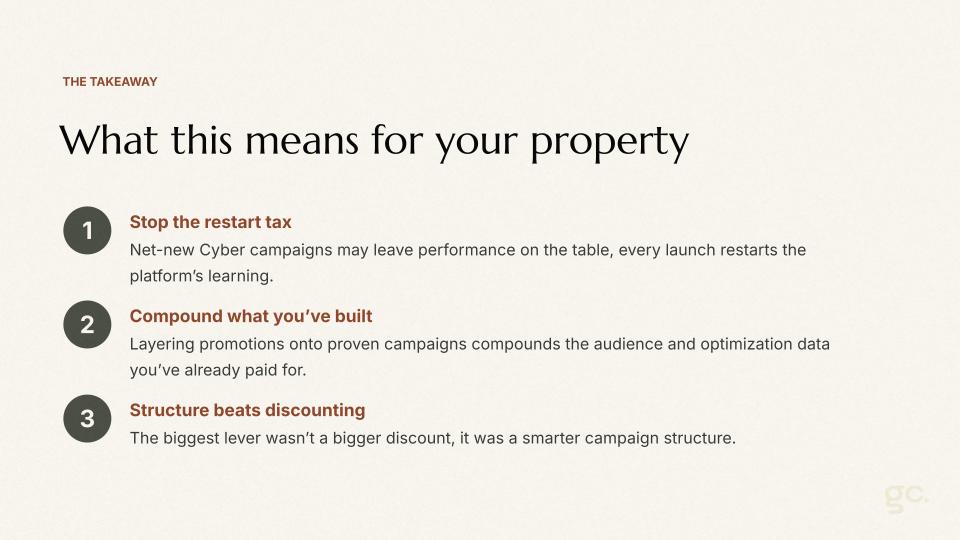
Cyber season is no longer just a nice-to-have on the hospitality marketing calendar. It's one of the highest-stakes promotional windows of the year, and the gap between a well-structured campaign and a loosely assembled one is growing wider.

For Cyber 2025, we ran a structured test across a consistent group of hotel and resort clients to answer one question: Does building Cyber promotions inside existing campaigns outperform launching net-new ones? 

The results were clear, and they have real implications for how hospitality brands should think about campaign architecture heading into 2026.

The strategy shift: Building inside what already works

In 2024, most Cyber campaigns followed a familiar playbook: launch a separate, net-new campaign for the promotional window. It's a logical approach. Isolated campaigns let you control budgets, tailor messaging, and track results cleanly. But they also come with a hidden cost.

Every new campaign starts the learning phase from scratch. Platforms like Meta need time to optimize delivery, which is a disadvantage when your sale window is measured in days, not weeks.

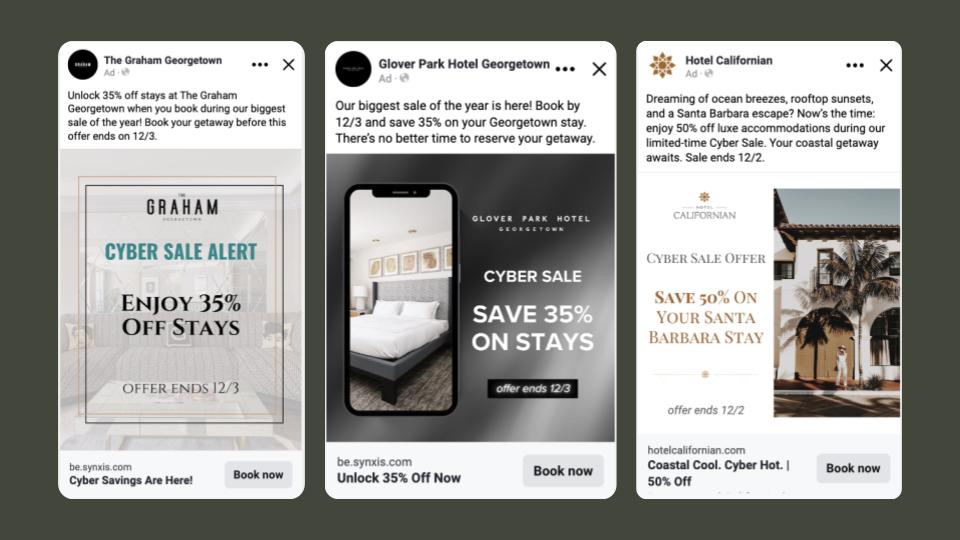
For Cyber 2025, we flipped that model. Instead of launching new campaigns, we added new ad sets inside existing, always-on campaigns. The goal was to carry forward the historical performance data, audience signals, and optimization momentum that those campaigns had already built. According to Meta's own guidance on campaign learning, campaigns that exit the learning phase deliver more stable and efficient results. We wanted to start there, not work our way back.
What the numbers actually showed

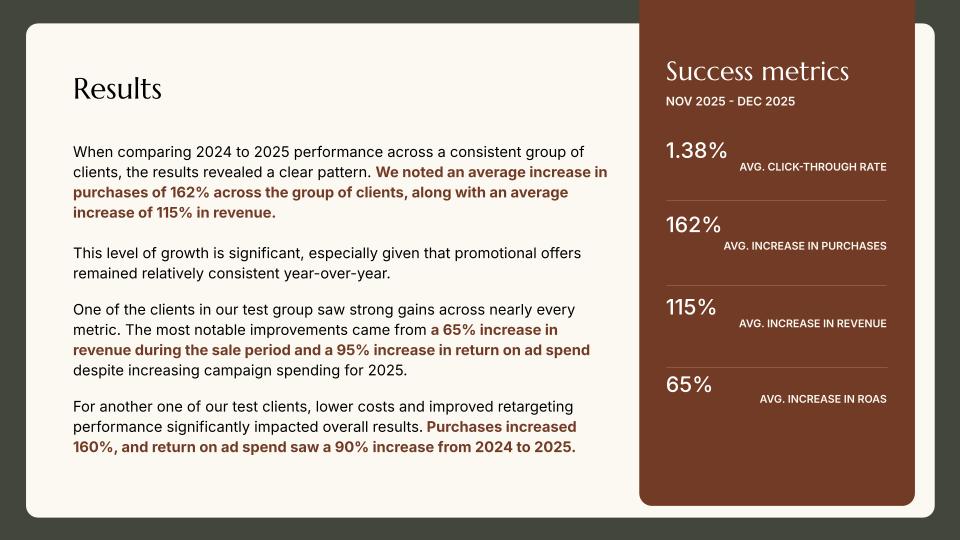
The results across our test group were significant. Purchases increased 76% year over year. Revenue grew 78%. And this happened while promotional offers remained largely consistent between 2024 and 2025.

The efficiency story was just as strong:

  • Prospecting cost per thousand impressions (CPM) dropped 35%
  • Retargeting CPM dropped 39%
  • Combined CPM across both audiences decreased 38%

Reaching more people at a meaningfully lower cost, while converting more of them, is the kind of outcome that moves the needle for a property's overall paid media return.

Individual property results reinforced the pattern

One property in the test group saw a 65% revenue increase during the sale period alongside a 95% lift in return on ad spend (ROAS), even after increasing overall campaign spending in 2025. Another saw purchases jump 160% with a 90% improvement in ROAS. These aren't edge cases. They represent what becomes possible when campaigns start optimized instead of having to earn it.

Lower click-through rates, better results

One of the more counterintuitive findings: click-through rates declined across the group, yet performance improved. This is consistent with what research from Nielsen has long argued: click-through rate is a weak proxy for advertising effectiveness. Campaigns became more efficient at reaching the right users at the right time, and those users converted.

The takeaway for hospitality marketing teams is worth internalizing. Optimizing for clicks during a short promotional window can actually work against you. The platform rewards campaigns that demonstrate delivery efficiency and conversion intent, not engagement metrics alone.
What to keep in mind before restructuring your Cyber campaigns

These results are strong, and context matters. A few variables influenced this test that any team should account for:

  • Several 2025 campaigns ran longer than their 2024 counterparts, which likely contributed to higher overall totals.
  • Some properties shifted their offers from a flat discount to "up to X% off," which can influence how users perceive and respond to the promotion.
  • A handful of clients moved from animated creative in 2024 to static imagery in 2025.

Campaign structure is a meaningful lever, and it's not the only one. Creative quality, offer strength, audience targeting, and budget strategy all shape outcomes. The structure creates the conditions for efficiency. Everything else determines whether you take full advantage of it.

This aligns with findings from Boston Consulting Group's work on marketing personalization and data activation, which consistently shows that leveraging existing behavioral data outperforms cold-start targeting when promotional windows are compressed.

What this means for your 2026 Cyber strategy

If your team is already planning for Cyber 2026, the campaign architecture conversation should happen now, not in October.

A few practical steps worth building into your planning process:

  • Audit your always-on campaigns and identify which have the strongest historical performance signals. These are your candidates for housing Cyber ad sets.
  • Plan your creative and offer strategy early enough to build and test before the promotional window opens.
  • Set clear performance benchmarks against your 2025 results, and track CPM alongside ROAS, not just click volume.
  • Build enough flexibility into your budget to scale what's working during the sale window without restarting a new campaign mid-flight.

Cyber season rewards preparation. The properties that saw the strongest results in 2025 weren't improvising their structure in November. They built a foundation that let the platform work for them.
Ready to build a smarter Cyber strategy?

Campaign structure is one of the most underutilized levers in hospitality paid media. If your team wants to stress-test your current approach, rebuild your Cyber architecture ahead of 2026, or just understand what's driving your CPM costs, we'd love to dig into it with you.

Reach out to the GCommerce team at gcommercesolutions.com and let's talk about what a stronger Cyber season looks like for your property.

Frequently asked questions about cyber campaign structure 

Does this campaign structure work for properties running Cyber promotions for the first time?

It can, with some caveats. The core advantage of building Cyber promotions inside existing campaigns is access to historical performance data and established audience signals. If a property has never run paid campaigns before, that foundation doesn’t exist yet. For first-timers, the priority should be launching always-on campaigns well ahead of the Cyber window so the platform has time to learn and optimize before the promotional period begins. The structure works best when there’s something worth building o


How long should an existing campaign run before we add a Cyber ad set to it?

There’s no universal threshold, but campaigns that have fully exited the learning phase and have consistent delivery and conversion data make the strongest candidates. Generally, a campaign running for at least 60 to 90 days with steady performance gives the platform enough signal to work from. The more conversion data the campaign holds, the better positioned it is to optimize quickly when a new ad set goes live inside it.


What if our Cyber offer changed significantly from the prior year?

Offer changes don’t eliminate the structural advantage, but they do add a variable worth tracking closely. A meaningfully different offer, whether in discount depth, booking window, or terms, can shift user behavior in ways that make year-over-year comparisons harder to interpret. The campaign still benefits from existing audience data and delivery efficiency. Just build your benchmarks around the new offer rather than assuming prior-year conversion rates will carry over directly.


AI is redefining SEO for hotels and resorts: Here’s how

SHARE:

Search has entered a new chapter. Generative AI is changing how travelers discover destinations, compare hotels and resorts, and make booking decisions. Traditional SEO still matters, but it no longer operates alone. AI-powered assistants now influence the answers travelers see before they ever click a link. For any property focused on hospitality marketing or on increasing direct bookings, this shift requires a new approach.

At GCommerce, we view this change as an opportunity. As a hospitality marketing agency and digital marketing agency built for hotels and resorts, we are helping brands adapt to what comes next in search.

From SEO to AEO: Where intent meets intelligence

For years, SEO optimized for rankings, traffic, and blue link visibility. Today, AI engines summarize, interpret, and synthesize information rather than simply listing it. This introduces AEO, or AI Engine Optimization.

AEO focuses on shaping how AI tools understand your brand and how often they reference your content within generated responses. Instead of optimizing only for clicks, AEO optimizes for citations, clarity, and semantic depth. It guides how AI describes your property and which details it elevates when travelers ask questions about hotel locations, amenities, or booking options.

Clicks are no longer the only metric. The mention is.

Why AEO matters for hospitality brands

AI-powered discovery impacts three essential areas for hotels and resorts.

  • Visibility: AI tools increasingly act as travel research assistants. You want them to surface your property when travelers explore options.
  • Accuracy: AI summaries must reflect your brand correctly, especially when describing amenities, pricing structure, or booking value.
  • Conversion: AI often guides the last step before travelers click into a site or begin comparing hotel metasearch channels such as Google hotel ads.
  • AEO complements SEO. SEO builds reach. AEO shapes perception and guides the right travelers to your content.

Content structured for AI, not just humans

Generative engines pull short, self-contained passages rather than full articles. AEO requires content that is modular, clear, and easily lifted into AI-generated answers.

For hotels and resorts, this includes concise descriptions of amenities, booking benefits, location advantages, or metasearch value. These passages serve as building blocks that help AI accurately reference your information when travelers ask questions such as “best property for families in [destination]” or “how do Google hotel ads work for booking direct.”

How AI changes your SEO strategy

This evolution shifts how hotels and resorts build their content portfolios.

Long-form content still adds value, but properties now benefit from creating more focused, question-based pieces that answer specific traveler needs. These smaller sections inform both SEO and AEO performance.

Measurement will also evolve. Beyond traffic, properties should evaluate:

  • How AI tools describe your brand
  • How accurately does AI represent your property’s benefits
  • How often does your content appears in AI generated response
  • How travelers convert after engaging with AI-influenced channels

These insights help refine both your organic strategy and your paid channels, including Google hotel ads and hotel metasearch programs.

The future of SEO for hotels and resorts

AI is reshaping how travelers discover information, evaluate choices, and take action. SEO and AEO now function together. SEO expands visibility. AEO shapes how AI interprets your content and whether it directs travelers to book with you.

At GCommerce, we see this as a powerful opportunity for any property wanting to increase direct bookings. The brands that thrive will be those that build structured, clear, evergreen content that speaks to travelers and machines with equal precision.

AI is not replacing SEO. It is redefining it. And for hotels and resorts ready to move toward a more intelligent search strategy, the path forward is already here.

Discover top ways your property can show up in GEN AI search results here.

How your hotel can get started with organic Reddit marketing

SHARE:

When most hotel brands think about social media, Reddit is not the first platform that comes to mind. But with more than 70 million daily active users spread across thousands of niche communities, it is one of the most influential spaces online. Unlike Instagram or Facebook, where polished visuals tend to dominate, Reddit thrives on honesty and conversation. That makes it powerful, but also very different from the channels you may already be using.

If you are considering adding Reddit to your hotel’s digital marketing strategy, the smartest first step is building an organic presence. Here is how your hotel can get started.

Understand the Reddit culture first

Reddit is built around communities called subreddits, which are essentially online forums for specific categories that can be extremely broad or very niche and narrow. Each one has its own tone, rules, and expectations. Before posting, spend time observing. Look at what earns upvotes, what gets ignored, and how people interact. The more you understand a community’s culture, the easier it will be to contribute in a way that feels natural for your hotel.

Lead with value, not promotion

This cannot be overstated: Redditors do not want ads disguised as posts. If you come in with heavy promotion of your hotel, it will not go well. Instead, share insights, answer questions, or contribute useful tips. A good test is to ask yourself, “Would this post still be interesting if my brand name was not attached?” If the answer is no, it probably will not land. Value first, brand second.

Start small and stay consistent

You do not need to post everywhere all at once. Begin with two or three subreddits that line up with your property’s audience and commit to posting once or twice per week. Just as important, leave thoughtful comments on other posts. A consistent presence matters more than a burst of activity followed by silence.

Use Reddit community features to spark conversation

Reddit has formats that make participation easy, such as AMAs (Ask Me Anything), polls, and photo threads. These work well because they invite dialogue rather than feel like announcements. When in doubt, choose the option that best creates a back and forth with the community.

Examples of subreddits to try:

  • Luxury Resorts: r/LuxuryTravel, r/TravelNoPics, r/solotravel 
  • Boutique / Lifestyle Hotels: r/Travel, city-specific subs (r/Paris, r/Miami), r/onebag
  • Family-Friendly Resorts: r/FamilyTravel, r/TravelHacks, r/Disney
  • Adventure / Eco Resorts: r/Backpacking, r/EcoTravel, r/Hiking
  • City / Business Hotels: r/Travel, r/solotravel, r/DigitalNomad

Pay attention and adjust based on what works

As you start posting on Reddit for your hotel, track what resonates. Which conversations spark comments? Which posts get saved? Which topics earn thoughtful replies? Use those signals to refine your approach and guide future content for your property.

Best practices for organic Reddit hotel marketing

  • Do not self-promote. Share knowledge, not pitches. Posts that read like marketing will backfire.
  • Be transparent. If you represent a brand, be upfront, but keep the focus on the value you provide.
  • Educate and entertain. Aim to make people think, learn, or laugh. That is what drives trust.
  • Respect the rules. Each subreddit is protective of its culture. Read the rules before posting. Violating subreddit rules can lead to being banned from that group.
  • Comment more than you post. Contributing to existing conversations builds credibility faster than starting new threads alone.
  • Prioritize quality over volume. A few meaningful posts are worth more than daily filler.
  • Keep visuals authentic. Behind the scenes photos or snapshots work better than polished ad-style images.
  • Engage like a person. Thank users, respond thoughtfully, and join the dialogue instead of broadcasting.

How organic Reddit presence supports paid media

Ironically, the best way to prepare for successful Reddit ads is to avoid looking like an advertiser in the first place. A strong organic presence builds familiarity and trust, and that trust carries over when users later see your brand in a paid placement.

Organic content is also a testing ground. The posts that perform best naturally can be promoted directly, while community conversations can shape ad copy that feels less like an ad and more like a contribution. In other words, organic lays the foundation and pay amplifies what is already working.

Final takeaway

Reddit rewards authenticity and punishes self-promotion. Brands that take the time to listen, contribute, and build trust will be far better positioned when they introduce paid campaigns later on. Start small, focus on value, and think long-term.

If you are interested in how Reddit can play a role in your marketing mix, our team at GCommerce Solutions can help you design an organic-first strategy that strengthens trust and drives results across both organic and paid media.

TLDR: How to start with organic Reddit

  • Do not self-promote. Value first, brand second.
  • Listen before posting. Every subreddit has its own rules and culture.
  • Start small. Pick two or three communities and post once or twice per week.
  • Engage like a person. Comment, reply, and join the dialogue.
  • Quality wins. A few strong posts beat constant low-effort ones.
  • Organic builds trust. Paid ads work better once the community already knows you.

[On-demand webinar] How AI is reshaping the inspiration to booking journey for hotels and resorts

SHARE:

AI is reshaping how travelers plan and book. Nearly a billion people now use tools like ChatGPT, and many are already collapsing the entire journey from inspiration to booking into a single conversation.

“AI assistants are already collapsing the inspiration-to-booking journey and changing how travelers discover options, compare, and convert," says Scott van Hartesvelt, Founder of GCommerce Solutions.

Here is what you will learn:

  • ✨ Why traveler behavior feels so unpredictable
  • 🤖 How AI assistants are influencing bookings behind the scenes
  • 🔍 The rise of zero click search and what it means for your visibility
  • 💡 How to prepare your property for Answer Engine Optimization

If you want to stay ahead of this change, this session is a must watch.

Download the on-demand webinar below. 👇

  • This field is for validation purposes and should be left unchanged.

Why the next generation of hotel marketing agencies won’t look like agencies

SHARE:

The hospitality marketing landscape is evolving fast. Traditional models built around long planning cycles, isolated channels, and post-campaign reporting cannot keep pace with how guests now discover, compare, and book stays.

For years, agencies followed a predictable rhythm: plan, buy, design, report. It worked when media channels were limited and performance was simple to measure. That era has passed.

Today, travelers move seamlessly between platforms. They browse social reels, compare rates on metasearch, scroll OTAs, read influencer reviews, and even consult AI travel planners before calling to confirm a reservation. Each touchpoint creates a trail of valuable data, but most hotels lack the infrastructure to connect it all.

That is why the next generation of hospitality marketing partners will not act like traditional agencies. They will function as platforms; blending technology, data, and strategy to unify media ecosystems into one adaptive system that learns, predicts, and performs.

From tactics to intelligence

In the past, success was defined by tactics: optimizing bids, tracking conversions, and hoping the data told a clear story. But the guest journey is now too fragmented for isolated insights.

A traveler may first see your property on TikTok, research rates on Google, check OTAs for reviews, and finally book direct through metasearch. If your marketing partner manages only one part of that journey, you are missing most of the picture.

Future-ready partners will manage ecosystems, not just channels. They will connect signals across every touchpoint, automate optimizations in real time, and transform reactive reporting into predictive intelligence. The question will shift from “How did this campaign perform?” to “What did this data teach us about guest intent, and how can we act on it?”

This evolution is where data becomes strategy. Intelligence replaces intuition.

Automation with a human touch

Automation is transforming what is possible, but it does not replace the human perspective. Algorithms can process millions of data points, but they cannot yet interpret emotion or context—the reasons a guest chooses one property over another.

The next generation of marketing partners will balance data automation with human insight. They will use analytics to surface opportunities and rely on experienced strategists and creators to turn those insights into compelling stories and experiences.

Imagine a platform that automatically adjusts your metasearch bids when pickup slows but relies on a strategist to interpret the cause and adapt the message. That collaboration between intelligence and empathy defines the future of hospitality marketing.

Agencies that thrive will automate routine work and invest human energy in strategy, creativity, and relationships, the work that technology cannot replicate.

The end of outsourcing

The traditional agency model was built around outsourcing. The new model is built around empowerment.

Hotels and resorts no longer need someone to “handle marketing.” They need partners who help them understand it—partners who unify PMS, CRS, and media data, visualize performance in real time, and highlight where demand and opportunity align.

In this environment, the agency becomes a co-pilot, not a vendor. Both sides share visibility into performance and make decisions collaboratively. Transparency becomes the foundation of trust.

When everyone sees the same data, decisions get faster and smarter. The agency’s role evolves from producing deliverables to providing intelligence and recommendations that move the business forward.

Redefining value in hospitality marketing

This transformation is not just about technology, it is about redefining value.

The best marketing partners will not measure success by impressions or clicks but by revenue contribution, efficiency, and growth. Hoteliers will no longer ask for monthly reports. They will ask, “What is our data telling us about next quarter?” or “Where should we shift spend to drive the most profitable demand?”

That is the future of marketing intelligence: proactive, predictive, and performance-aligned.

The beginning of a new era

Hospitality marketing is entering a reinvention. Automation, AI, and data convergence are reshaping how hotels attract guests and how marketing partners deliver value.

Those who cling to legacy models will struggle. Those who adapt will redefine what it means to be a marketing partner. They will connect the dots between platforms and people, between data and creativity, between performance and purpose.

Because the next generation of hospitality marketing is not about managing campaigns. It is about building intelligence.

Ready to move beyond traditional hotel marketing? Partner with GCommerce to unify your data, media, and strategy into one intelligent platform that drives direct bookings and long-term growth. Contact us today to start building a smarter hospitality marketing ecosystem.

Top ways your property can show up in GEN AI search results

SHARE:

GEN AI search, built using LLMs or large language models, is quickly becoming the new front door for travel discovery. Instead of scrolling through ten pages of links, guests are now asking GEN AI-powered search engines for personal recommendations, trip plans, and the best properties for specific needs. That shift creates both opportunity and risk for hotels and resorts. Visibility depends on clear signals, structured data, and a strong foundation that AI tools can understand.

Here is how properties can strengthen their presence across GEN AI ecosystems and increase direct bookings in a landscape where AI is becoming a primary travel advisor.

1. Start with a healthy and accessible website

Your website is the foundation of your visibility. If AI agents cannot crawl or interpret it, they cannot recommend your property.

A strong foundation includes:

  • Removing no follow directives that block AI crawlers.
  • Fixing broken links and improving internal linking so content forms a clear hierarchy.
  • Improving load speed, especially on mobile.

A clean, crawlable site gives LLM bots the clarity they need to understand what your property offers. This is the starting point for any hospitality marketing strategy and is still one of the most effective ways to increase direct bookings.

2. Use schema to structure your content

LLMs rely heavily on structured data markup to interpret information. Schema informs LLMs about details such as rooms, amenities, dining, FAQs, and more.

Key steps include:

  • Adding schema markup to high-intent pages, including rooms, dining, amenities, FAQs, and local experiences.
  • Ensure your hospitality marketing agency audits and maintains all structured data.

Schema markup isn’t new; it's been used to provide search engines with structured information. Schema markup’s importance is increased with LLMs and is often the single most impactful technical improvement for hotel metasearch visibility and LLM recommendations. It gives AI confidence in your content and increases the likelihood of appearing in results for hotels and resorts in your destination.

3. Local SEO (still) matters, and reviews carry more weight than ever

Because LLMs summarize information, they rarely list ten properties. They often recommend only one or two. Local SEO and reputation signals influence those recommendations. Our studies have found that Google gives preference to its own product information, notably Google Business Profile, but all GEN AI platforms we’ve studied surface information from these top listing sites.

Focus on:

  • Keeping NAP details consistent across every platform.
  • Investing in review generation and consistent review management.
  • Responding to reviews with clarity and care.

Reviews act as trust signals in LLM ecosystems. Properties with strong sentiment, detailed feedback, and active engagement are more likely to be recommended organically.

4. Build FAQ content that mirrors LLM query patterns

LLMs are designed to answer questions. Your content should mirror that structure.

Ways to support AI understanding:

  • Create a dedicated FAQ page.
  • Add page-specific FAQs to rooms, amenities, dining, and attractions pages.
  • Answer questions with simple, conversational phrasing.

Clear questions and clear answers allow AI systems to confidently incorporate your property in responses. This content also supports SEO and Google hotel ads placements.

5. Write in natural, conversational language

LLMs favor clarity and human wording over heavy marketing language. Content that sounds like a local guide performs better than content that reads like a brochure.

Enhance your content by:

  • Using approachable phrasing.
  • Incorporating question-based structures that align with real user queries.
  • Adding semantic clarity, such as walking distances, landmarks, and context.

This approach supports organic visibility, metasearch clarity, and the guest experience.

6. Prioritize on-page SEO and content depth

Content remains a core signal for both search engines and AI tools. Depth matters more than volume.

Strengthen your foundation with:

  • Clear titles and headers.
  • Organized page structure and scannable formatting.
  • Regular blog content that explains experiences, itineraries, or local insights.

Even if guests never read your blog, it fuels LLMs with the context they need to understand your property. This supports direct booking growth and enhances your digital marketing footprint.

7. Create unique destination itineraries

LLMs often generate complete trip plans. Properties that supply detailed itineraries are more likely to be included in those recommendations as cited sources.

Build 3, 5, and 7-day itineraries that cover themes such as culinary experiences, culture, outdoors, family travel, or romance. Include your property naturally within the flow of the trip. These pages do not need to drive organic traffic. They exist to train AI models on your destination expertise.

8. Use video to strengthen multimodal signals

Modern LLMs process both text and visual content. Video offers rich context that AI tools use to understand what makes your property unique.

Support AI visibility by:

  • Uploading and optimizing videos on YouTube. (YouTube is the 2nd largest search engine and a favorite training source for LLMs)
  • Including clear titles, strong descriptions, and schema markup.
  • Repurposing video clips within blogs and FAQs.

Video is a high-value signal source for hotel metasearch, AI recommendations, and overall hospitality marketing.

9. Participate in Reddit and social channels with purpose

Organic website content is not enough. AI tools pull signals from social channels, forums, and structured conversations across the web.

Contribute thoughtful content such as:

  • Q&A-style posts that answer common traveler questions.
  • Carousel-style explainers with practical tips.
  • Long form posts that link to structured, schema-rich pages.

Social engagement becomes another data source that validates your expertise.

10. Prepare for GEN AI platform advertising

GEN AI native platform advertising will rapidly reshape how guests discover hotels and resorts. Google is already commercializing AI results, and ChatGPT is expected to introduce paid placements in the next two years.

Properties with strong structured content, consistent signals, and clear data will be positioned to benefit from early adoption. This shift parallels the early days of hotel metasearch, when proactive brands gained an advantage that compounds over time.

11. Protect against OTA disintermediation

As LLMs begin offering direct booking experiences, they prefer real-time structured feeds, notably MCPs. If a hotel does not provide one, the system defaults to OTA inventory.

OTAs are already integrating with major AI platforms, and that means third parties may receive the booking opportunity before the property does. This dynamic mirrors early metasearch displacement, where a lack of structured data gave OTAs an advantage.

12. Use direct MCP feeds to reclaim visibility

Hotels can now surface their own inventory directly in LLM search results. This returns power to the property and restores opportunities to increase direct bookings.

GCommerce’s emerging MCP connectivity provides:

  • Real-time rates and availability.
  • Direct booking links.
  • Structured data that positions properties ahead of OTAs in AI-generated results.

If you are ready to strengthen your presence in LLM search results and position your property for the next era of discovery, our team can help. GCommerce builds the data foundation, structured content, and API connectivity that hotels and resorts need to increase direct bookings and stay visible in an AI-driven landscape.

Contact GCommerce to start the conversation and learn how your property can lead in the new world of LLM-powered travel.

Keep Reading