Why the next generation of hotel marketing agencies won’t look like agencies

SHARE:

The hospitality marketing landscape is evolving fast. Traditional models built around long planning cycles, isolated channels, and post-campaign reporting cannot keep pace with how guests now discover, compare, and book stays.

For years, agencies followed a predictable rhythm: plan, buy, design, report. It worked when media channels were limited and performance was simple to measure. That era has passed.

Today, travelers move seamlessly between platforms. They browse social reels, compare rates on metasearch, scroll OTAs, read influencer reviews, and even consult AI travel planners before calling to confirm a reservation. Each touchpoint creates a trail of valuable data, but most hotels lack the infrastructure to connect it all.

That is why the next generation of hospitality marketing partners will not act like traditional agencies. They will function as platforms; blending technology, data, and strategy to unify media ecosystems into one adaptive system that learns, predicts, and performs.

From tactics to intelligence

In the past, success was defined by tactics: optimizing bids, tracking conversions, and hoping the data told a clear story. But the guest journey is now too fragmented for isolated insights.

A traveler may first see your property on TikTok, research rates on Google, check OTAs for reviews, and finally book direct through metasearch. If your marketing partner manages only one part of that journey, you are missing most of the picture.

Future-ready partners will manage ecosystems, not just channels. They will connect signals across every touchpoint, automate optimizations in real time, and transform reactive reporting into predictive intelligence. The question will shift from “How did this campaign perform?” to “What did this data teach us about guest intent, and how can we act on it?”

This evolution is where data becomes strategy. Intelligence replaces intuition.

Automation with a human touch

Automation is transforming what is possible, but it does not replace the human perspective. Algorithms can process millions of data points, but they cannot yet interpret emotion or context—the reasons a guest chooses one property over another.

The next generation of marketing partners will balance data automation with human insight. They will use analytics to surface opportunities and rely on experienced strategists and creators to turn those insights into compelling stories and experiences.

Imagine a platform that automatically adjusts your metasearch bids when pickup slows but relies on a strategist to interpret the cause and adapt the message. That collaboration between intelligence and empathy defines the future of hospitality marketing.

Agencies that thrive will automate routine work and invest human energy in strategy, creativity, and relationships, the work that technology cannot replicate.

The end of outsourcing

The traditional agency model was built around outsourcing. The new model is built around empowerment.

Hotels and resorts no longer need someone to “handle marketing.” They need partners who help them understand it—partners who unify PMS, CRS, and media data, visualize performance in real time, and highlight where demand and opportunity align.

In this environment, the agency becomes a co-pilot, not a vendor. Both sides share visibility into performance and make decisions collaboratively. Transparency becomes the foundation of trust.

When everyone sees the same data, decisions get faster and smarter. The agency’s role evolves from producing deliverables to providing intelligence and recommendations that move the business forward.

Redefining value in hospitality marketing

This transformation is not just about technology, it is about redefining value.

The best marketing partners will not measure success by impressions or clicks but by revenue contribution, efficiency, and growth. Hoteliers will no longer ask for monthly reports. They will ask, “What is our data telling us about next quarter?” or “Where should we shift spend to drive the most profitable demand?”

That is the future of marketing intelligence: proactive, predictive, and performance-aligned.

The beginning of a new era

Hospitality marketing is entering a reinvention. Automation, AI, and data convergence are reshaping how hotels attract guests and how marketing partners deliver value.

Those who cling to legacy models will struggle. Those who adapt will redefine what it means to be a marketing partner. They will connect the dots between platforms and people, between data and creativity, between performance and purpose.

Because the next generation of hospitality marketing is not about managing campaigns. It is about building intelligence.

Ready to move beyond traditional hotel marketing? Partner with GCommerce to unify your data, media, and strategy into one intelligent platform that drives direct bookings and long-term growth. Contact us today to start building a smarter hospitality marketing ecosystem.

Top ways your property can show up in GEN AI search results

SHARE:

GEN AI search, built using LLMs or large language models, is quickly becoming the new front door for travel discovery. Instead of scrolling through ten pages of links, guests are now asking GEN AI-powered search engines for personal recommendations, trip plans, and the best properties for specific needs. That shift creates both opportunity and risk for hotels and resorts. Visibility depends on clear signals, structured data, and a strong foundation that AI tools can understand.

Here is how properties can strengthen their presence across GEN AI ecosystems and increase direct bookings in a landscape where AI is becoming a primary travel advisor.

1. Start with a healthy and accessible website

Your website is the foundation of your visibility. If AI agents cannot crawl or interpret it, they cannot recommend your property.

A strong foundation includes:

  • Removing no follow directives that block AI crawlers.
  • Fixing broken links and improving internal linking so content forms a clear hierarchy.
  • Improving load speed, especially on mobile.

A clean, crawlable site gives LLM bots the clarity they need to understand what your property offers. This is the starting point for any hospitality marketing strategy and is still one of the most effective ways to increase direct bookings.

2. Use schema to structure your content

LLMs rely heavily on structured data markup to interpret information. Schema informs LLMs about details such as rooms, amenities, dining, FAQs, and more.

Key steps include:

  • Adding schema markup to high-intent pages, including rooms, dining, amenities, FAQs, and local experiences.
  • Ensure your hospitality marketing agency audits and maintains all structured data.

Schema markup isn’t new; it's been used to provide search engines with structured information. Schema markup’s importance is increased with LLMs and is often the single most impactful technical improvement for hotel metasearch visibility and LLM recommendations. It gives AI confidence in your content and increases the likelihood of appearing in results for hotels and resorts in your destination.

3. Local SEO (still) matters, and reviews carry more weight than ever

Because LLMs summarize information, they rarely list ten properties. They often recommend only one or two. Local SEO and reputation signals influence those recommendations. Our studies have found that Google gives preference to its own product information, notably Google Business Profile, but all GEN AI platforms we’ve studied surface information from these top listing sites.

Focus on:

  • Keeping NAP details consistent across every platform.
  • Investing in review generation and consistent review management.
  • Responding to reviews with clarity and care.

Reviews act as trust signals in LLM ecosystems. Properties with strong sentiment, detailed feedback, and active engagement are more likely to be recommended organically.

4. Build FAQ content that mirrors LLM query patterns

LLMs are designed to answer questions. Your content should mirror that structure.

Ways to support AI understanding:

  • Create a dedicated FAQ page.
  • Add page-specific FAQs to rooms, amenities, dining, and attractions pages.
  • Answer questions with simple, conversational phrasing.

Clear questions and clear answers allow AI systems to confidently incorporate your property in responses. This content also supports SEO and Google hotel ads placements.

5. Write in natural, conversational language

LLMs favor clarity and human wording over heavy marketing language. Content that sounds like a local guide performs better than content that reads like a brochure.

Enhance your content by:

  • Using approachable phrasing.
  • Incorporating question-based structures that align with real user queries.
  • Adding semantic clarity, such as walking distances, landmarks, and context.

This approach supports organic visibility, metasearch clarity, and the guest experience.

6. Prioritize on-page SEO and content depth

Content remains a core signal for both search engines and AI tools. Depth matters more than volume.

Strengthen your foundation with:

  • Clear titles and headers.
  • Organized page structure and scannable formatting.
  • Regular blog content that explains experiences, itineraries, or local insights.

Even if guests never read your blog, it fuels LLMs with the context they need to understand your property. This supports direct booking growth and enhances your digital marketing footprint.

7. Create unique destination itineraries

LLMs often generate complete trip plans. Properties that supply detailed itineraries are more likely to be included in those recommendations as cited sources.

Build 3, 5, and 7-day itineraries that cover themes such as culinary experiences, culture, outdoors, family travel, or romance. Include your property naturally within the flow of the trip. These pages do not need to drive organic traffic. They exist to train AI models on your destination expertise.

8. Use video to strengthen multimodal signals

Modern LLMs process both text and visual content. Video offers rich context that AI tools use to understand what makes your property unique.

Support AI visibility by:

  • Uploading and optimizing videos on YouTube. (YouTube is the 2nd largest search engine and a favorite training source for LLMs)
  • Including clear titles, strong descriptions, and schema markup.
  • Repurposing video clips within blogs and FAQs.

Video is a high-value signal source for hotel metasearch, AI recommendations, and overall hospitality marketing.

9. Participate in Reddit and social channels with purpose

Organic website content is not enough. AI tools pull signals from social channels, forums, and structured conversations across the web.

Contribute thoughtful content such as:

  • Q&A-style posts that answer common traveler questions.
  • Carousel-style explainers with practical tips.
  • Long form posts that link to structured, schema-rich pages.

Social engagement becomes another data source that validates your expertise.

10. Prepare for GEN AI platform advertising

GEN AI native platform advertising will rapidly reshape how guests discover hotels and resorts. Google is already commercializing AI results, and ChatGPT is expected to introduce paid placements in the next two years.

Properties with strong structured content, consistent signals, and clear data will be positioned to benefit from early adoption. This shift parallels the early days of hotel metasearch, when proactive brands gained an advantage that compounds over time.

11. Protect against OTA disintermediation

As LLMs begin offering direct booking experiences, they prefer real-time structured feeds, notably MCPs. If a hotel does not provide one, the system defaults to OTA inventory.

OTAs are already integrating with major AI platforms, and that means third parties may receive the booking opportunity before the property does. This dynamic mirrors early metasearch displacement, where a lack of structured data gave OTAs an advantage.

12. Use direct MCP feeds to reclaim visibility

Hotels can now surface their own inventory directly in LLM search results. This returns power to the property and restores opportunities to increase direct bookings.

GCommerce’s emerging MCP connectivity provides:

  • Real-time rates and availability.
  • Direct booking links.
  • Structured data that positions properties ahead of OTAs in AI-generated results.

If you are ready to strengthen your presence in LLM search results and position your property for the next era of discovery, our team can help. GCommerce builds the data foundation, structured content, and API connectivity that hotels and resorts need to increase direct bookings and stay visible in an AI-driven landscape.

Contact GCommerce to start the conversation and learn how your property can lead in the new world of LLM-powered travel.

[Ebook] 2026 digital marketing trends & predictions for hotels and resorts

SHARE:

The pace of change in hospitality marketing is accelerating. Travelers are searching differently, expecting clearer answers, and relying on platforms that reward structured data and transparent pricing. Hotels and resorts are entering a year where connected intelligence and metasearch performance will influence more revenue than ever before.

Our new ebook, 2026 digital marketing trends and predictions for hotels and resorts, offers a clear view of what is ahead and how properties can prepare for a more competitive landscape. It breaks down the shifts that matter most, including the rise of first party intelligence, the growing influence of hotel metasearch, and the role of answer-ready content in increasing direct bookings.

Inside the ebook you will learn how to:
• Strengthen your property’s position across hotel metasearch and Google hotel ads
• Use first party data to support personalized marketing and higher conversion rates
• Build connected data ecosystems that unify insights across channels
• Improve visibility within conversational and AI-driven search environments
• Create clarity and trust with accurate pricing, consistent details, and structured content

This guide is built for hospitality leaders who want to move into 2026 with confidence. It highlights the strategies that help properties increase direct bookings and partner more effectively with a hospitality marketing agency or digital marketing agency.

Download the ebook and give your property a strategic edge for the year ahead.

2026 digital marketing trends & predictions for hotels and resorts

SHARE:

Why connected data, hotel metasearch excellence, first-party intelligence, and answer-ready content will define the year ahead.

As we step into 2026, hospitality marketing is entering a new era shaped by connected data, transparent pricing, first-party intelligence, and metasearch performance. Travelers now expect immediate answers, consistent rates across channels, and personalized experiences rooted in real intent. To meet those expectations, hotels and resorts must unify every signal from search, metasearch, CRM, onsite behavior, and booking engines into one intelligent ecosystem.

This forecast outlines how hospitality marketing is evolving and how your property can increase direct bookings, strengthen visibility across answer engines, and build lasting guest loyalty.

1. First-party data becomes the lifeblood of direct bookings

First-party data is no longer an advantage. It is the engine that fuels direct bookings. As privacy standards tighten and reliance on third-party cookies disappears, hotels and resorts will depend on CRM enrichment, stay history, rate behavior, and onsite intent signals to deliver relevant and timely offers.

In 2026, we expect properties to:

  • Use predictive modeling to identify which guests are most likely to book midweek shoulder dates and send targeted email or SMS messages based on that modeled intent.
  • Build owned audiences that outperform third-party segments, especially for brand and metasearch campaigns.
  • Activate booking journey insights to adjust offer sequencing. For example, a traveler who viewed suites three times but abandoned the checkout page might receive a value-added perk instead of a discount.

Hotels and resorts that use first-party data to inform real-time automation will see measurable gains in direct bookings and higher revenue per guest. A digital marketing agency with hospitality expertise can help build these workflows and segment audiences cleanly and responsibly.

2. Connected data ecosystems define performance leaders

The most successful properties in 2026 will be those that create a single source of truth across metasearch, paid media, CRM, and onsite analytics. This shift is fueled by API expansion and automatic rollup reporting that eliminates manual exports and fragmented dashboards.

Properties will use connected data ecosystems to:

  • Understand how Google hotel ads support last click revenue while upper funnel social campaigns influence awareness and assisted conversions.
  • Review cross-property or cross-channel performance in one view instead of chasing data from multiple partners.
  • Shift budgets more confidently because the data reveals which channels consistently increase direct bookings.

For example, a management company with a 12-property portfolio may consolidate performance reporting to identify that two properties are outperforming on hotel metasearch while others need rate accuracy improvements. These insights help leaders adjust budgets quickly and align strategy across an entire portfolio.

Connected data is the new competitive advantage, and hospitality marketers who embrace it will optimize faster and more effectively.

3. Answer engine optimization becomes core to visibility

Travelers are no longer just typing queries. They are asking questions and expecting complete answers. Multimodal search, voice search, and AI-driven recommendations will reward properties that provide structured, accurate information.

In 2026, answer engine optimization will include:

  • Structuring content so AI tools can identify the property’s amenities, pet policies, resort fees, accessibility features, and room types without ambiguity.
  • Maintaining precise availability and rate accuracy so AI assistants can pull reliable data for travelers researching a stay.
  • Building robust FAQ pages that answer real questions like “Is parking included?”, “Do you have oceanfront rooms?”, or “What is the closest hiking trail near the property?”.

Hotels and resorts that prioritize answer readiness will appear more often in conversational search environments and generative travel planning tools. This directly supports efforts to increase direct bookings by meeting travelers earlier in their research process.

4. Metasearch optimization moves to center stage

Hotel metasearch continues to grow as one of the most influential channels in the booking journey. Google hotel ads, Tripadvisor, and Bing’s evolving travel products make metasearch one of the clearest paths to increase direct bookings.

In 2026, metasearch optimization will revolve around:

  • Dynamic bidding that responds to stay patterns like length of stay, booking window, or day of week demand.
  • Improving feed quality so room types, taxes, and availability consistently match what guests see on the booking engine.
  • Increasing rate competitiveness to outperform OTAs during peak search periods.

For example, properties using real-time feed accuracy tools see fewer drop-offs because prices stay consistent from metasearch click to booking engine checkout. A hospitality marketing agency with hotel metasearch expertise can help properties adjust campaigns and maintain healthy ROAS throughout the year.

5. Transparency and accuracy become conversion powerhouses

Guests make faster decisions when they trust the information in front of them. Inconsistent pricing or unclear fees create friction that sends travelers back to OTAs.

In 2026, properties that lead with transparency will:

  • Provide unified cancellation policies across all channels.
  • Ensure resort fees and tax details match exactly between Google hotel ads and the booking engine.
  • Use clear room type descriptions that align with traveler expectations.

For example, a guest comparing prices on a metasearch engine may abandon if the rate they click does not match what appears on the booking engine. Properties that prioritize accuracy earn trust and convert more bookings without needing to add discounts.

6. Zero interface discovery requires structured data excellence

As predictive AI assistants grow, guests will increasingly rely on recommendations that appear before a traditional search occurs. These assistants will surface properties based on relevance, accuracy, and structured data cleanliness.

Hotels and resorts should prepare by:

  • Maintaining clean room type hierarchies so AI tools know which rooms are premium, which include kitchenettes, and which are best for families.
  • Investing in structured data markup to help AI engines understand amenities, accessibility features, parking, pet policies, and dining options.
  • Ensuring booking engine availability is clear, consistent, and machine-readable.

A property that offers unique experiences, like a stargazing package or wellness retreat, will benefit when those details are well structured and easily parsed. Being answer-ready becomes a major competitive advantage.

7. Creative storytelling strengthens data-driven strategy

Even as automation increases efficiency, creativity remains essential. In 2026, storytelling will complement data activation and help properties stand out across channels.

Properties will see the strongest results when they:

  • Share short-form videos that highlight authentic guest experiences, such as a sunrise from an oceanfront balcony or a chef preparing a signature dish.
  • Use user-generated content to build trust and social proof.
  • Publish blog content that enhances SEO while providing local value, such as “A weekend guide to Park City” or “Where to hike near our property”.

Data informs when to tell the story. Creative brings the story to life. Combining both strengthens visibility on answer engines, hotel metasearch results, and social platforms.

8. First-party intelligence redefines loyalty

Loyalty is shifting from points to personalized experiences informed by first-party intelligence. Properties will use onsite behavior, CRM data, and booking history to generate meaningful connections with guests.

In 2026, properties can expect to:

  • Predict future stays by analyzing patterns such as repeat spa bookings or seasonal travel habits.
  • Personalize communication based on traveler type. For example, a guest who books wellness packages may receive early access to new spa experiences.
  • Identify at-risk guests who have not returned in more than 18 months and deliver targeted win-back campaigns.

This shift builds stronger long-term relationships and supports a more sustainable strategy to increase direct bookings.

9. Purpose-driven experiences influence guest decisions

Travelers care about the values behind the property they choose. Sustainability, community connection, and authentic storytelling matter more each year.

In 2026, purpose-driven hospitality marketing will include:

  • Highlighting partnerships with local artisans or conservation groups.
  • Sharing measurable sustainability progress, such as water reduction programs or native landscaping efforts.
  • Featuring experiences that support local culture, like guided market tours or chef-led farm visits.

These stories resonate in social feeds, answer engines, and onsite content. They help hotels and resorts stand out in crowded markets and create a deeper connection with the guest.

10. Hospitality data platforms become the new marketing partner model

The hospitality industry is shifting from traditional marketing agencies to hospitality data platforms that integrate analytics, automation, and performance-focused media.

In 2026, properties will expect partners who can:

  • Connect multi-property and multi-channel data through APIs.
  • Optimize metasearch performance based on real-time behavior rather than static rules.
  • Activate first-party data seamlessly across paid search, social, and CRM campaigns.
  • Provide clear, reliable insights that guide strategy and support operational decision-making.

This evolution positions marketing as a revenue engine that fuels long-term growth.

11. Hotel marketing budgets will be tight in 2026

Economic pressure and rising media costs will push hotels and resorts to be more selective with every marketing dollar. Broad targeting and unfocused channel mixes will become too expensive, making measurable efficiency essential for any property looking to increase direct bookings.

  • Hotels and resorts will need to be laser-focused with targeting
    Precision will define performance. Hotels and resorts will rely more heavily on first-party data, real-time signals, and unified insights across paid search, hotel metasearch, Google hotel ads, social media, and programmatic display and video. The properties that are leveraging intelligence on who is most likely to book, and which channels drive that demand, will outperform the market.
  • The rise of pay-per-stay multi-channel media platforms will take the cake
    Outcome-aligned media models will accelerate. Pay-per-stay platforms give hotels a predictable cost structure and tie spend directly to consumed revenue. As these platforms expand across channels, they will offer hotels and resorts a more straightforward way to optimize hospitality marketing while reducing risk and improving transparency.

The future belongs to connected, answer-ready hospitality marketing

The next wave of hospitality marketing is not about adding more tools. It is about connecting the right ones. In 2026, success comes from unified data ecosystems, strong hotel metasearch performance, first-party intelligence, and structured content that keeps your property visible across every modern search environment.

Hotels and resorts that embrace this shift will increase direct bookings, build deeper guest relationships, and thrive in an increasingly competitive digital landscape.

A new layer is beginning to take shape. GCommece predicts that LLMs will soon introduce their own advertising models, creating a new marketplace where structured property data, transparent pricing, and real-time performance signals will determine visibility. 

Hospitality brands that prepare now with clean, connected data and strong content foundations will be positioned to capture demand as these AI-driven environments mature.

Ready to navigate 2026 with clarity and confidence? Connect with GCommerce to build a data-powered, performance aligned strategy that increases direct bookings and strengthens your property’s marketing efficiency.


Seeing the whole picture: Why channel-level data matters for hotel marketing

SHARE:

The blind spot in hotel marketing

Every hotel marketer faces the same dilemma: where should we put the next dollar? Paid search, metasearch, social, display, retargeting, video — the options are endless.

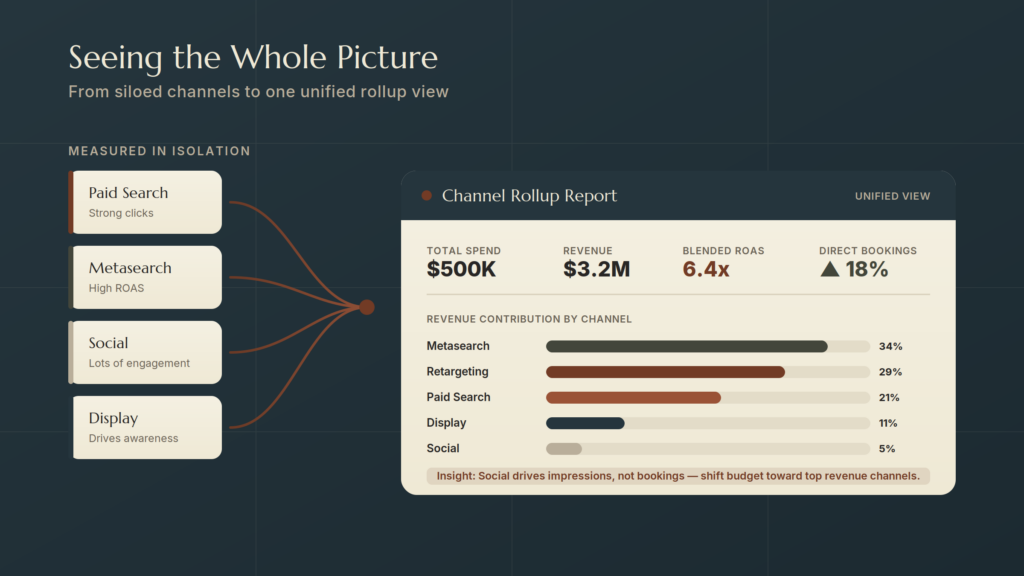
The problem is that channels are usually measured in isolation. Paid search may look strong on clicks, metasearch may boast high ROAS, and display may drive awareness. But without seeing all channels together, decisions are made in the dark.

Why channel rollups matter

Channel rollup reporting delivers the holistic view marketers need. By aggregating spend, clicks, conversions, and revenue into one clear framework, hotels can:

  • Pinpoint efficiency — Spot high-performing channels and amplify them.
  • Eliminate waste — Scale back underperformers draining budget.
  • Balance strategy — Ensure reliance on branded campaigns doesn’t mask gaps in unbranded visibility.
  • Test smarter — Evaluate emerging channels fairly against proven ones.

The impact in action

Consider a marketing director managing $500,000 in annual spend. On paper, social campaigns look strong — plenty of engagement. But when rolled up against other channels, social is driving impressions without bookings. Meanwhile, metasearch and retargeting are generating the majority of revenue.

With this insight, even a 10% budget reallocation could significantly boost returns.

Stretching budgets further

Hospitality marketing is under constant pressure to deliver more with less. OTAs are spending aggressively across channels, making efficiency critical for independents and groups alike.With rollup data, marketers no longer just ask “what happened?” They can finally answer: What should we do next?

A unified view of your data, finally

Every hotel operator knows the frustration: performance data scattered across properties, channels, and platforms, each living in its own silo. Pulling it together means hours of manual work, and even then, the full picture stays out of reach.

GCommerce Rollup APIs were built to solve exactly that. Purpose-built for the complexity of hospitality data, they connect your performance metrics across multiple properties, marketing channels, and media systems, giving your team instant access to the insights that drive smarter decisions.

  • Multi-Property Rollup API Roll up data from individual properties into one centralized view. Compare performance by region, brand, or management group, track total portfolio results with flexible date ranges and filters, and export directly into Looker Studio, Power BI, Tableau, or your own platform via secure, real-time endpoints.
  • Channel Rollup API Eliminate the gaps between marketing platforms. Combine paid search, hotel metasearch, display, and social data into one normalized schema, so you can evaluate true channel efficiency, identify budget trends, and integrate cleanly into your existing data warehouse or dashboard environment.

Both APIs come with consistent, normalized data models, token-based authentication, optional historical data backfill, and dedicated developer documentation and support. Whether you manage ten properties or a thousand, the infrastructure scales with you.

GCommerce brings two decades of hospitality data experience and the technology behind Metadesk to every integration. We understand hotel marketing data because we helped shape the industry it serves.

Integrate once. Scale everywhere. Get started with our API Product offerings today.

Frequently asked questions about channel-level data

What is channel rollup reporting in hotel marketing?

Channel rollup reporting is a method of aggregating performance data — spend, clicks, conversions, and revenue — from every paid marketing channel (paid search, metasearch, Google Hotel Ads, social, display, retargeting, video) into a single, unified framework. Instead of reviewing each channel in its own dashboard, a rollup gives marketers one holistic view so they can compare channels side by side, spot the true revenue drivers, and decide where the next dollar should go.


Why isn't measuring each channel separately enough?

When channels are measured in isolation, each one can look successful on its own terms: paid search shows strong clicks, metasearch boasts high ROAS, and social generates plenty of engagement. But those isolated metrics hide the bigger picture. A channel that drives lots of impressions may contribute almost no actual bookings, while a quieter channel quietly produces most of your revenue. Without a combined view, you risk over-funding low performers and under-funding the channels actually filling rooms.


How does channel-level data help increase direct bookings and reduce wasted spend?

A unified view lets you pinpoint efficient channels and scale them up, identify underperformers and pull budget back, and balance branded versus unbranded visibility so you’re not masking gaps in demand capture. Because OTAs spend aggressively across every channel, this efficiency is what helps independent hotels and groups compete for direct bookings. As the example in this article shows, even a modest 10% budget reallocation toward proven revenue channels can meaningfully lift returns — turning your reporting from “what happened?” into “what should we do next?”


[Ebook] Mastering Meta Audience Segmentation for better ROAS

SHARE:

Meta’s audience tools offer a wide range of targeting possibilities, but knowing which segments actually improve performance can feel unclear. To help bring clarity and direction, we analyzed how different audience types behave, how they impact revenue, and which adjustments produce the strongest results. The findings are now available in a practical guide built from real data and real campaigns.

Inside the ebook, you’ll learn:
• How audience freshness affects retargeting outcomes
• Which segments deliver stronger revenue and ROAS
• When to remove low-value audiences to improve efficiency
• How separating existing customers from engagers enhances performance

If you are looking for a more strategic approach to Meta targeting, this resource offers clear insights that can help guide stronger decision making.

👉 Download the Ebook.

Keep Reading