How to Optimize Your Hotel’s Metasearch Campaigns for Mobile Devices

SHARE:

Google Search started prioritizing mobile first back in 2016 as visitation and growth from users on mobile devices started growing. As of 2023, almost 60% of traffic on the web is from mobile devices. Visibility on mobile devices is crucial if your hotel wants to be present during important parts of the consumer journey to purchase. GCommerce’s portfolio of hotel websites sees over 66% of all traffic coming from mobile devices.

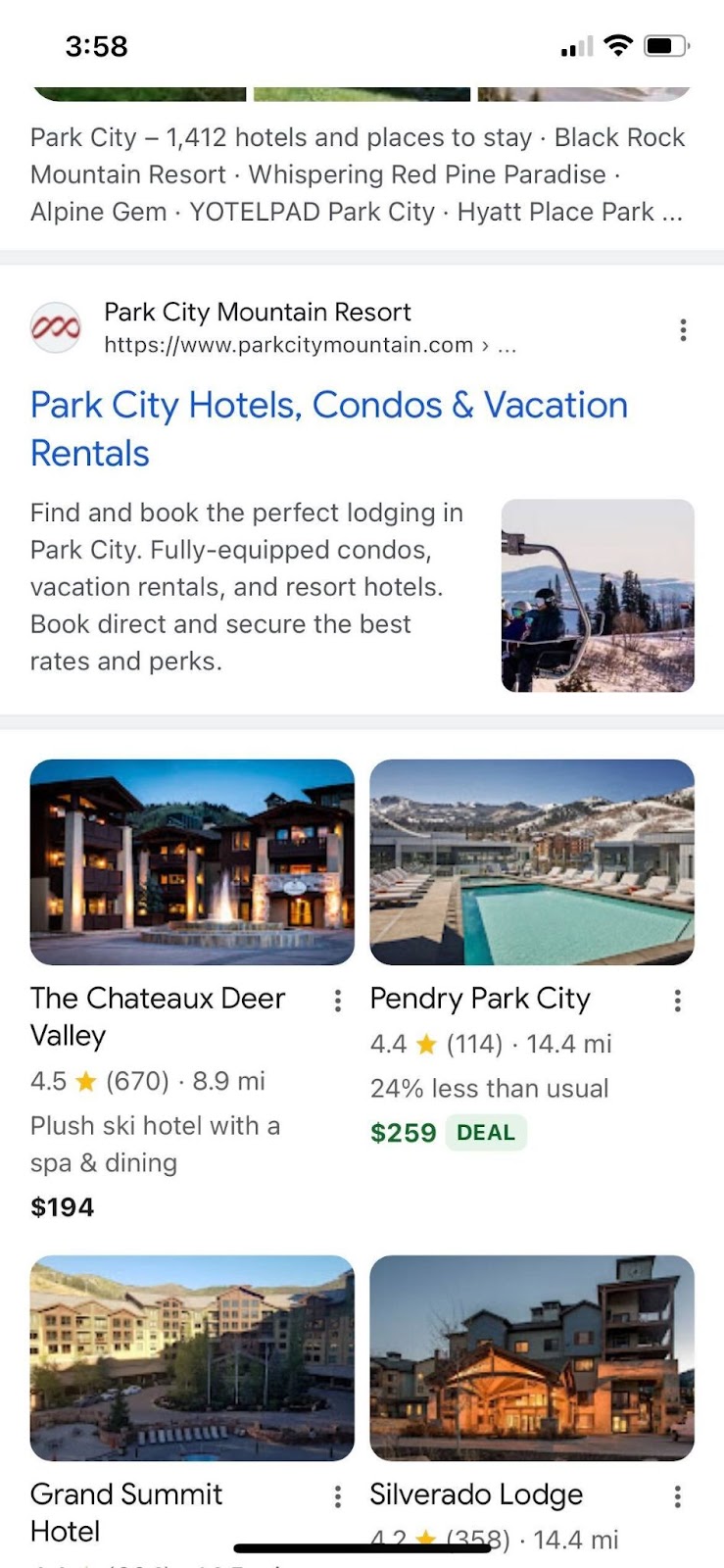
Hotel metasearch campaigns have become an increasingly important part of this journey, especially on Google search. It’s powering new SERP features visible down the continuous scroll page, such as this newer hotel listing feature (with rates from hotel ads) under organic listings shown below.

Learn how your hotel can best approach optimizing your hotel ads and metasearch for this device type and ensure you have the right visibility to reach your goals.

How do I optimize my hotel’s metasearch ad campaigns for mobile devices?

Campaign Adjustments

Metadesk recommends optimizing your hotel metasearch campaigns based on performance by segment based on your hotel’s objectives. Some platforms, such as Google Hotel Ads offer the ability to use a bid modification by device type. You can also opt out of certain device types on channels such as Google and TripAdvisor altogether. You can view reporting on how each device type performs in terms of clicks, bookings, impression share, and more within metasearch management platforms to better understand how each device type segment performs before making any specific adjustments. 

Optimize Your Landing Page for Mobile Devices

An important part of your hotel’s metasearch performance is the booking engine landing page where the traffic lands. Although most hotels work with 3rd party providers, making it hard to have control over things like page speed - optimizing this experience can improve performance from mobile traffic in your metasearch campaigns. Make sure your mobile booking page is easy to navigate on a mobile device. You could also test mobile-only offers or last-minute deals to appeal to mobile device users, many of whom tend to be more likely to be last-minute bookers than desktop users.

Optimize For Local Search + Your Google Business Profile Listing

A critical part of your Google Hotel Ads’ visibility in Google search results is how well you’re focused on local SEO ranking signals. This includes how built out and up-to-date your Google Business Profile listing is, how many reviews your hotel has vs the competition, making sure you're responding to reviews, and more.

What device type drives the most bookings for hotel metasearch?

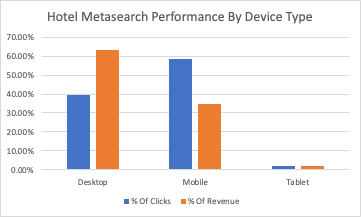
Although mobile devices account for over 60% of site traffic on average, this traffic tends to be higher in the funnel during the consumer path to purchase. On average, mobile devices only account for 30% of a hotel’s total website revenue production. The trend is the same as we look specifically at hotel metasearch campaign production. GCommerce’s portfolio sees 58% of all hotel metasearch clicks come from mobile devices but only 35% of total revenue.

This data can help you optimize your budget allocation.

If you are limited on budget for these typically bottom-of-funnel campaigns and focused on driving higher impression share to the segments that produce more revenue, you might opt to increase bid adjustments for desktop or decrease them for mobile traffic.

Remember, though, even though most bookings come via desktop - it’s important to be visible on mobile since that’s where consumers are spending most of their time (and clicks) interacting with your campaigns while they are shopping and considering which hotel to stay at in a destination - they just tend to book on desktop. If you remove visibility and impressions from mobile, you might end up hurting your overall performance due to lowered visibility.

Google Consent Mode Updates

SHARE:

In the coming weeks, Google will launch consent mode v2. This is an update to their consent mode tag setting that allows your website visitors' cookie preferences to be passed via their selections on your domain’s cookie banner/consent management platform to Google’s suite of ad products, such as Google Ads and Google Marketing Platform. You can learn more about the details of consent mode here

The update supports “Google’s ongoing commitment to a privacy-centric digital advertising ecosystem” and means that “advertisers must adhere to the EU consent policy to use ad personalization” to target visitors based in the EU and UK. If your website does not comply with the consent mode requirements, you can only continue to serve ads on Google platforms that are not personalized, such as remarketing ads, to people located in EU and UK countries. 

If targeting users in these countries is critical to your business, a thorough policy structure around GDPR and how to comply with advertising policies in these countries should be something you work through with your legal teams and roll out to any marketing providers assisting with your advertising.

How can I enable consent mode?

The first step to enabling Google’s consent mode is to set up a consent management platform on your site. A consent management platform, also sometimes called a “cookie banner,” allows website visitors to choose their preferences around what is collected via cookies and sent to Google platforms such as Ads and Analytics. 

Using one of Google’s certified consent management platforms means the platform's settings will be updated so you can enable consent mode across Google products.

If you already have a content management platform, make sure you go into settings and enable consent mode.

If you don’t already have a consent management platform, Google has a list of official providers that can support your domain’s consent management needs. You can find the full list of Google-certified CMPs here. GCommerce recommends OneTrust as a CMP and can assist with setting up/integrating it onto your site, but there are many choices available for you to select from to help with your company’s consent mode compliance needs. 

Once you’ve set up your CMP, work with the provider to enable consent mode settings and alert GCommerce so we can assist with any necessary Google Tag Manager steps.


You can learn more about Google’s updates to consent mode here.

What Google’s Sunset of Commission Bid Strategies Means for Your Hotel Ads Campaigns

SHARE:

Google recently announced that support for commission-based bid strategies in Google Hotel Ads would be deprecated, and the bid strategy types would be going away in October 2024

Historically, Google Hotel Ads campaign types have had access to a few different bid strategies. Commission-based bid strategies are unique to hotel ads campaigns, and they allow hotels to set their bid optimization to be billed based on either pay-per-stay or pay-per-conversion. 

What does this mean for your Google Hotel Ads campaigns?

For hotels that want to run hotel ads campaigns, the ecosystem requires they use a 3rd party connection to access their rates and inventory feed via Google’s Hotel Center. This hotel center feed is then connected via third-party platforms or directly from a hotel’s CRS provider. 

As long as your hotel ads and metasearch provider isn’t relying upon one of these bid strategies, then no change is needed. 

At Metadesk, we rely on advanced bid algorithms and machine learning technologies coupled with ongoing optimization and targeting methods. Although our most popular billing model happens to be a pay-per-stay model, we don’t utilize Google’s pay-per-stay or pay-per-conversion bid strategy type. So, no change is needed to keep the current visibility and success you’re currently experiencing with our metasearch management services.

LinkedIn Static vs Video Results- Lead Generation Advertising For Hotels

SHARE:

In May, we utilized LinkedIn advertising campaigns to promote a member’s club through lead generation for one of our hotel clients. There are many ad types to choose from when advertising on LinkedIn, including static, messaging ads, carousels, videos, text ads, and more.  🏨💼

We decided to put static ads and video ads to the test. View our findings and which ads were more successful in our full mini case study, here. 🏆😎

DEI Origins at GCommerce

SHARE:

GCommerce has charted its own path of Diversity, Equity, and Inclusion (DEI).  Equity was always a central building block of the famed company culture (recipient of Best Place to Work in 2019 by Outside Magazine).  However, a fateful series of conversations in 2022 started us down a path of deliberate intention and focus.  In the process, the company has become more introspective and more articulate about our beliefs.  We’ve developed a process that ensures Diversity, Equity, and Inclusion are as much an aspiration as a practice, a process that insists we continue to make progress in pursuit of that goal never achieved.  

It started with a conversation.  The Founder of GCommerce, Scott van Hartesvelt, had just read the seminal and controversial Harvard Business Review (HBR) study titled “Why Diversity Programs Fail.”  In it, the authors make a compelling case that the ways in which corporate America has addressed DEI have not only failed to produce positive results they have actually reinforced negative behaviors.  He shared some of the findings with two colleagues, Alex Scharpf and Lindley Cotton, who were both better educated on the subject.  The ensuing discussion made it clear that there were both moral and business imperatives to be thoughtful about DEI and that GCommerce was well-positioned to break the mold highlighted in the HBR article.  A larger group of employees from across the company was quickly empaneled to jumpstart the initiative.

GCommerce DEI Charter

After lots of deliberation, a formal charter took shape with 4 key components.  The charter became the organizing document for both the company itself as well as the company’s “DEI Study Group”, a group of volunteers from across all departments interested in helping GCommerce further the DEI mission through new programming and education.

GCOMMERCE DEI TRUE NORTH

To ensure our compass is always pointed towards equity, we established four guiding principles:

  1. Leadership from GCommerce is required.  We chose to be thoughtful and progressive to achieve our moral and business goals.
  2. Forced participation and assimilation with DEI initiatives create animosity instead of growth and understanding.  Therefore, we aimed to avoid this whenever possible, instead favoring more integrated efforts.
  3. Recruiting, education, job training, and mentoring are the tops of the spear when it comes to making meaningful progress.  As such, they would help organize and instruct our overall DEI initiatives.
  4. Diversity, Equity, and Inclusion do not create just a moral imperative but also a business one.  Companies that embrace diversity and equity perform measurably better in all facets of their business.

GOLDEN RULES

Per the Harvard Business Review study, people with varying perspectives on DEI topics often feel alienated by the tenor of discussions, further entrenching their beliefs and robbing others of hearing their perspectives.  To combat this, Alex Scharpf authored our “Golden Rules” to maintain civil, effective conversations within the company moving forward.

  1. All Perspectives Deserve Respect - Inclusivity is not a set of hard-and-fast rules but rather an ongoing discussion.  Very few things are “right” and “wrong” in every single context, and everyone deserves a chance to be heard.
  2. No One Knows Everything - Everyone comes from different backgrounds, with a different level of exposure to various issues.  There’s no shame in not knowing something - inclusion is a constant state of learning and we’re all learning together. 
  3. Everyone Makes Mistakes - Inclusion is a continuous process, and it takes time for a person to adapt to changes.  No one is perfect, and mistakes are just that - mistakes.  Use them as an educational opportunity, but don’t dwell on them.

STUDY GROUP GOALS

The goals of the DEI Study Group, as established at its onset, guide the group to this day:

  1. Bring awareness and education internally for GCommerce, while providing a safe space for conversation.
  2. Widen individual knowledge and understanding of DEI.
  3. Make GCommerce an inclusive company that others will be drawn to.
  4. Support and encourage other colleagues to be their true selves.
  5. Assist clients with better representation in marketing.
  6. Become a model for other companies to eventually emulate.

DEI MISSION STATEMENT

Finally, the charter articulated a formal DEI mission statement.

GCommerce is dedicated to fostering, cultivating, and preserving a culture of diversity, equity, and inclusion as both a moral and business imperative.

Our team members are the company’s most valuable asset.  The collective sum of the individual differences, life experiences, knowledge, innovation, self-expression, unique capabilities, and talent that our employees invest in their work represents a significant part of not only our culture but our reputation and the company’s achievement.  To that end, we not only embrace diversity, equity, and inclusion, we seek it out to strengthen our company.

We embrace and encourage our employees’ differences in age, color, disability, gender identity or expression, religion, sexual orientation, and other identity characteristics that make our employees unique.

DEI Study Group - Executing GCommerce’s DEI Charter

GCommerce is invested in making our DEI practices present and vibrant in the ongoing operations of the business.  The group is open to participation from all corners of the company, with meetings held every other week and frequently attended by executives, managers, and team members from every department.  The group’s work primarily focuses on the four areas of Recruiting, Education, Training, and Mentorship but remains largely self-determined while working in the spirit of the company mission and pillars.

Highlights - Two Years In

We are proud of the work the company has accomplished over the last two years.  We are equally proud of the system: the process that we’ve established to ensure the work continues in perpetuity.  Diversity, Equity, and Inclusion are no longer just things we promote but rather who we are and what we aspire to be.  

Highlights from the first two years include:

  • Invested over $200,00 in service hours to the development and management of our DEI initiative.
  • Researched and delivered eight robust all-company education sessions.
  • Provided resources for self-education on DEI topics.
  • Created spaces for company-wide discussions to take place.
  • Updated and improved recruiting and hiring practices, including consideration for better representation, social and neurodiversity sensitivity in interviews, and recruiting methodology.
  • Evaluated daily accessibility at GCommerce, from website navigation and branding to internal meeting policies and ADA options.
  • Conducted frequent sentiment surveys of the entire company for directional guidance.
  • Reviewed and modified client marketing recommendations to encourage better representation in the marketing we deploy.
  • Developed public-facing content related to DEI, to extend our education outside of the company.

What’s Next

GCommerce is not, nor will it ever be a finished product.  It’s a company of individuals, each of whom contributes to the GCommerce story in their own way during their time with the company.   Our consistency lies in our mission and our vision.  

Looking at the immediate future, we are excited to be rolling out a more formal mentorship program, giving team members from across the company exposure to those with whom they may not normally engage.  We are thinking hard about how to be more intentional with our recruiting practices because the most succinct way to ensure diversity and representation is by living these core values as a company.  We are doubling down on engagement and education for team members, especially those who have recently joined the organization and weren’t there for the genesis of this grand project.  We are learning. We are growing.  Most importantly, we are listening with humility. 

What Happened to Threads? (A 2024 Update)

SHARE:

After becoming the fastest app ever to reach 100 million users last summer, Instagram's X (formerly Twitter) alternative, Threads, has fallen out of the news cycle and off many of our phone's homepages. At this point, you may be asking: what's going on with Threads, and should we still be paying attention to the app?

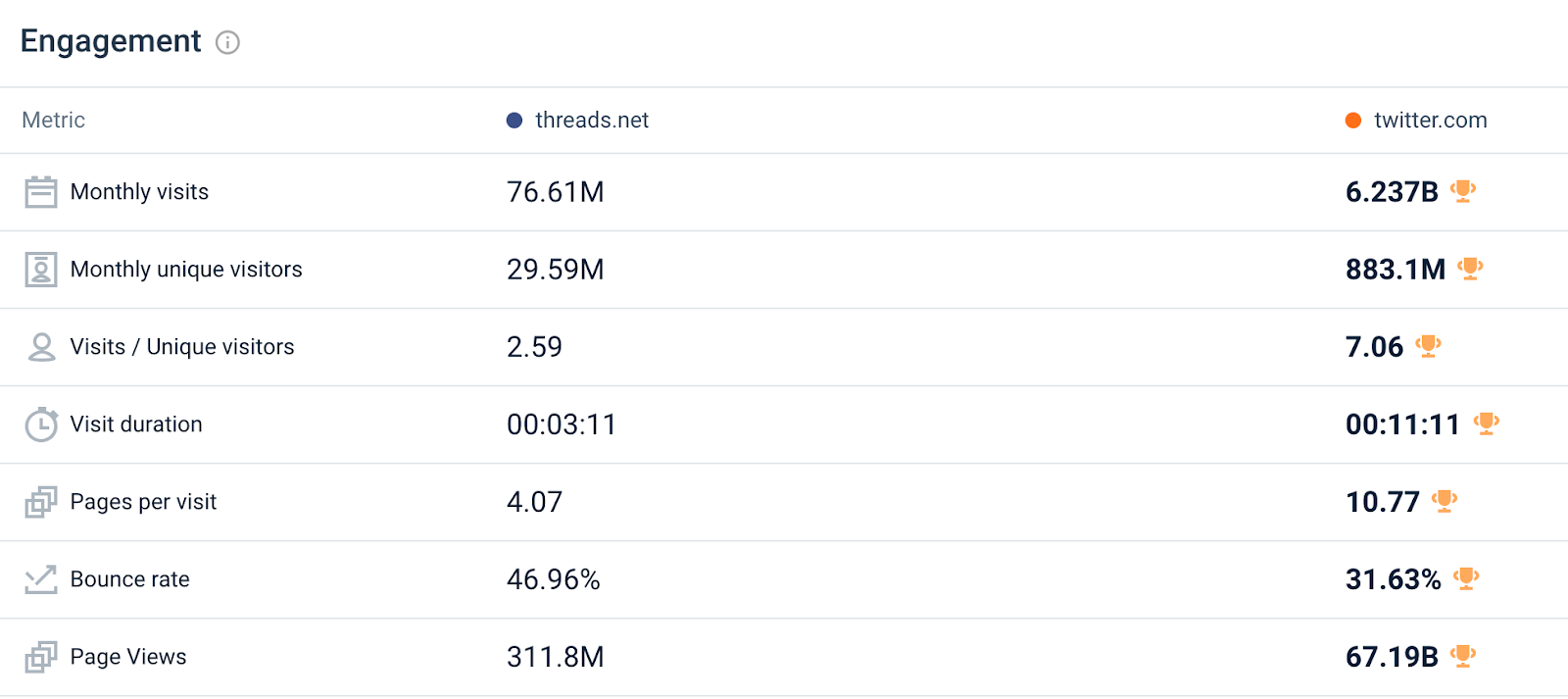
With Threads celebrating its half-birthday in January, it's a great time to dive into statistics on just how well (or poorly) the app is performing. According to SimilarWeb's statistics, Threads saw just 76 million visits in December, with an average session duration of about 3 minutes. Website visits are up from November by about 50% but don't hold a candle to X's 6.2 billion visits with an average session duration of over 11 minutes.

As mentioned, however, things are trending upward for Threads, with visits increasing by over 50% from November to December. Notably, December saw the release of Threads in Europe and the beginnings of testing with integration with the ActivityPub protocol, opening threads up to the entire federated universe – a topic we wrote about when Threads first launched

Late last year, Threads also launched tags and topics, allowing users to find new subjects to engage in and people to connect with, something that was sorely missing when the platform first launched. These tags don’t seem to have taken the same prevalence that hashtags on X do, so discoverability can still be difficult on the platform, especially with the drastically lower number of users of the platform. 


All in all, Threads has not become the hit that Mosseri and Zuck once hoped it would become, but there’s still a chance for growth with the continued updates the platform keeps pushing. For now, it doesn’t seem to be pushing the needle in one direction or the other for hospitality brands, but if we see any changes on that front, you can be the first to know by signing up for our newsletter.

Keep Reading