AI doesn’t rank hotels. It learns which ones to trust.

SHARE:

In our last post, "Why AI visibility ultimately collapses back to data", we made the case that AI visibility ultimately collapses back to data.

That idea challenges a lot of current thinking. It reframes AI discovery as something earned over time rather than optimized into existence through prompts, schema, or surface-level tactics.

But it naturally raises a more important question:

If AI systems infer visibility from data, what does brand authority actually look like in an AI-driven travel market?

Authority is inferred, not declared

Hotels don’t tell AI systems that they are authoritative. AI systems infer authority from patterns.

Those patterns are built over time and reinforced across many signals:

  • How consistently a hotel shows up
  • How often travelers choose it
  • How reliably it delivers on expectations
  • How well its signals align across platforms

In an AI-driven world, authority isn’t a claim. It’s a pattern that emerges when data agrees.

A single strong signal can’t carry authority on its own. If engagement says one thing, availability says another, and pricing or reputation contradicts both, AI hesitates. And hesitation reduces visibility.

We’ve been here before

This isn’t the first time marketers have gone through a shift like this.

When Google first introduced PageRank, it fundamentally changed how visibility was earned. Ranking wasn’t determined by how many times a keyword appeared on a page. It wasn’t even primarily about how well-written a website was. It was about signals of credibility and relevance across the broader web.

Many people tried to game that system through keyword stuffing, link schemes, and other shortcuts. Some of those tactics worked temporarily. Most didn’t last.

What ultimately mattered was whether a site was referenced, trusted, and reinforced by other credible sources over time.

In many ways, we’ve come full circle.

The difference now is that visibility is no longer centered on a single website. AI-driven discovery doesn’t evaluate brands based solely on what lives on their domain. It evaluates them based on how they show up across the entire digital ecosystem.

This time, it’s not about ranking pages. It’s about understanding brands.

AI systems are inferring authority not from isolated signals, but from a hotel’s broader presence, performance, and consistency across channels. The same pattern applies: shortcuts may appear tempting, but durable visibility is earned through trust, reinforcement, and alignment over time.

Signal coherence matters more than channel coverage

Many hotels worry about being everywhere. Every platform. Every new AI surface. Every emerging discovery channel.

But AI doesn’t need you everywhere. It needs your signals to agree.

Brand authority is inferred when a hotel’s identity, positioning, and performance signals are coherent across the places travelers research, compare, and book. That coherence matters more than sheer coverage.

AI systems are looking for corroboration:

  • Does this hotel look like the same entity across sources?
  • Do pricing and availability signals align?
  • Does performance reinforce positioning?

Authority doesn’t come from owning every channel. It comes from avoiding contradictions across them.

Performance is the strongest authority signal

AI pays close attention to what travelers actually do.

Engagement, conversion, and booking behavior matter more than how well something is described. Over time, AI learns which hotels are consistently selected, which satisfy intent, and which reinforce positive outcomes.

This is why performance-based signals are so powerful:

  • Repeated selection
  • Sustained conversion
  • Repeat behavior
  • Strong review velocity tied to actual stays

AI doesn’t just listen to what a hotel says. It watches what travelers choose.

And while short-term spikes may get noticed, it’s long-term patterns that establish authority.

PR as an authority signal

Brand authority isn’t built through owned channels alone. Third-party validation plays an important role in how trust is inferred.

When hotels are consistently referenced by respected publications, destination guides, and industry voices, those mentions act as corroborating signals. They reinforce credibility in the same way strong performance does, by validating a hotel’s positioning outside of its own marketing channels.

In an AI-driven discovery environment, effective PR isn’t about press hits for their own sake. It’s about earning references that clarify who a hotel is, what it’s known for, and why it should be trusted. These third-party signals help reinforce brand authority in the broader ecosystem AI systems learn from.

Inconsistency erodes trust faster than invisibility

One of the fastest ways to undermine brand authority in an AI-driven ecosystem is inconsistency.

Small misalignments that may seem manageable in isolation can quietly erode trust:

  • Pricing patterns that contradict positioning
  • Availability signals that don’t align across systems
  • Attribute drift between platforms
  • Messaging that promises experiences not reinforced by outcomes

In an AI system, inconsistency creates hesitation. And hesitation reduces confidence.

For hotels, this doesn’t mean perfection is required. It means contradictions shouldn’t go unnoticed or unresolved.

Authority is built through reinforcement, not optimization cycles

AI systems learn over time. They reward stability, predictability, and reinforcement.

This creates an important shift in mindset. Constant reinvention, frequent pivots, and isolated optimization efforts can actually weaken authority by disrupting signal continuity.

The hotels that win aren’t constantly trying to redefine themselves. They’re consistently reinforcing who they are, how they perform, and what travelers can expect.

Authority compounds when signals are stable and outcomes reinforce them.

Where most hotels get stuck

Most hotels don’t lack brand authority. But they do lack visibility into whether their signals agree and how those signals are interpreted beyond their own name.

For years, hotel marketing has been shaped by a very real constraint: domain authority and scale. Independent and boutique hotels have long struggled to compete with branded properties and OTAs for destination-level keywords. Even when a hotel ranks well for its own name, visibility for broader market and destination searches has often been out of reach.

That challenge hasn’t disappeared. But the way authority is inferred is changing.

AI-driven discovery is less focused on the raw authority of a single domain and more focused on whether a brand is consistently understood, referenced, chosen, and reinforced across the ecosystem. This shifts the problem from how big your website is to how coherent your brand signals are.

This is where many hotels get stuck.

Data lives in silos. Teams optimize individual channels in isolation. Performance is measured, but not always connected back to discovery, reputation, or trust. As a result, authority is something hotels know they have in practice, but struggle to see, manage, or reinforce systematically.

The challenge in an AI-driven market isn’t creating authority from scratch. It’s understanding how existing authority shows up beyond branded searches, and sustaining it consistently across the signals AI systems actually observe.

What comes next

If brand authority is inferred from coherent, performance-backed signals, the next question becomes operational:

How do hotels see, validate, and reinforce those signals at scale?

In our next post, we’ll explore how data platforms make brand authority measurable, sustainable, and durable in an AI-driven travel market, and why they are becoming foundational to long-term AI visibility.

Why AI visibility ultimately collapses back to data

SHARE:

There’s no shortage of buzz around AI right now. Large language models (LLMs), generative search experiences, and “AI optimization” tactics are dominating conversations across hospitality marketing.

And the excitement is justified. AI is already changing how travelers discover hotels, evaluate options, and make booking decisions. For marketers and hoteliers alike, there are real opportunities to adapt content, refine messaging, and improve visibility inside these new interfaces.

But beneath the surface, something more fundamental is happening.

In the long run, winning in AI visibility will always tie back to data.

Not prompts. Not hacks. Data.

AI doesn’t create authority; it infers it

LLMs don’t “decide” what to recommend in the way a human does. They infer authority, relevance, and trust from patterns in data.

That distinction matters, especially as the race to build AEO offerings has led many teams to focus heavily on executional tactics like schema markup and FAQs. Those elements are important, and they play a meaningful role in helping AI interpret information. But they are not sufficient on their own.

AI systems don’t treat authority as a checkbox. They infer it from signals accumulated over time.

Those signals come from many places:

  • Structured data that clearly defines what a hotel or brand is
  • Consistency across platforms and sources
  • Behavioral signals like engagement, conversion, and booking patterns
  • Historical performance and reliability

Together, these inputs form a picture of brand authority. Not just what a hotel claims to be, but how consistently it shows up, how often it’s chosen, and how reliably it delivers on guest expectations.

This is why brand authority matters more than any single optimization tactic. Schema and FAQs help AI interpret information, but authority is what gives that information weight.

For hotels, building brand authority in an AI-driven world is less about chasing visibility and more about reinforcing fundamentals:

  • Showing up consistently wherever travelers research, compare, and book stays, from search and maps to metasearch, OTAs, and review platforms
  • Delivering guest experiences that drive strong engagement, positive reviews, repeat stays, and direct bookings
  • Maintaining accurate, aligned property data across websites, booking engines, metasearch, listings, and third-party channels
  • Earning trust over time through pricing integrity, reliable availability, and guest satisfaction, not marketing promises

When data is incomplete, inconsistent, or outdated, AI systems hesitate. When brand authority is weak or fragmented, recommendations become generic or disappear altogether. Over time, no amount of surface-level optimization can compensate for that gap.

AI doesn’t reward those who publish the most structured data. It rewards the brands whose data reflects real-world trust, consistency, and performance.

Short-term wins come from tactics. Long-term wins come from systems.

Right now, it’s possible to gain incremental AI visibility through tactical efforts:

  • Adjusting content to align with AI-driven queries
  • Experimenting with prompt-oriented optimization
  • Tweaking page structure, schema, and language

These efforts matter, especially during periods of change. But they are, by definition, short-lived advantages.

As AI systems mature, they increasingly favor structure over tactics:

  • Clean, structured data
  • Measurable outcomes
  • Proven performance
  • Signals that persist over time

The hotels that win aren’t optimizing for the moment. They’re building durable data foundations that compound.

AI discovery is entity-based, not keyword-based

Traditional search trained marketers to think in keywords. AI shifts the frame entirely.

Large language models don’t retrieve answers by matching exact phrases. Instead, they interpret prompts as questions about entities and the relationships between them.

When a traveler types or speaks a prompt like:

  • “What’s the best family-friendly resort near Yellowstone?”
  • “Where should I stay in Napa for a romantic weekend?”
  • “Which hotels near downtown Austin have great food and easy parking?”

The model isn’t looking for pages optimized around those exact words. It’s reasoning through a network of relationships:

  • Location
  • Property type
  • Amenities and experiences
  • Guest intent
  • Historical performance and reputation

In that context, a hotel isn’t just a website. It’s an entity defined by data:

  • A physical location
  • A brand and reputation
  • A set of amenities and experiences
  • A pricing and availability profile
  • A history of guest satisfaction and outcomes

This is where prompts are often misunderstood.

Prompts don’t create visibility on their own. They only surface what the model already understands. If an AI system doesn’t have clear, consistent, and trusted data describing those entities and relationships, no amount of prompt optimization can reliably compensate.

When relationships aren’t well defined in data, AI hesitates. Recommendations become generic, incomplete, or disappear entirely. Visibility suffers not because a hotel is “missing keywords,” but because the system can’t confidently understand what it is, how it fits the request, or why it should be recommended.

In an AI-driven world, prompts are simply the question. Data determines the answer.

Where AEO fits in a data-first AI strategy

This is where Answer Engine Optimization (AEO) plays a critical role. Not as a collection of prompts or AI shortcuts, but as the discipline of structuring, validating, and distributing trusted data so AI systems can accurately understand and represent a property.

Done correctly, AEO operationalizes a data-first approach. It ensures that entity relationships, performance signals, and guest experiences are translated into formats AI systems can confidently use across the places travelers increasingly rely on for discovery.

Distribution now matters more than optimization

For years, the hotel website was the center of gravity. Today, it’s just one node in a much larger ecosystem.

AI systems pull signals from everywhere:

  • Booking engines and transaction platforms
  • Reviews and reputation sources
  • Local listings and business profiles
  • Feeds, APIs, and structured data sources
  • Historical demand and conversion data

Visibility is no longer about perfecting a single destination. It’s about ensuring accurate, consistent data flows across the entire ecosystem where AI learns, validates, and reinforces information.

Feedback loops are the real competitive moat

The most powerful advantage in AI discovery isn’t being understood once. It’s being learned from repeatedly.

AI systems reinforce what works:

  • What gets selected
  • What converts
  • What satisfies traveler intent
  • What performs consistently over time

That requires clean measurement, reliable attribution, and closed-loop data systems. Without those feedback loops, hotels remain static in AI models. With them, visibility compounds.

The real shift hoteliers must confront

AI isn’t replacing marketing. It’s changing what marketing is built on.

Content still matters, but it’s becoming a translation layer. Technology still matters, but it’s becoming infrastructure. Data is becoming the source of truth and leverage.

For hoteliers, this shift is critical. AI-driven discovery will increasingly favor properties that can clearly and consistently describe who they are, what they offer, where they’re located, and how they perform across every platform where travelers research and book.

The hotels that win in AI won’t be the ones asking how to game the system. They’ll be the ones building brands and data foundations that the system trusts.

LLMs may change the interface travelers use to find you. Your data will determine whether you show up at all and how you’re positioned when you do.

In our next post, we’ll break down what brand authority actually looks like in an AI-driven travel market and how hotels can influence the signals AI relies on…

Hotel visibility in AI search results: Where to start

SHARE:

Visibility in AI search results is a vital piece of your hotel’s success within the current marketing landscape. AI search results become more relevant every day, but it’s not always clear how to improve your hotel’s standings. 

Overview

AI models assess a variety of factors when digesting data and generating responses, prioritizing information that satisfies their built-in content preferences. Though visibility in AI search results is never a guarantee, aligning with these preferences across various marketing channels is the most effective way to make an impact for your hotel. 

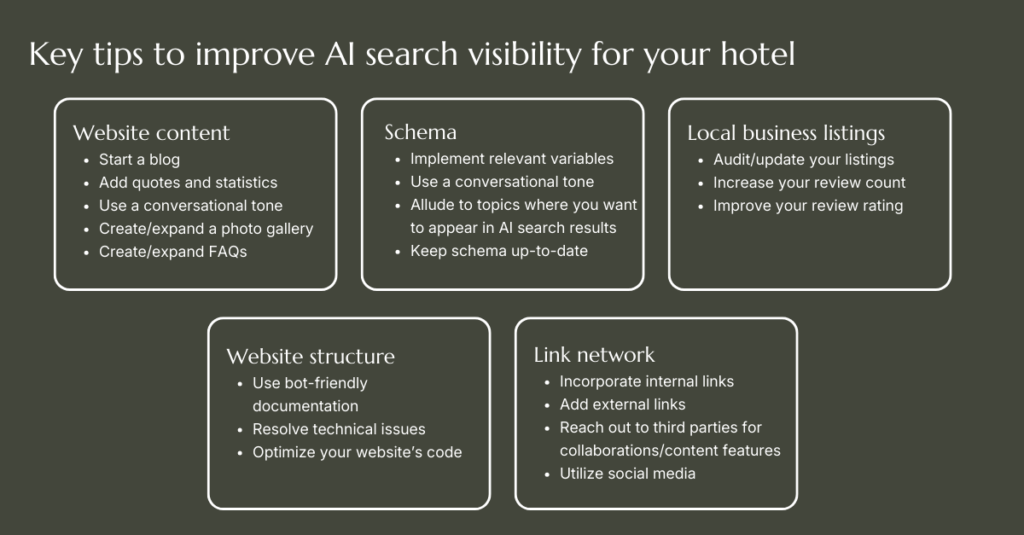
Here are the main factors that AI models assess when generating search results. We’ll dive into more detail on each category in the rest of this article:

Website content

The content of your hotel’s website is arguably the most important factor behind AI search visibility. It’s vital that your website includes pages that are easily digestible for AI models, seamless to incorporate into AI search results, and applicable to the searches you want to rank for.

  • Relevance: Your content should match what users are actually searching for. Consider FAQs, guest reviews, and your own AI searches to see what your guests want to know.
  • Breadth/variety: A wide range of content provides your hotel with more opportunities to show up in AI search results. The more information you provide to an AI model, the more likely you are to appear.
  • Uniqueness: If your hotel’s website provides information that no one else does, AI search models have no choice but to incorporate your data. Unique content reduces competition, improving your AI search visibility.
  • Freshness: While certain AI models have a cutoff date for training data, all AI models prefer the content that is most recent within their database. Fresh, up-to-date information is most likely to show up in AI search results.
  • Tone: AI models strive to reduce the amount of friction required to generate a response. If your content already matches the more conversational tone used in AI search results, your hotel is more likely to appear.
  • Citations: Including quotes, sources, and citations improves your website’s credibility, which is an important factor considered by AI models.

Local business listings

Local business listings such as those on Google Business Profile, Yelp, and Tripadvisor are another significant source of information for AI models. Because this data is incorporated into AI search responses, accurate and in-depth listings across a variety of websites are likely to improve your hotel’s visibility in AI search. Also impactful are your hotel’s reviews within these listings, as social proof is another factor considered by AI models.

  • Quantity: A wide variety of local business listings across the internet can improve your hotel’s visibility in AI search due to the large volume of data thereby made available to AI models.
  • Accuracy: When business information is consistent across the web, including multiple local listings and even normal website content, this increases your hotel’s credibility and likelihood of appearing in AI search results.
  • Depth: The more information that’s included in your listings, the better. Fully fleshed out local listings provide more opportunities for AI models to incorporate your data, and proves your reliability as a source for AI responses.
  • Number of reviews: AI models tend to see popular businesses as having higher credibility, with high review counts often increasing visibility in AI search results.
  • Review rating: Judging a business based on real human feedback allows AI models to provide quality recommendations, and positive reviews are a powerful form of social proof.

Schema

The use of schema is another factor that can significantly impact visibility in AI search. Well-structured, neatly coded schema makes information about your hotel incredibly easy for AI models to digest, improving visibility in AI search.

  • Type of variables: Schema variables cover a wide variety of businesses and web content. Using the correct types of schema for your hotel and website ensure that AI models can easily find your hotel and correctly interpret your information.
  • Depth: Highly detailed schema with a large quantity of relevant data is more likely to be used by AI models when generating responses.
  • Tone: Similar to on-page content, using a conversational tone in applicable schema variables such as descriptions may increase the likelihood of your hotel’s information being incorporated into AI search results.
  • Relevance: Make sure that your hotel’s schema reflects the topics that you want to appear for. Where applicable, incorporate focus keywords and relevant topics into your schema to maximize your visibility in AI search.

Website structure

Though website structure isn’t a make-or-break factor behind visibility in AI search results, a clean and optimized website structure can improve your hotel’s visibility by making it easier for AI models to digest and interpret your content.

  • Bot-friendly documentation: llms.txt, sitemap.xml, and robots.txt documents all assist with webpage discoverability, making it easier for AI models to use your hotel’s content in AI search results.
  • Lack of technical errors: Excessive technical errors such as 404 pages, duplicate content, or outdated webpages can slow down AI models, decreasing their ability to find and digest your hotel’s information.
  • Well-optimized code: Intuitive sub-folder structure, neat and organized code layout, and quick load times streamline the AI training process, making your content easier to understand and potentially improving your hotel’s visibility in AI search.

Link network

Incoming links, outgoing links, and external brand mentions can improve your hotel’s visibility in AI search by boosting your hotel’s credibility and providing positive social proof. While this is another factor that won’t make or break your visibility, a strong and credible link network will only increase your hotel’s chances of appearing within AI search results.

  • Internal links: Linking to other pages within your website makes it easier for AI models to find new pages and understand the connections between your content.
  • External links: Linking to outside sources suggests that your content is well-researched and well-connected, improving credibility.
  • Incoming links and brand references: When outside sources link to or mention your hotel, that acts as a form of social proof which can improve both credibility and prestige, increasing your hotel’s likelihood of being shown within AI search results.

Social media

Posting on social media isn’t immediately linked to visibility in AI search, but your hotel’s presence on these channels can still have an impact. AI models often source from social media, particularly Reddit, YouTube, Instagram, and Facebook, to determine the overall impression of your hotel.

  • Sentiment: Just as business reviews can guide AI models towards quality recommendations, general sentiment from social media comments and customer posts can influence which businesses appear in AI search results.
  • Reach: Online buzz with a wide audience reach indicates business credibility and quality to AI models, increasing the likelihood of your hotel being recommended.
  • Engagement: When customers are highly engaged with your hotel, this suggests that your business is a quality recommendation that is likely to resonate with users, improving your hotel’s chances of appearing within AI search responses.

Takeaways

AI models use information from a variety of sources across multiple marketing channels when generating responses. However, there’s a common thread among most of these factors: to improve your hotel’s visibility in AI search, focus on the guest experience.

  • Develop relevant, thorough content that resonates with your guests. 
  • Keep your information up-to-date across all channels.
  • Ensure your website is easy to navigate and understand, for both human and robot users.

For tips on getting started with AI search reach out to GCommerce for more information.

Smarter campaign structure for stronger cyber sale results

SHARE:

Cyber season is no longer just a nice-to-have on the hospitality marketing calendar. It's one of the highest-stakes promotional windows of the year, and the gap between a well-structured campaign and a loosely assembled one is growing wider.

For Cyber 2025, we ran a structured test across a consistent group of hotel and resort clients to answer one question: Does building Cyber promotions inside existing campaigns outperform launching net-new ones? 

The results were clear, and they have real implications for how hospitality brands should think about campaign architecture heading into 2026.

The strategy shift: Building inside what already works

In 2024, most Cyber campaigns followed a familiar playbook: launch a separate, net-new campaign for the promotional window. It's a logical approach. Isolated campaigns let you control budgets, tailor messaging, and track results cleanly. But they also come with a hidden cost.

Every new campaign starts the learning phase from scratch. Platforms like Meta need time to optimize delivery, which is a disadvantage when your sale window is measured in days, not weeks.

For Cyber 2025, we flipped that model. Instead of launching new campaigns, we added new ad sets inside existing, always-on campaigns. The goal was to carry forward the historical performance data, audience signals, and optimization momentum that those campaigns had already built. According to Meta's own guidance on campaign learning, campaigns that exit the learning phase deliver more stable and efficient results. We wanted to start there, not work our way back.

What the numbers actually showed

The results across our test group were significant. Purchases increased 76% year over year. Revenue grew 78%. And this happened while promotional offers remained largely consistent between 2024 and 2025.

The efficiency story was just as strong:

  • Prospecting cost per thousand impressions (CPM) dropped 35%
  • Retargeting CPM dropped 39%
  • Combined CPM across both audiences decreased 38%

Reaching more people at a meaningfully lower cost, while converting more of them, is the kind of outcome that moves the needle for a property's overall paid media return.

Individual property results reinforced the pattern

One property in the test group saw a 65% revenue increase during the sale period alongside a 95% lift in return on ad spend (ROAS), even after increasing overall campaign spending in 2025. Another saw purchases jump 160% with a 90% improvement in ROAS. These aren't edge cases. They represent what becomes possible when campaigns start optimized instead of having to earn it.

Lower click-through rates, better results

One of the more counterintuitive findings: click-through rates declined across the group, yet performance improved. This is consistent with what research from Nielsen has long argued: click-through rate is a weak proxy for advertising effectiveness. Campaigns became more efficient at reaching the right users at the right time, and those users converted.

The takeaway for hospitality marketing teams is worth internalizing. Optimizing for clicks during a short promotional window can actually work against you. The platform rewards campaigns that demonstrate delivery efficiency and conversion intent, not engagement metrics alone.

What to keep in mind before restructuring your Cyber campaigns

These results are strong, and context matters. A few variables influenced this test that any team should account for:

  • Several 2025 campaigns ran longer than their 2024 counterparts, which likely contributed to higher overall totals.
  • Some properties shifted their offers from a flat discount to "up to X% off," which can influence how users perceive and respond to the promotion.
  • A handful of clients moved from animated creative in 2024 to static imagery in 2025.

Campaign structure is a meaningful lever, and it's not the only one. Creative quality, offer strength, audience targeting, and budget strategy all shape outcomes. The structure creates the conditions for efficiency. Everything else determines whether you take full advantage of it.

This aligns with findings from Boston Consulting Group's work on marketing personalization and data activation, which consistently shows that leveraging existing behavioral data outperforms cold-start targeting when promotional windows are compressed.

What this means for your 2026 Cyber strategy

If your team is already planning for Cyber 2026, the campaign architecture conversation should happen now, not in October.

A few practical steps worth building into your planning process:

  • Audit your always-on campaigns and identify which have the strongest historical performance signals. These are your candidates for housing Cyber ad sets.
  • Plan your creative and offer strategy early enough to build and test before the promotional window opens.
  • Set clear performance benchmarks against your 2025 results, and track CPM alongside ROAS, not just click volume.
  • Build enough flexibility into your budget to scale what's working during the sale window without restarting a new campaign mid-flight.

Cyber season rewards preparation. The properties that saw the strongest results in 2025 weren't improvising their structure in November. They built a foundation that let the platform work for them.

Ready to build a smarter Cyber strategy?

Campaign structure is one of the most underutilized levers in hospitality paid media. If your team wants to stress-test your current approach, rebuild your Cyber architecture ahead of 2026, or just understand what's driving your CPM costs, we'd love to dig into it with you.

Reach out to the GCommerce team at gcommercesolutions.com and let's talk about what a stronger Cyber season looks like for your property.

Frequently asked questions about cyber campaign structure 

Does this campaign structure work for properties running Cyber promotions for the first time?

It can, with some caveats. The core advantage of building Cyber promotions inside existing campaigns is access to historical performance data and established audience signals. If a property has never run paid campaigns before, that foundation doesn’t exist yet. For first-timers, the priority should be launching always-on campaigns well ahead of the Cyber window so the platform has time to learn and optimize before the promotional period begins. The structure works best when there’s something worth building o


How long should an existing campaign run before we add a Cyber ad set to it?

There’s no universal threshold, but campaigns that have fully exited the learning phase and have consistent delivery and conversion data make the strongest candidates. Generally, a campaign running for at least 60 to 90 days with steady performance gives the platform enough signal to work from. The more conversion data the campaign holds, the better positioned it is to optimize quickly when a new ad set goes live inside it.


What if our Cyber offer changed significantly from the prior year?

Offer changes don’t eliminate the structural advantage, but they do add a variable worth tracking closely. A meaningfully different offer, whether in discount depth, booking window, or terms, can shift user behavior in ways that make year-over-year comparisons harder to interpret. The campaign still benefits from existing audience data and delivery efficiency. Just build your benchmarks around the new offer rather than assuming prior-year conversion rates will carry over directly.


AI is redefining SEO for hotels and resorts: Here’s how

SHARE:

Search has entered a new chapter. Generative AI is changing how travelers discover destinations, compare hotels and resorts, and make booking decisions. Traditional SEO still matters, but it no longer operates alone. AI-powered assistants now influence the answers travelers see before they ever click a link. For any property focused on hospitality marketing or on increasing direct bookings, this shift requires a new approach.

At GCommerce, we view this change as an opportunity. As a hospitality marketing agency and digital marketing agency built for hotels and resorts, we are helping brands adapt to what comes next in search.

From SEO to AEO: Where intent meets intelligence

For years, SEO optimized for rankings, traffic, and blue link visibility. Today, AI engines summarize, interpret, and synthesize information rather than simply listing it. This introduces AEO, or AI Engine Optimization.

AEO focuses on shaping how AI tools understand your brand and how often they reference your content within generated responses. Instead of optimizing only for clicks, AEO optimizes for citations, clarity, and semantic depth. It guides how AI describes your property and which details it elevates when travelers ask questions about hotel locations, amenities, or booking options.

Clicks are no longer the only metric. The mention is.

Why AEO matters for hospitality brands

AI-powered discovery impacts three essential areas for hotels and resorts.

  • Visibility: AI tools increasingly act as travel research assistants. You want them to surface your property when travelers explore options.
  • Accuracy: AI summaries must reflect your brand correctly, especially when describing amenities, pricing structure, or booking value.
  • Conversion: AI often guides the last step before travelers click into a site or begin comparing hotel metasearch channels such as Google hotel ads.
  • AEO complements SEO. SEO builds reach. AEO shapes perception and guides the right travelers to your content.

Content structured for AI, not just humans

Generative engines pull short, self-contained passages rather than full articles. AEO requires content that is modular, clear, and easily lifted into AI-generated answers.

For hotels and resorts, this includes concise descriptions of amenities, booking benefits, location advantages, or metasearch value. These passages serve as building blocks that help AI accurately reference your information when travelers ask questions such as “best property for families in [destination]” or “how do Google hotel ads work for booking direct.”

How AI changes your SEO strategy

This evolution shifts how hotels and resorts build their content portfolios.

Long-form content still adds value, but properties now benefit from creating more focused, question-based pieces that answer specific traveler needs. These smaller sections inform both SEO and AEO performance.

Measurement will also evolve. Beyond traffic, properties should evaluate:

  • How AI tools describe your brand
  • How accurately does AI represent your property’s benefits
  • How often does your content appears in AI generated response
  • How travelers convert after engaging with AI-influenced channels

These insights help refine both your organic strategy and your paid channels, including Google hotel ads and hotel metasearch programs.

The future of SEO for hotels and resorts

AI is reshaping how travelers discover information, evaluate choices, and take action. SEO and AEO now function together. SEO expands visibility. AEO shapes how AI interprets your content and whether it directs travelers to book with you.

At GCommerce, we see this as a powerful opportunity for any property wanting to increase direct bookings. The brands that thrive will be those that build structured, clear, evergreen content that speaks to travelers and machines with equal precision.

AI is not replacing SEO. It is redefining it. And for hotels and resorts ready to move toward a more intelligent search strategy, the path forward is already here.

Discover top ways your property can show up in GEN AI search results here.

How your hotel can get started with organic Reddit marketing

SHARE:

When most hotel brands think about social media, Reddit is not the first platform that comes to mind. But with more than 70 million daily active users spread across thousands of niche communities, it is one of the most influential spaces online. Unlike Instagram or Facebook, where polished visuals tend to dominate, Reddit thrives on honesty and conversation. That makes it powerful, but also very different from the channels you may already be using.

If you are considering adding Reddit to your hotel’s digital marketing strategy, the smartest first step is building an organic presence. Here is how your hotel can get started.

Understand the Reddit culture first

Reddit is built around communities called subreddits, which are essentially online forums for specific categories that can be extremely broad or very niche and narrow. Each one has its own tone, rules, and expectations. Before posting, spend time observing. Look at what earns upvotes, what gets ignored, and how people interact. The more you understand a community’s culture, the easier it will be to contribute in a way that feels natural for your hotel.

Lead with value, not promotion

This cannot be overstated: Redditors do not want ads disguised as posts. If you come in with heavy promotion of your hotel, it will not go well. Instead, share insights, answer questions, or contribute useful tips. A good test is to ask yourself, “Would this post still be interesting if my brand name was not attached?” If the answer is no, it probably will not land. Value first, brand second.

Start small and stay consistent

You do not need to post everywhere all at once. Begin with two or three subreddits that line up with your property’s audience and commit to posting once or twice per week. Just as important, leave thoughtful comments on other posts. A consistent presence matters more than a burst of activity followed by silence.

Use Reddit community features to spark conversation

Reddit has formats that make participation easy, such as AMAs (Ask Me Anything), polls, and photo threads. These work well because they invite dialogue rather than feel like announcements. When in doubt, choose the option that best creates a back and forth with the community.

Examples of subreddits to try:

  • Luxury Resorts: r/LuxuryTravel, r/TravelNoPics, r/solotravel 
  • Boutique / Lifestyle Hotels: r/Travel, city-specific subs (r/Paris, r/Miami), r/onebag
  • Family-Friendly Resorts: r/FamilyTravel, r/TravelHacks, r/Disney
  • Adventure / Eco Resorts: r/Backpacking, r/EcoTravel, r/Hiking
  • City / Business Hotels: r/Travel, r/solotravel, r/DigitalNomad

Pay attention and adjust based on what works

As you start posting on Reddit for your hotel, track what resonates. Which conversations spark comments? Which posts get saved? Which topics earn thoughtful replies? Use those signals to refine your approach and guide future content for your property.

Best practices for organic Reddit hotel marketing

  • Do not self-promote. Share knowledge, not pitches. Posts that read like marketing will backfire.
  • Be transparent. If you represent a brand, be upfront, but keep the focus on the value you provide.
  • Educate and entertain. Aim to make people think, learn, or laugh. That is what drives trust.
  • Respect the rules. Each subreddit is protective of its culture. Read the rules before posting. Violating subreddit rules can lead to being banned from that group.
  • Comment more than you post. Contributing to existing conversations builds credibility faster than starting new threads alone.
  • Prioritize quality over volume. A few meaningful posts are worth more than daily filler.
  • Keep visuals authentic. Behind the scenes photos or snapshots work better than polished ad-style images.
  • Engage like a person. Thank users, respond thoughtfully, and join the dialogue instead of broadcasting.

How organic Reddit presence supports paid media

Ironically, the best way to prepare for successful Reddit ads is to avoid looking like an advertiser in the first place. A strong organic presence builds familiarity and trust, and that trust carries over when users later see your brand in a paid placement.

Organic content is also a testing ground. The posts that perform best naturally can be promoted directly, while community conversations can shape ad copy that feels less like an ad and more like a contribution. In other words, organic lays the foundation and pay amplifies what is already working.

Final takeaway

Reddit rewards authenticity and punishes self-promotion. Brands that take the time to listen, contribute, and build trust will be far better positioned when they introduce paid campaigns later on. Start small, focus on value, and think long-term.

If you are interested in how Reddit can play a role in your marketing mix, our team at GCommerce Solutions can help you design an organic-first strategy that strengthens trust and drives results across both organic and paid media.

TLDR: How to start with organic Reddit

  • Do not self-promote. Value first, brand second.
  • Listen before posting. Every subreddit has its own rules and culture.
  • Start small. Pick two or three communities and post once or twice per week.
  • Engage like a person. Comment, reply, and join the dialogue.
  • Quality wins. A few strong posts beat constant low-effort ones.
  • Organic builds trust. Paid ads work better once the community already knows you.

Keep Reading