Hotels have long held rate and discounted at the last minute, but Flip.to’s Spacetime data shows guests plan stays for months before they book. Ed St. Onge, President of Flip.to, recommends a modest discount (around 8%) 90 to 120 days out, then raising rates as arrival nears. The result is premium ADRs on the earliest and latest bookings, direct demand captured before the OTAs take over, and more time for revenue and marketing teams to act on real demand signals.
What the full interview here to discover if earlier discounts could help extend your hotel's booking window.
GCommerce + Flip.To
Whitney Ryan, Partnerships Manager at Metadesk, recently sat down with Ed St. Onge, President of Flip.to, to unpack a hot take on hotel pricing that runs against almost everything revenue managers were taught: discount early, not late.
Meet Ed St. Onge and Flip.to
Whitney: Tell us a bit about yourself and Flip.to.
Ed: I've been building tech for this industry my entire adult life. In the early 2000s, I built the industry's first channel manager, EasyYield, which was later acquired by TravelClick. After that, I wanted to keep solving problems for hotels, this time on the marketing side. Martech was overdue for an upgrade, and that's where Flip.to came from.
For the 15 years we've been around, we've been best known for building complex, personalized journeys that drop into different parts of a hotel's marketing to make it more efficient. Our newest product, Spacetime, is our answer to Google Analytics and Adobe Analytics, built specifically for the hotel industry. It's also the data behind a lot of what we'll talk about today.
Rethinking the hotel booking window
Whitney: Conventional wisdom says hotels should hold their rates and only discount at the last minute to fill empty rooms. Why are you telling hoteliers to do the opposite?
Ed: Everything I'm going to say is based on what the data now shows us about consumer behavior. The old advice to wait until the last minute to drop rate was built on our understanding of the booking window. And the booking window does look very last minute for most hotels. But back up and look at the planning window, meaning when people actually start searching for dates, and you'll find that even someone with a 7- or 14-day booking window was on your site, on and off, for months before they booked.
Once we saw that, we noticed something else. For a lot of hotels, shrinking booking windows were a self-fulfilling prophecy. They had trained their travelers that there's no value in booking early. You'll still get early bookers who need to lock in your hotel, and you should get them at a premium. But flexible travelers who are willing to take a risk to save money have learned to wait until the last minute.
The other problem is that most of that last-minute timing falls after the peak of your marketing influence. It actually feeds the OTAs, whose demand naturally builds later than your direct channel demand. That was an aha moment for us, so we asked a few hotels where we were seeing this pattern to run an experiment and try it a different way.
What early hotel discounting looks like in practice
Whitney: Can you walk us through what discounting early actually looks like for a hotel?
Ed: Say you're looking at a specific set of dates with a target BAR, and you know that if you don't hit your occupancy goal, you're willing to discount 20%.
Rather than waiting until the last minute and dropping the full 20%, what we've found really effective is moving 90 to 120 days before arrival and dropping only part of the way, say 8%. Then over the next couple of months, you dial it in. Maybe you drop a little more, maybe you don't. Maybe you get what you need and start raising rates right away.
Every destination has its own seasonality, so 90 to 120 days is an average. But the hotels that made that window their sweet spot for their most aggressive discounting, and then built rate as the dates got closer, saw results. The goal is for your furthest-out and closest-in bookings to carry your most premium ADRs, with a plateau in the middle for guests who will book earlier when they see what feels like a good deal.
Whitney: 8% sounds modest. Does something that small really move the needle?
Ed: It absolutely can. Starting at 8% gives you room to go further if you need to, without holding a deep rate for a long time. What matters is showing movement in price. Consumers are savvy. They're on your site long before they buy, and they're paying attention to how you price yourself.
They also have an easier time comparing your prices through Google metasearch, and increasingly they can see how those prices change over time. So when you move at a time the rest of the market isn't moving, they see an opportunity to lock something in. Later, they see your rates rising as the dates approach, and that sticks with them too. You're not just hitting the sweet spot with a modest step. You're training your guests.
There's another problem with deep last-minute discounts: you miss the people who can't decide that fast. If you drop your rate 20% two weeks out, how many people can actually act on it? Offer it earlier and more people have time to plan, put in for PTO and make it happen. A modest discount further out reaches a much wider audience. The longer you wait, the smaller the pool of people who can travel on short notice.
A real-world example: A San Francisco Hotel in September
Whitney: You're sharing an example of a San Francisco hotel and how it approached September. What made you pick this one?
Ed: We've worked with this hotel for a while, and they shifted to this strategy a little over a year ago. Their September shows what's possible. It also shows that things don't always go exactly to plan, and can still land where they need to.
In Spacetime, there's an insight that shows how demand built for any stay month and how well that demand converted. For each month leading up, we can see how many users were on the site looking at September stays, how many transactions came from that audience and at what ADR. Here's how September built:
Booking month
What happened with September stays
January
8 transactions at an ADR of almost $700
February
9 transactions at a $417 ADR
March
9 transactions at a $413 ADR
April
Pushed a little harder: 26 transactions at a $421 ADR
May
Dialed back slightly while converting September demand at 4%
June and July
Held that 4% conversion while starting to raise rates
August
Conversion dipped, but far more people were looking: 181 transactions at a $509 ADR
September (in month)
Most bookings were for dates after the holiday, still at a $514 ADR. Conversion dropped to 2%, which was fine because the hotel had already filled up
This is a really good picture of finding that zone. People who want to plan far in advance see an ADR you're very happy to get. Around the midpoint, you experiment with how to unlock and hold a high conversion rate on demand. Then in the months leading up to arrival, you raise rates.
Protecting property rate integrity
Whitney: Some hotels hear the word "discount" and get nervous. Does discounting risk cheapening the brand?
Ed: There are a couple of ways you can hurt your brand. The first is always-on discounts. If I see a 20% discount every time I visit your site, for any dates, that's not a discount. That's your price. Consumers understand that, and it hurts your brand. It also takes away a lever you could use to change behavior.
The second is last-minute discounting, which tells people you need them. Instead of a slow, steady value conversation about why you're a great place to stay, it reads as desperate. It's coupons, and it plants a seed of doubt.
Adjusting price over time is a normal course of business, even for the most premium brands. Consumers know that if they buy at the right time, they'll get a good price, and if they buy at the wrong time, they'll pay what's optimal for the brand. None of that feels cheap. Discounting starts from "we have to achieve this ADR, and anything below it is a discount." Dynamic pricing starts from where the market is and what price best achieves your goals. That's not really discounting at all.
Forecasting with real hotel demand signals
Whitney: Let's talk about planning. How does discounting early help a hotel with forecasting?
Ed: It starts with paying attention to where demand is on your site at any given time. Most hotels don't know what people are searching for on their site today. They have guesses, usually based on booking window. When you have the data, you start seeing signals over time.
One thing we built into Spacetime is the ability to pick any date range of site activity. For this same hotel, I can look at what people searched for over the last month: how much demand there was for stays this month, for October, for November, and how well each converted. You'll see something most people understand in theory but not in numbers. In the last 30 days, this hotel had more than 1,000 people planning trips past March, converting at really high rates and really good ADRs.
So this shouldn't be a patchwork effort where you pick one period to conquer. It should be regular practice. Where is demand today? How are we optimizing to it? What's the natural timing of our travelers? How do we line up both our revenue strategy and our marketing strategy to that?
If you see only 800 people on the site interested in December over the last 30 days, but they converted at 3.8% at a healthy ADR, the conversation should be how to get more of that, and how to get it in September, not November. It's a shift in how marketing and revenue management work together. Your booking window says one thing, but the planning window is where you can really optimize your marketing and your revenue.
Inside Spacetime Analytics for Hotels
Whitney: Is there anything else in Spacetime you want to share?
Ed: One of our goals with Spacetime was something we call democratizing the data. That doesn't just mean giving everyone access, which is easy. It means building insights that work for specific roles inside the hotel, so more of your team actually looks at your analytics.
The first insight I showed is what we call the goals insight. Beyond showing how you got here, it forecasts what the website needs to drive for any stay month for the hotel to hit its budget. That's been especially useful for agencies and marketers, because it's a meaningful KPI tied to the health of the hotel. Instead of focusing on ROAS or site conversion, you focus on real business goals, like "we need $1 million driven by the website for February stays," and you can watch the pacing.
Google Analytics and Adobe Analytics are built on the retail ecommerce model, where users make transactions and transactions are revenue. In travel, a transaction is a reservation for future dates, and you need to understand how you're selling and driving demand to those dates. We've worked hard to build the hotel business model into analytics, and to present it so people without PhDs in data analysis can read it. At a glance, I can see where a property stands against every future month goal, how it's pacing and how it did in previous months. Then I can dig in and figure out what to do about it.
This solves a real problem. When we asked our agency partners, GCommerce included, how we could make things better between them and their hotels, one of the first answers was: we never know the need dates, and we spend so much time on calls asking about them. This insight is our answer. Give everyone visibility into pace and goal.
And this is marketing analytics. It looks very different from most GA4 or Adobe dashboards. These are data narratives that help you get to action.
Where direct bookings and hotel metasearch fit
Whitney: Where do direct bookings and hotel metasearch fit into all of this?
Ed: With metasearch, there's a lot more at play. You have rate parity challenges, and your budget can burn if your rate strategy isn't set correctly. In Spacetime, we've made it obvious when metasearch conversion is moving and when a lot of demand is coming from metasearch. That's generally well-baked demand that should convert highly, so when you see it move, there's a good chance someone is undercutting you. We've built a lot of insights around that, all to improve the direct channel.
Something surprised us when we built the goals insight. Hotels constantly talk about how important it is to grow the direct channel, yet most of the hotels we've shown it to had never assigned a specific performance target to it. How can you focus on moving something without a goal to measure against? How can you make marketing spend decisions without a goal for what that spend needs to do? And that goal can't be ROAS, because you can't pay your staff in ROAS. You have to sell specific dates to cash flow the hotel.
All of this is about giving everyone the data they need to shift strategy and make real progress on direct bookings, including understanding the role metasearch plays. For a lot of hotels, it's a heavy driver of conversion and a key way to push back against the OTAs.
The mindset shiftf or hotel revenue teams
Whitney: This sounds like a mindset shift for hotel revenue teams. How would you describe it?
Ed: It won't be a complete shift for teams using advanced revenue management systems, which are always reading demand signals and adjusting. But it is a shift for teams going off their gut. And if you're relying on your gut, remember that you might not be listening to it every day, because you're busy.
The big shift is to set the foundation early so you have time to make decisions. If you let things play out and wait until the last minute to discount, you're just hoping people see it. Start early and you have levers beyond discounting. You can pair a modest price break with audience generation, promote the timing and promote the rate plan. Instead of letting your market dynamics happen to you, you define them. You might even decide a target matters enough to spend a little more to hit it, knowing you can overachieve it.
So yes, it's a mindset shift for some, but it makes your job easier in the long run and gives you control instead of leaving you to react.
The one thing for hoteliers to remember
Whitney: For hoteliers ready to try this, what's the one thing to remember?
Ed: Get more of your team involved in understanding what's happening with your marketing. That's been the single biggest impact driver we've seen for hotels that have adopted Spacetime. And I don't just mean your agency or your marketing people, or even your revenue managers. Have your GM spend some time asking questions about marketing. The more eyes you have on it, the more likely you'll catch an opportunity while there's still time to act on it.
The takeaway for hoteliers
The biggest lesson from this conversation: early discounting isn't about giving away margin. It's about buying more information and putting your tools to work before you need them.
Want to see how Spacetime can help you put this into practice, or talk through direct booking strategy, digital marketing or metasearch? Connect with the teams at GCommerce and Flip.to.
Frequently asked questions about discounting early for hotels and resorts
What does it mean to discount early instead of late?
Instead of saving your deepest rate cut for the final weeks before arrival, you make a smaller cut 90 to 120 days out and then adjust over the following months. For example, if you’d be willing to drop 20% to hit occupancy, start with about 8% early. You can go further if needed or start raising rates once demand builds.
Will discounting early hurt my hotel’s brand or rate integrity?
Not when it’s done strategically. The real brand risks are always-on discounts, which become your actual price, and last-minute discounts, which signal desperation. Adjusting price over time is normal for premium brands. Early, temporary moves teach guests that booking at the right time is rewarded.
How do I know when guests are planning stays at my hotel?
Look at your planning window, not just your booking window. Website analytics built for hotels, such as Flip.to’s Spacetime, show how many people are searching each future stay month, how well that demand converts, and at what ADR. Reviewing those signals regularly helps revenue and marketing teams agree on when to adjust rates and where to focus spend.
UNBOUND 2026 Takeaways: AI Search Tips for Hotel Marketers
AI search is now roughly 56% the size of worldwide search by monthly query volume, and 73% of B2B buyers use AI during vendor research.
Blogs are the most cited page type in AI answers, at 62% of citations across 14 million searches, and cited content is about 25% more recent than what ranks in traditional Google results.
Backlinks showed little correlation with AI citations. Structure, freshness, and consensus across LinkedIn, Reddit, and YouTube matter more.
About 40% of AI citations change every month, so AI visibility should be tracked as a trend, not scored to two decimals.
64% of AI email summaries misrepresented the sender’s original message, and only live text gets read.
Companies with 40 or more landing pages generate 12x the leads of those with one to five.
The cost of a production-level video has collapsed. One person built a full commercial in six hours.
What is UNBOUND?
UNBOUND, formerly INBOUND, is HubSpot’s annual marketing and sales conference. GCommerce attends every year.
Here are our top ten takeaways from UNBOUND 2026.
1. Should AI choose your targets or write your copy?
Source: Harrison Rose; Co-Founder and CEO of GoodFit
Short answer: Let AI choose the targets, and keep the message human. The sessions argued that AI’s highest-value work is deciding where to focus, not drafting the email.
Lead qualification has moved from rooms full of human LDRs to classification models, where one strategist oversees many models scoring accounts continuously. The signals went well past basic firmographics and included country, year founded, industry, employee count, hiring activity, tech stack, ad spend, funding, social ad volume, and paid traffic share. A won-versus-lost plot by employee count showed wins clustered tightly in one company-size band while losses scattered everywhere else.
Today humans make the targeting decisions and AI writes the copy. Next, AI decides who we sell to, and humans own what we say.
What to do at your hotel
Pull two years of booking and CRM data and plot won versus lost by feeder market, booking window, channel, and trip purpose to find your own cluster.
Move spend toward the segments that actually fill rooms rather than the ones that generate the most inquiries.
Protect voice and guest storytelling as human work, since that is what will differentiate you once targeting is automated.
2. What actually makes AI answer engines cite your content?
Source: Aja Frost; Head of Growth Marketing at Mercury
Short answer: Structure, specificity, and freshness. A study of more than one million AI responses across 14 million searches found that formatting choices correlate more strongly with citations than domain authority does.
The strongest structural signals were question-based headings, FAQ schema plus visible on-page FAQs, 20 or more external links, a descriptive H1, statistics unique to your business, block quotes, and a TL;DR section. The engines do not behave identically. Google AI Overviews correlated most strongly with these factors, Gemini and AI Mode showed moderate lift, and ChatGPT showed little or even negative correlation, so no single playbook wins everywhere.
The blog is not dead. Blog posts were the most cited page type at 62% of citations. What has changed is length and intent: the average ChatGPT conversation runs about 350 words against roughly five words in a Google search, so content needs to answer specific situations rather than broad terms.
What to do at your hotel
Rewrite page headings as the questions guests actually ask, then answer each one in the first two sentences below the heading.
Add FAQ schema and a visible FAQ block to room, rates, and policy pages, plus a TL;DR at the top of long posts.
Publish statistics only you have, such as average booking window, repeat guest rate, or seasonal occupancy patterns.
3. Does link building still drive AI visibility?
Source: Amanda Kopen; Manager of Emerging Channels At HubSpot
Short answer: No. Backlinks showed little correlation with AI citations, and frequently cited pages often had no link authority at all.
Answer engines are looking for the best snippet to answer a question, not the most authoritative domain, and they look for consensus across sources. LinkedIn, Reddit, and YouTube were named as the platforms that matter most, and user-generated content carries real weight. Freshness is the other lever: cited content is about 25% more recent than what ranks in Google, and recently updated pages send a strong signal.
What to do at your hotel
Put a visible “last updated” date on every page that carries factual information about the property.
Set a quarterly refresh cadence for rates, amenities, policies, and seasonal guides rather than writing once and walking away.
Treat review responses, Reddit threads about your destination, and YouTube property tours as AI visibility work, not just reputation work.
4. How do you know if your AEO work is working?
Source: Amanda Kopen; Manager of Emerging Channels At HubSpot
Short answer: You measure trends over months. Real measurement needs a stable object, repeatable observability, and a known denominator, and AI search offers none of the three.
The same prompt returns different answers over time because models change, context shifts as the model adapts to the user, and the user’s own phrasing moves. Roughly 40% of citations change every month and about 70% change within six months. That volatility creates two traps worth naming for clients: the false precision fallacy, where a score looks exact because it has decimals, and score chasing, where the number moves without the brand being affected at all.
Your website is still the center of AEO. Everything else orbits it.
What to do at your hotel
Report AI visibility as a direction over a quarter, not a week-over-week number.
Track which questions you appear for, not just how often, so you can see whether you own high-intent queries.
Keep investing in the website itself, since every other AEO tactic depends on what it says.
5. Which AEO experiments actually won?
Source: Amanda Kopen; Manager of Emerging Channels at HubSpot
Short answer: Glossary and FAQ pages, reclaimed 404s, and JavaScript-free pages won. The llms.txt file did not.
HubSpot ran an experimentation lab and published the results. The backdrop is what they called the great decoupling: impressions are climbing while clicks fall, with a 61% decrease in click-through rate, at the same time that 73% of B2B buyers use AI in vendor research. A glossary of CRO, marketing, and sales terms outperformed other HubSpot content by 15%, which they attributed to semantic clarity rather than keyword density. LLMs frequently hallucinate URLs with slightly wrong slugs, so a dynamic 404 page that routes those visitors to relevant content recovers traffic that would otherwise bounce. Pages published without JavaScript improved the accuracy of what AI said about pricing. Meanwhile llms.txt, intended as a roadmap for crawlers, drew zero visits.
What to do at your hotel
Build a glossary or FAQ hub covering the terms guests search, from resort fee and early check-in to shoulder season.
Make the 404 page route lost visitors to your best-answering content instead of a dead end.
Render rates, policies, and availability information as plain HTML so AI reads it accurately.
6. What order should your website messaging follow?
Source: Kate DiLeo; CEO at The Brand Trifecta
Short answer: Differentiators first, tagline last. Messaging converts when it moves a buyer from “What do you mean?” to “You get me!” to “Tell me how it works.”
The Brand Trifecta of tagline, value proposition, and differentiators leads the home page, supported by a positioning statement, with audience pages, offering pages, and supporting content coming after. The conversion moment happens right after the differentiators, which is why storytelling and feature detail belong further down. Before writing anything, do the front-end work: analyze competitors and customers, mine sales and onboarding call transcripts for the words buyers actually use, and build a tone of voice system with a celebrity anchor, at least ten descriptors, and rules for grammar, sentence structure, and cadence.
Keep differentiators to three to five themes rather than a feature list, using a “we do this, so that you get this” structure, and place them just below the fold. Euler cut five differentiators to three and rewrote each opening line as a pain statement. Name your category in the positioning statement using a formula such as “[Brand] is the [category] for [audience] that [outcome] through [distinctive advantage],” and resist cutting the category to save words. Make the value proposition a pain statement plus a call to action, written in second person above the fold. Keep the tagline to five or six words that provoke a question, as Euler did with “Scalable Partner Operations. Predictable Partner Revenue.”
What to do at your hotel
Pull three differentiators from the language guests use in reviews, not from the amenity list.
Build separate trifectas for leisure, groups, and weddings, all written in one voice.
Use AI for drafts and options, then make the final calls yourself.
7. Are your ads landing on pages that match them?
Source: Michelle Lim; Chief Executive Officer at Flint
Short answer: Probably not, and that gap is the cheapest conversion win available. Companies with 40 or more landing pages generate 12x the leads of those with one to five.
Top spenders ship 15 to 19 or more new ad creatives a week, and only about one in twenty wins. Yet nearly all of that traffic lands on a handful of generic pages, which breaks the promise the ad just made.
Pull your five best-performing ads. Build five pages that match them. That is the week.
What to do at your hotel
Build one landing page per offer, package, or audience for paid social and metasearch, not a single catch-all.
Carry the ad’s exact headline and image through to the page so the message matches.
Retire pages tied to expired offers instead of letting them collect traffic.
8. How affordable is high-end video now?
Source: Alejandro Matamala Ortiz; Co-Founder and Chief Innovation Officer at Runway and Matt Slamowitz; Editor and Director
Short answer: Cheap enough to change the plan. One person built a full production-level commercial in six hours using generative video tools, work that used to carry a six-figure budget.
With the barrier that low, the recommendation was to develop multiple creative directions per brand moment and see what sticks, rather than spending the entire budget perfecting a single concept. That pairs directly with the ad-to-landing-page point above, since more creative only pays off if each direction has a page behind it.
What to do at your hotel
Produce three to five creative directions per campaign instead of one hero video.
Test them against each other in paid social before committing budget to the winner.
Keep real property footage in the mix, since guests can tell the difference.
9. Who do AI email summaries actually serve?
Source: Jay Schewdelson; Founder, president, and CEO at Guru Media Hub/Outcome Media
Short answer: Not you, unless you write for them. Copilot, Gmail, and others now summarize incoming email, and 64% of those summaries misrepresented the sender’s original message.
Only live text is read. If you can highlight it, it counts. Text baked into an image does not, and alt text does not either. With Copilot adoption growing quickly, a larger share of every send is being read through a summary rather than directly.
What to do at your hotel
Put the action, the property or offer, and the deadline in the first 200 live-text characters.
Use bullets, which summarize more reliably than dense paragraphs.
Stop putting the offer inside the hero graphic, which is where most hotel emails hide it.
10. How do you build guests into fans?
Source: David Meerman Scott; Marketing Strategist/Advisor
Short answer: Through generosity and real proof, not polish. Fandom comes from an emotional relationship, and the examples on stage all involved giving something away.
The Grateful Dead let fans record concerts, and that generosity built one of the most durable fandoms in music. The other advice was blunt: eliminate gobbledygook and internal language, with “innovative” named the most overused marketing word of the past year, and use real photographs rather than AI-generated or stock imagery when representing your business. Showcase your most passionate customers and build a group of like-minded people around the brand.
The same session pairs with the internal alignment discussion elsewhere at the conference: map the customer journey as a playground rather than a funnel, since people wander, enter and exit repeatedly, and use your content in ways you did not plan for. Then audit which incentives are quietly pushing your teams to work against each other.
What to do at your hotel
Give away something genuinely useful, such as a local guide built from staff knowledge.
Use real property and staff photography, and retire the stock imagery.
Check where agency, property sales, and front desk goals conflict, especially around direct booking versus OTA volume.
Frequently asked questions about GCommerce + UNBOUND
What is AEO?
Answer engine optimization is the practice of structuring content so that AI answer engines such as Google AI Overviews, ChatGPT, Gemini, and Perplexity cite it when answering a question. It overlaps with SEO but rewards structure, specificity, and freshness more than domain authority.
Is SEO dead?
No. The underlying work of publishing clear, useful pages still matters, and the website remains the center of AEO. What has changed is that clicks are falling while impressions rise, so being cited matters alongside ranking.
Do backlinks help with AI citations?
The research presented at UNBOUND found little correlation between backlinks and AI citations. Frequently cited pages often had no meaningful link authority.
Why do AI email summaries get things wrong?
Summaries are generated only from live text, and 64% of them misrepresented the original message in the research shared on stage. Content inside images, including alt text, is invisible to the summarizer.
Which platforms matter most for AI visibility?
LinkedIn, Reddit, and YouTube were named as the most important off-site sources, and answer engines favor user-generated content when looking for consensus.
What is structured data for hotels? A simple guide to winning more Google visibility
Picture this: two hotels show up in Google search. One listing shows a star rating, a nightly rate, and a note that the property is pet-friendly. The other is just a plain blue link with a short description. Which one gets clicked?
The first one wins almost every time. And the secret behind that richer listing isn't a bigger marketing budget. It's structured data.
If that term sounds technical, don't worry. This guide breaks it down in plain language, explains why it matters for your property, and tells you exactly where to start.
What is structured data, and why should hotel marketers care?
Structured data, including schema, is a small piece of code added to your hotel website that tells traditional search engines and Large Language Models, including Google, exactly what your property is, what it offers, how guests rate it, and more.
Here's the simplest way to think about it:
Without structured data, Google has to guess what your page is about.
With structured data, you hand Google a clear, organized fact sheet that it can read instantly.
Google uses that fact sheet to build richer, more informative search listings.
When you get it right, information such as contact details, amenities, review ratings, and more can all show up directly in search results.
Does structured data help with AI search, too?
Yes, and this is becoming more important every year. Structured data is arguably one of the most important factors behind AI visibility. And as travelers increasingly use AI tools like Google's AI Overviews, ChatGPT, and Perplexity to research hotels, AI visibility plays a bigger role in driving both awareness and bookings.
Here's why structured data is so important to AI search visibility:
AI tools, particularly Large Language Models, prefer content that's clearly organized and easy to extract.
Properties with a complete, accurate schema are more likely to be cited in AI-generated answers.
The same practices that earn rich results in traditional Google search also help you show up when someone asks an AI model for hotel recommendations.
This is where Answer Engine Optimization (AEO) connects directly to structured data. AEO is about formatting your content so AI systems can pull clear, accurate answers from it quickly, and structured data is a core part of that foundation.
What does structured data actually look like?
On Google, structured data is used to build features known as “rich results,” an enhanced Google listing with expanded information about a website or business. Instead of just a title and brief description like a traditional organic search result, rich results pull in additional details from your structured data and visually display an expanded card of information about your website and hotel.
Rich results for hotels can include:
Star ratings from guest reviews
Information about on-property establishments such as dining options, spas, or golf courses
Available offers, packages, and specials
Upcoming and recurring events at the property
FAQ callouts like free WiFi, check-in and check-out times, pools, or pet-friendly status
For every extra detail you display in search, there’s one less reason for a traveler to book through an Online Travel Agent (OTA) instead of coming to you directly.
What types of structured data matter most for hotels?
All structured data types and variables come from schema.org, which defines the shared vocabulary that Google, other traditional search engines, and even Large Language Models use to understand web content. For hotels and resorts, these are the types that do the most work:
Hotel schema: Your starting point. Communicates basic business information, including your property name, address, phone number, general price range, images, and associated social media accounts.
AggregateRating schema: Aggregates/combines your guest review score and displays it as a consolidated star rating in search results, building instant trust with travelers before they visit your site.
FAQPage schema:Google ended FAQ rich results, but GCommerce and other sources still reccommend including FAQS.
Offers schema: Provides additional visibility for specials and packages offered by your hotel.
Restaurant,BarOrPub, and otherFoodEstablishmentschema: Helps your dining outlets appear in food-related searches independently of the hotel, and makes it clear to search engines that these businesses are associated with your hotel.
OtherLocalBusiness schema: Useful for spas, fitness centers, golf courses, and other amenities you want to surface in their own relevant searches or more clearly associate with your hotel.
Event schema: Helps your upcoming or recurring events gain visibility in search results, particularly for searches around events, activities, and things to do.
While each of these types is beneficial, you don't need to add everything on day one. Start with the Hotel schema and work out from there. Hotel schema alone can meaningfully change how your listing looks in search and greatly improve your visibility. In addition, frequently adding and updating schema variables signals to search engines that your website is high-quality and credible, further improving your visibility within both traditional and AI search results.
Why do so many hotel websites get this wrong?
Most hotel websites either have no structured data at all or have it set up incorrectly. The tricky part is that schema errors are completely invisible to your website visitors but still affect search results. These errors are very visible to Google, other search engines, and LLMs, all of which will quietly ignore bad markup without any public indication. Consequently, missing variables or schema errors, even small ones, may prevent your hotel’s information from appearing in search results.
Here are the three most common problems we see with structured data:
No structured data at all: Many hotel websites are built on content management systems that don't add schema by default. Though the site looks great, Google and other platforms see a blank fact sheet. No schema, or incorrectly implemented schema, means no rich results and lower search visibility as a whole.
Incomplete schema: A Hotel schema block missing required fields, such as an address, phone number, or website URL, won't qualify for rich results. Partial markup gets treated almost the same as no markup, drastically impacting your hotel’s search visibility.
Outdated information: If your schema includes one phone number, but your webpage and Google Business Profile list another, Google can flag that. Regular audits matter, especially after large changes like a website redesign or property rebrand.
Stopping at metadata: Webpage metadata, such as page title and description, tells search engines about a specific webpage and its content. Structured data goes beyond metadata, expanding information about all aspects of your business.
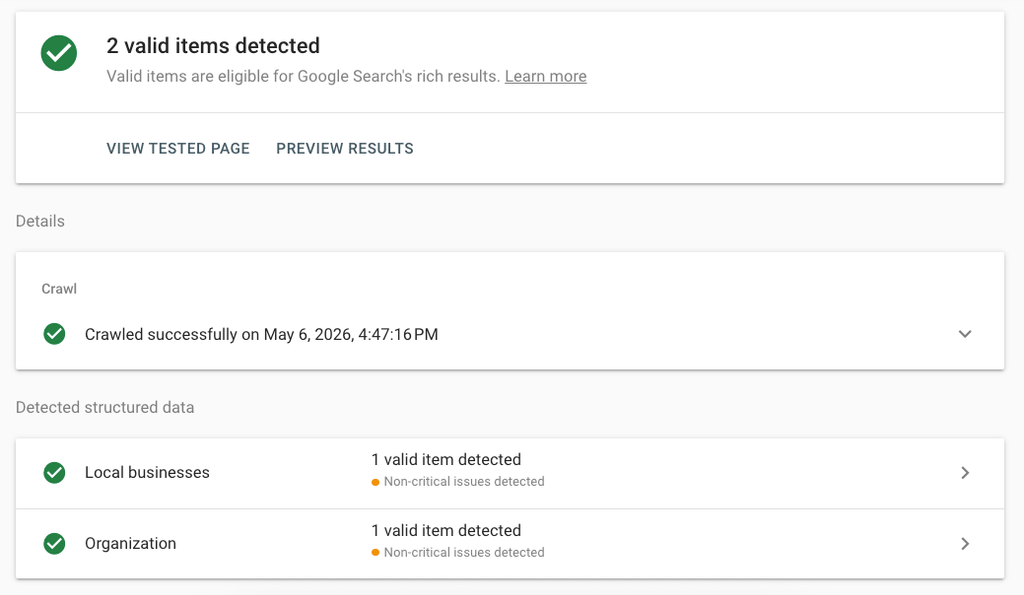
The fastest way to check the status of your current schema is running your homepage, or any other page with implemented schema, through Google's Rich Results Test. This test shows you exactly what Google sees, helping you identify missing schema variables and flagging any errors in your markup.
How do you add structured data to a hotel website?
Typically, structured data implementation will fall onto a web developer, a digital marketing partner, or someone else with access to your website’s backend. Some content management systems have plugins, built-in templates, or other tools that simplify the process, but structured data is implemented through code and therefore requires technical expertise.
Regardless of method, structured data is added through a block of JSON-LD code. When implemented correctly, schema code lives entirely in the background with no change in how anything looks to visitors. Using Google’s recommended format for schema variables and including all relevant information will maximize the chances of your schema working as intended.
As just one example, here’s the information that a complete Hotel schema block should include:
Schema type- in this case, “Hotel”
Property name
Property address
Phone number
Hours- in this case, 24 hours
Website URL
Optional details, including, but not limited to:
Price range
Property image
Geographic coordinates (latitude and longitude)
Social media profiles
Availability of amenities such as dining, pet-friendly accommodations, parking, etc.
How do you know if your structured data is working?
Once your schema code has been implemented, here's how to confirm it's working and up-to-date:
Look for and click into the appropriate “type” in the list. Hotel schema will be under “Local businesses.”
Note that schema types often overlap, and schema may be present for categories that you don’t expect. For example, “Breadcrumbs” are included by default within most CMS types, and the “Organization” schema is often created automatically using information from Hotel or Dining-related code.
Expand the relevant schema details and check for accuracy.
What happens after my hotel implements structured data?
While structured data itself won’t directly impact your visibility on search engines or AI search platforms, the following improvements are common:
Structured data may help with rankings by improving the digestibility and credibility of your website and content.
Schema can make your presence in search more complete and compelling, improving click-through rate and other engagement metrics. Better engagement can also positively affect overall search performance.
The more content that exists about your hotel online, the more likely it is that your information is picked up and used by search engines and Large Language Models.
Google typically crawls and processes new structured data within a few weeks, and rich results can start appearing in search shortly after. You can expect to see movement within 30 to 60 days.
Implementing schema also carries very little risk. Incorrect schema won’t break your site or hurt your current rankings, and the worst outcome is that your code is simply ignored.
Structured data is an easy, effective way to improve search visibility on both traditional search engines, such as Google, as well as AI-powered platforms. Ready to add structured data, or unsure if your current schema is set up correctly? GCommerce audits hotel and resort websites for schema gaps, validates your markup, and builds a comprehensive strategy that connects structured data with your broader direct booking goals. Let's take a look together.
Frequently asked questions about structured data
Does structured data guarantee my hotel will get rich results?
No. Structured data makes your hotel eligible for rich results, but Google decides when and how to display them. Accurate, complete markup that matches the content visible on your page gives you the best chance. Running your pages through Google’s Rich Results Test and fixing any errors or missing fields is the most reliable way to stay eligible.
How often should hotels update their structured data?
Update your schema whenever key property information changes, such as your phone number, price range, amenities, offers, or upcoming events. Beyond that, a quarterly audit is a smart habit, along with a full review after any website redesign, rebrand, or CMS migration. Keeping your schema current also signals to search engines and AI platforms that your information is reliable.
Is structured data the same as my Google Business Profile?
No, but the two work together. Your Google Business Profile is managed within Google and powers your listing in Maps and local search. Structured data lives on your own website and describes your property to Google, other search engines, and AI platforms. Your name, address, phone number, and other details should match across both, since inconsistencies can weaken trust in your information.
[Case study] Turning AI discovery into bookings at a Nashville luxury hotel
A luxury boutique hotel in Nashville partnered with GCommerce to get found where travelers are now asking: ChatGPT, AI Overviews, and other answer engines. Twelve months later, AI discovery is a measurable acquisition channel and organic revenue is at a record high.
From 187 to 2,385 AI search sessions in 12 months. See how LLM optimization, smarter FAQs, and schema put a Nashville hotel in the answer.
Regional drive distance markets are not new to the hotel digital marketing playbook and 2026’s economic and travel reports are highlighting the resurgence of this important target audience to revenue success. As budgets tighten, travelers are trading the long flight and international travel for the short trip they can drive to within a day. That shift is already showing up in the data, and it's quietly redrawing the map of where properties should spend their marketing dollars this year.
2026 Drive market hotel marketing takeaways:
Travelers are choosing shorter, closer-to-home stays as the economy cools and flight prices remain high.
Drive markets, the regions within a few hours' drive of your property, are where demand is concentrated.
Your own geo data provides the ideal target markets to capitalize on with drive market strategies
Geo-targeting and personalization let you speak to those travelers by where they are located - target promotions, callouts and more help you speak to them personally
Properties that hold or grow marketing spend in a downturn tend to gain share, not lose it.
What is a drive market, and why does it matter now?
A drive market is any region close enough that travelers reach your property by car instead of by plane, usually within a one to four hour radius. In a soft economy, those markets carry more weight, because a tank of gas feels like a smaller commitment than airfare for a family of four.
The numbers back it up. Lighthouse hotel search data across the G20 shows the share of consumers searching for properties in their own country rose from 54.1% to 57.5% year over year in the first quarter of 2026. By April, 60% of searches were domestic, and the US led the shift with a 7% jump.
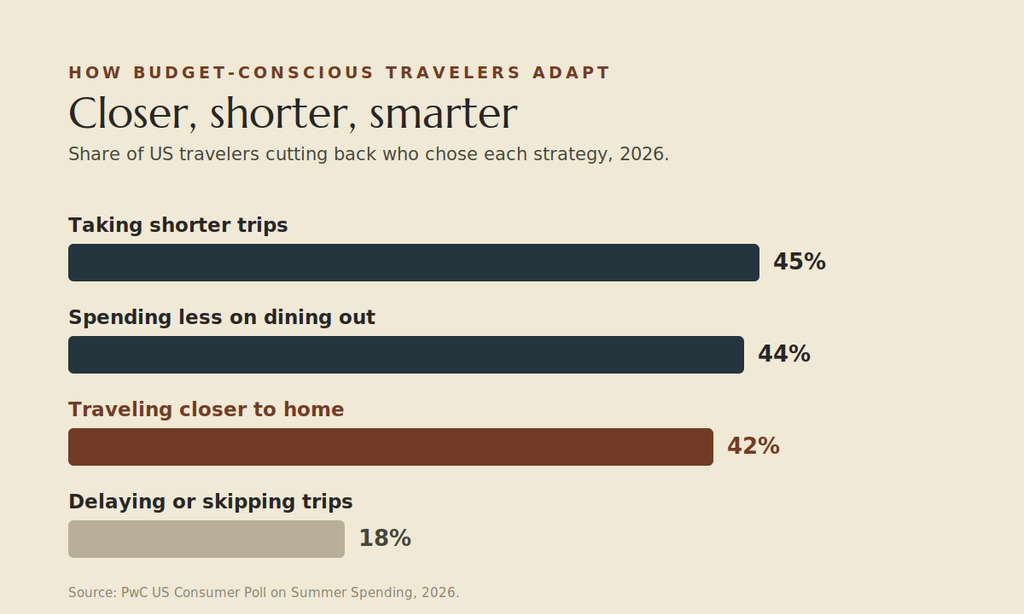
Consumer surveys tell the same story. PwC's 2026 summer spending poll found that among travelers cutting back, 45% are taking shorter trips and 42% are traveling closer to home. The guest who once flew across the country is now looking for a reason to stay regional.
Image: How budget-conscious travelers are adapting in 2026 (source: PwC US Consumer Poll on Summer Spending).
The counterintuitive move: Spend more when others spend less
When bookings get soft, the reflex is to trim your hotel’s marketing budget. The research points the other way.
Kantar's review of the long-running Profit Impact of Market Strategy (PIMS) database found that brands that raised advertising during recessions gained more market share than brands that raised it during good times, roughly +0.9 points versus +0.5. The brands that went quiet had to rebuild recognition from scratch once demand returned. You can read the full Kantar analysis here.
There's a simple reason this works for hotel marketing. It takes more effort to fill a property in a soft economy driving higher marketing costs per booking, and your competitors make it easier by reducing their own budgets and media spend. Media costs tend to drop, the feed gets less crowded, and there’s an opportunity for your hotel’s brand to stand out and gain recognition.
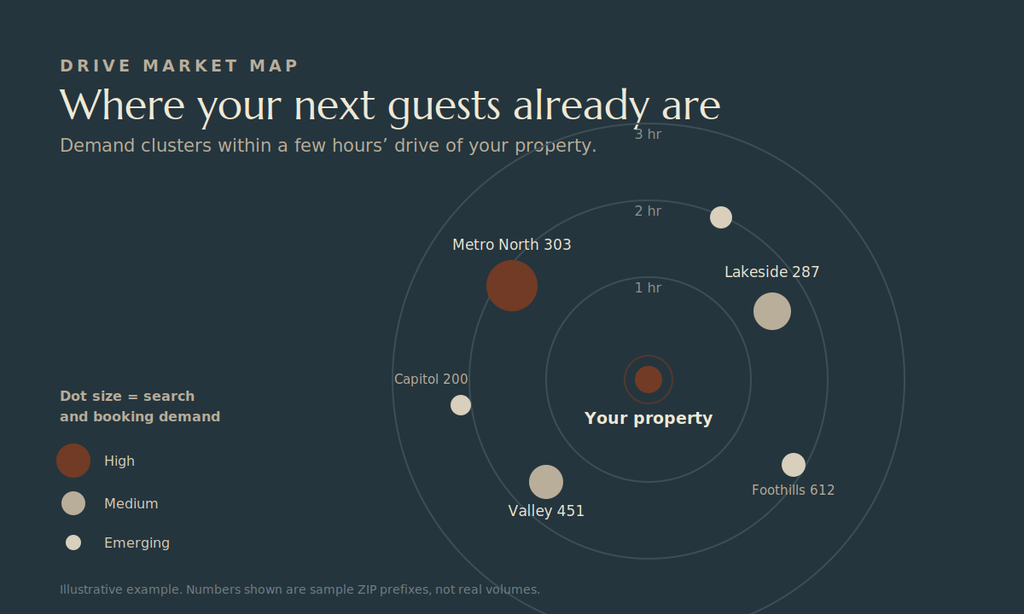
Use your hotel’s data draw your drive market targeting map
Before you spend a dollar, find out where your guests already are. Your Google Analytics 4 (GA4) and your booking engine (BE) holds the key to discovering the most lucrativ markets that book your property. Pull the geographic data from both, and a pattern appears: a handful of metros and ZIP codes drive a large share of your hotel’s revenue and market demand.
Once you can see which regions are your historically top producers, you know exactly where to point your budget.
Image: A drive market map ranks nearby feeder regions by real search and booking demand.
Customize your hotel’s messaging to the drive market
Dive into what motivates your local drive market audience - from custom packages for local residents to packages that include parking - lean into messaging that capitalizes on your property’s experience and makes the stay sweeter for those driving from nearby markets. Travelers have even been conditioned to search for local state resident offers, make your hotel eligible for these searches by providing one and building a promotional strategy to amplify it.
Acknowledgment is the most affordable loyalty tool you have. In past downturns, properties handed out gas cards to soften the cost of the drive, and the gesture worked because it met guests where they were. The modern version is the same idea in fresh packaging.
Build offers that speak to the regional guest and make them feel seen:
a fuel or travel credit that offsets the drive
a resident or neighbor rate for guests from your top feeder ZIP codes
a midweek package built for the short, two-night escape
perks like late checkout or free parking that lower the friction of a quick trip
An important component to these offers, they don’t focus on simply reducing your average rate. They build on value and packages while courting the local drive market audience with offers that are geared towards them.
Let GCommerce help build your hotel’s custom drive market strategy
The economy is rewriting travel habits in real time, and the properties that listen to their data will fill rooms while others wait for the old patterns to return. The job now is to meet them there, with the right offer, in the right ZIP code, at the right moment.
Most properties define a drive market as anywhere within a one to four hour drive, though the right radius depends on your location and the pull of nearby metros. Use your booking engine data to confirm where guests actually come from.
Should we cut our hotel’s marketing spend during a downturn?
The evidence says no. Brands that maintain or grow spend in a downturn tend to gain market share and recover faster, while those that go quiet lose visibility that is expensive to rebuild.
How do we find our hotel’s best drive markets?
Start with your own geo data. Your website analytics and booking engine show which regions and ZIP codes search for and book your property, so you can rank feeder markets by demand and value before spending a cent.