What Google's Agentic Booking Test means for hotels

SHARE:

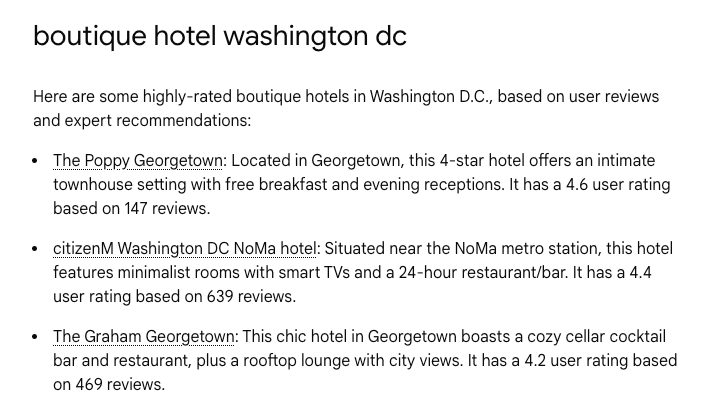
Google recently confirmed it has begun testing agentic hotel booking within AI Mode for a limited number of U.S. users. The announcement has generated a lot of discussion throughout the travel industry, but the implications extend well beyond another booking feature.

Here are the five things hoteliers should know right now:

1. This is Google's response to the rise of AI search

Over the past year, many in the industry have questioned whether travelers will begin planning trips in ChatGPT, Perplexity, Claude, and other AI assistants instead of Google Search.

This announcement suggests Google has no intention of giving up that position.

Rather than asking users to switch to a separate AI application, Google is embedding AI directly into Search through AI Mode and extending it all the way through the booking journey.

The goal isn't simply to answer travel questions. It's to keep travelers inside Google's ecosystem from inspiration to transaction.

Unlike Google, which is actively testing an agentic hotel-booking experience and developing lodging-specific commerce infrastructure through UCP, OpenAI has recently shifted away from making ChatGPT the native transaction layer for travel. ChatGPT remains a powerful discovery and planning interface, but its current model relies more heavily on travel partners, such as Booking.com and Expedia, to provide inventory and complete bookings. Google’s recent announcement shows a prioritization of agentic commerce, while OpenAI has deprioritized native checkout as its primary travel-commerce model in favor of app-based, partner-managed fulfillment.

What should hotels understand about Google’s agentic test? 

  • Google is bringing AI-powered planning and booking into the search experience travelers already use.
  • Rather than requiring travelers to adopt a separate AI tool, Google can retain the search, comparison, and booking journey within its own ecosystem.
  • This reinforces that AI search is likely to complement and reshape traditional search behavior rather than immediately replace it.
  • Hotels should expect travel research to become more conversational, personalized, and action-oriented.

2. Google is trying to own discovery - not become an OTA

Google has repeatedly stated it does not intend to become an online travel agency. Instead, its vision is to help travelers discover and compare options while allowing booking partners to complete the transaction and handle servicing.

Whether that strategy evolves over time remains to be seen, but it's an important distinction.

For hotels, this means existing distribution partners and booking engines remain central to the booking process.

What are the key takeaways for hotels regarding how Google wants to handle agentic bookings?

  • Google’s stated role is to help travelers find, compare, and select options, while booking partners complete the reservation and handle servicing.
  • Hotels’ existing booking engines, CRS providers, metasearch partners, and OTAs remain important parts of the transaction path.
  • The major question is not whether Google becomes an OTA; it is which partner’s offer, rate, and content Google chooses to surface. Make sure you are focused on optimization.
  • Hotels should continue prioritizing direct-booking readiness while maintaining accurate, competitive distribution across key partners.

3. Connectivity is becoming a competitive advantage

Perhaps the most important technical announcement is Google's Universal Commerce Protocol (UCP), which enables AI agents to complete transactions without sending users to another website.

That means booking engines, CRS providers, and distribution platforms will increasingly need to expose inventory, pricing, policies, and payment workflows in ways AI systems can consume.

Hotels with strong connectivity will be better positioned as AI-powered commerce continues to evolve.

What are key takeaways for hotels when it comes to agentic connectivity?

  • Agentic commerce for hotels depends on systems being able to share current availability, rates, room details, policies, payment information, and booking confirmation data.
  • Booking engines, CRS providers, channel managers, and other connectivity partners will play an increasingly strategic role in making sure hotels are eligible.
  • Hotels with outdated, fragmented, or inaccurate feeds may be less likely to appear correctly, or at all, in AI-powered booking experiences.
  • Inquire with your technology partners about their roadmap for Google’s Universal Commerce Protocol, AI booking integrations, and agent-referred booking reporting. Are they focused on AI agent readiness?

4. AI changes what "being discoverable" means

For years, hotels have focused on ranking well in search results and driving clicks to their websites. As AI becomes part of the booking journey, discoverability expands beyond rankings. Hotels will increasingly benefit from accurate rates, rich property information, structured amenities, policies, reviews, and high-quality content that AI can confidently interpret.

What are key takeaways for hotels to remain discoverable in the new agentic environment?

  • Traditional rankings and clicks still matter, but AI systems must also be able to understand and trust the hotel’s information.
  • Complete room descriptions, amenity details, accessibility information, guest policies, fees, packages, photos, and reviews will carry more weight in the decision path.
  • Hotels should make it easy for an AI to answer high-intent questions, such as whether parking is available, which rooms sleep a family of four, or whether the property is walkable to a local attraction.
  • Consistency matters: the same property facts should align across the website, booking engine, Google Business Profile, hotel metasearch feeds, OTAs, and CRS.

5. This is an early test - not a complete transformation

Google describes this as a limited U.S. test, and many details—including how broadly it will roll out and exactly how bookings will be processed, remain unknown. That means hotels don't need to overhaul their digital strategy tomorrow. However, the direction is becoming clear: AI is moving beyond helping travelers research hotels and toward helping them complete bookings.

What this means for hotel marketers:

  • The fundamentals haven't changed - optimizing for visibility (similar to today’s Map Pack and Local SEO) will still matter to win in this new agentic marketing environment
  • Hotels still need compelling creative, strong paid media, quality websites, competitive pricing, and excellent guest experiences.
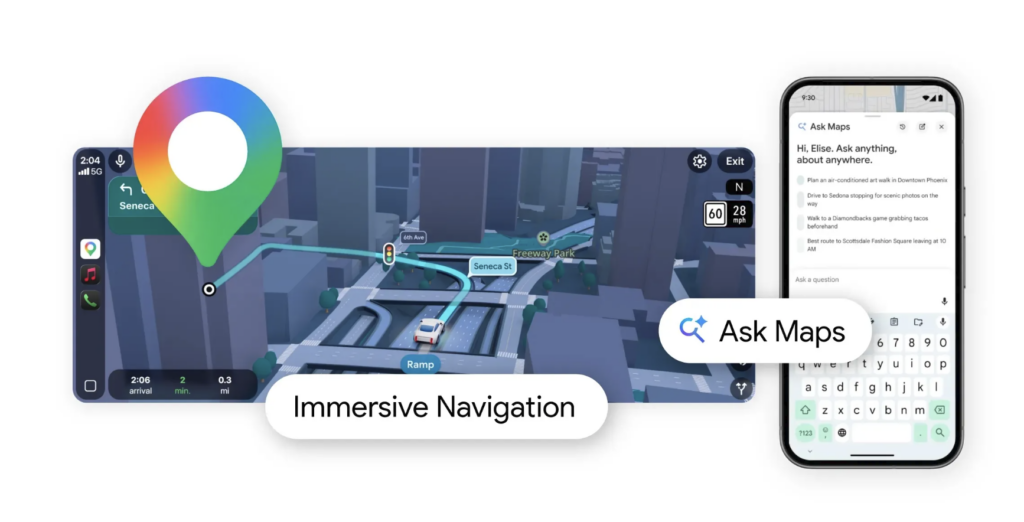
  • Google continues to push towards feed-based campaigns - the future of hotel marketing visibility and conversion will rely on adoption of connected feeds such as hotel metasearch. The best example of this in Skift’s article was the new “Ask Maps” feature (in addition to longstanding hotel metasearch ads). Our take: this will expand to additional ad placements and channels sooner rather than later; make sure you’re building a clean foundation now.
  • Data architecture and cleanliness remain vital to how your hotel can prepare for an agentic marketing future. Make sure you’re leveraging a hospitality data platform to turn insights into better optimization decisions to strengthen authority
  • Reviews and photos move further into the transaction path. Because the agentic flow is designed to surface reviews and room photos directly inside the booking decision (not just on a listing page), review management and visual content quality are now closer to a direct revenue lever than a reputation exercise.
  • Hotel content must become decision-ready. Consider calling out content that resolves the questions a traveler asks conversationally: “Is the pool heated year-round?”, “Which room accommodates two adults and two children?”, “Can I walk to the convention center?”, “Are resort fees included?”, and “Which rooms have a balcony?” 
  • Measurement is becoming a bigger blind spot as reservations move away from click-based attribution paths. Current reporting from Google and other agentic providers is lacking - without continued expansion from Google, Bing, and other agentic platforms with enhanced reporting, it will be even harder to attribute bookings to channels and campaigns.

What's changing is the way travelers interact with those assets. As AI becomes another interface for discovering and booking travel, structured data, modern connectivity, and high-quality content will become increasingly important components of a successful digital strategy.

The travel industry has spent the last two years asking whether AI would replace search. Google's answer appears to be something different: make AI the future of search itself.

Frequently asked questions about Google Agentic Booking

Is Google’s agentic hotel booking available to all travelers and hotels?

SEO helps hotels and resorts capture high-intent travelers earlier in their booking journey by improving visibility in organic search results. By aligning content with traveler intent, optimizing site performance, and targeting the right keywords, properties can reduce reliance on OTAs and increase direct bookings while improving profitability.


Will Google complete the reservation or send travelers to a booking partner?

The answer depends on the product experience. Google’s agentic hotel-booking test has limited public detail, so Google has not clearly explained every booking handoff or completion flow.skift
However, Google’s UCP for Lodging framework is designed to support direct, in-flow hotel reservations on Google AI surfaces such as AI Mode in Search. That does not necessarily mean Google becomes the seller of the reservation: the hotel, OTA, or other participating booking partner can remain the party completing and servicing the transaction.developers.google


Will hotels still be able to drive direct bookings?

Yes, at least under Google’s stated UCP model. Google says the business implementing UCP remains the merchant of record and retains its customer relationship, data, and post-booking experience, which creates a path for an on-brand booking engine to power an AI-assisted direct reservation.developers.google
That said, direct booking will increasingly depend on technical eligibility coupled with foundational optimization aimed at visibility, reviews, and reputation. A hotel’s rates, availability, room content, policies, images, and payment/booking workflow must be accurate and accessible enough for the AI experience to recommend and transact on its offer.


How will agentic bookings be tracked in analytics and attributed across channels?

This is one of the major concerns and blind spots hotel marketers should be aware of with agentic booking. There is not yet a standard public reporting model for Google’s limited hotel-booking test. Hotels should not assume that traditional organic, paid-search, metasearch, referral, or direct-channel reporting will fully identify AI-assisted bookings.skift


Will hotels have to pay for placement or commission?

Google has not publicly disclosed the commercial terms for its limited agentic hotel-booking test, including whether participation, placement, clicks, or completed bookings will carry a fee.skift


How does Google compare with ChatGPT travel booking?

Google is building agentic booking into surfaces where travelers already search and compare hotels, including AI Mode and Maps. Its UCP for Lodging initiative is designed for direct, in-flow reservations while allowing the participating business to remain merchant of record.developers.google

ChatGPT’s current travel approach is more partner-app based. For example, Expedia can show live lodging results, pricing, availability, and visuals within ChatGPT, then send the traveler to Expedia to complete the reservation. OpenAI also has an Agentic Commerce Protocol for embedded checkout, but it states that participating merchants, not OpenAI, validate and accept orders, process payments, and remain merchants of record.


What data should a hotel audit first?

Begin with the data most likely to determine whether an AI can confidently recommend and book the property:

  • Real-time rates, inventory, minimum-stay rules, taxes, mandatory fees, deposits, and cancellation policies.
  • Property facts, amenities, accessibility details, pet policies, parking, dining, pool/spa information, and location attributes.
  • Room-level names, occupancy, bed types, images, inclusions, and differentiators.
  • High-quality photos, current reviews, accurate business-profile information, and consistent facts across the hotel website, booking engine, Google surfaces, metasearch, OTAs, and CRS.
  • Offer and loyalty logic, including member rates, packages, promo rules, and ancillary products.

This is consistent with both Google’s emphasis on instant booking through UCP and OpenAI’s commerce requirements for refreshed structured data such as descriptions, pricing, inventory, media, and fulfillment details.


How AI is changing the way guests discover and book hotels

SHARE:

Navigating the new customer journey in the age of AI

A turning point for hospitality marketing

The hospitality industry has always been defined by human connection. It is a business built on relationships, experience, and trust. Yet the landscape around that human core continues to shift at a pace we have never seen before. Economic anxiety, dramatic changes in consumer behavior, and rapid advances in artificial intelligence are converging to reshape how travelers find, evaluate, and book a stay.

GCommerce founder Scott van Hartesvelt reflects on a career shaped by several eras of digital disruption and the resilience required to navigate change. Today, hoteliers face another moment of uncertainty but also another moment of opportunity.

The question is no longer whether AI will reshape the booking journey for hotels and resorts. The question is how fast it will happen and how hotels can establish an advantage while this transformation is underway.

This guide outlines what has changed, what is at stake, and what actions hotels can take today to increase direct bookings, strengthen visibility, and stay relevant as AI-powered discovery becomes the norm. 

We have been here before

Every major shift in hospitality marketing has been met with uncertainty. Each one also delivered meaningful advantages for hotels and resorts that acted early.

  • The early 2000s : Paid search reshaped the marketing landscape. Google Ads allowed hotels to place targeted messages in front of travelers actively searching for a destination or type of stay. This was the beginning of behavioral targeting. The earliest adopters gained a performance advantage and lower acquisition costs while late adopters hesitated in the face of unfamiliar technology.
  • Late 2000s and early 2010s : The financial crisis created intense pressure on hotel budgets; at the same time, social platforms introduced psychographic targeting. These tools opened a new path for audience segmentation based on interests, affinities, and social patterns rather than search intent alone. Early adopters again benefited from lower costs and increased visibility.
  • Early 2020s: COVID created another existential shock. In parallel, significant advances in data, OTT, CTV, and micro targeting emerged. Adoption again varied. Some hotels leaned in while others pulled back.

Across each era, the adoption curve followed the same pattern: early movers gained sustained advantage while late adopters fell behind. This history matters because AI represents a disruption at a greater speed and scale than any that came before.

The new disruption facing hotels and resorts

The current environment combines two forces that make decision-making difficult for hotel leaders.

  • Declining confidence in financial performance: Tariffs, changes in international travel patterns, recession fears, negative RevPAR projections, and unpredictable spending behavior are creating real uncertainty for properties across the country.
  • A major shift in consumer behavior: Travelers are using new tools, planning differently, and engaging less with the traditional funnel. As a result, many hotels are reducing their investment in marketing. According to Gartner, hotels now allocate 8.4% of room revenue to marketing, down from 11% before the pandemic. This is the environment in which AI adoption is accelerating.
  • AI adoption is moving at an unprecedented speed: Technology adoption has never moved this quickly. AI has reached ubiquity in record time.Large language model capability is doubling every four to six months, far outpacing the original innovation curve predicted by Moore’s Law. This acceleration is often referred to as Hinton’s Law, a model that reflects the compounding impact of data, algorithms, and computing power. Travelers are not only adopting these tools; they are also using them. They are weaving them into their travel planning.
    • 52% of US adults now use tools like ChatGPT, Gemini, Claude or Copilot.
    • ChatGPT has hundreds of millions of weekly active users.
    • All Fortune 500 companies have integrated AI into their operations.
    • ChatGPT reached 50 million users in 2 months, surpassing the adoption rates of television and the internet. The chart on slide 19 highlights this dramatic acceleration.
  • The traditional customer journey is collapsing: For more than two decades, the inspiration to booking journey has remained largely unchanged. Travelers move from inspiration to consideration, then preference, intent, and finally booking. Yet travelers no longer move through these phases in the same way.

The current state of travel planning

Travelers view an average of 141 pages of content over 45 days before booking.This should be a marketer’s dream because each page represents an opportunity for intervention. Yet customers do not enjoy the process:

  • 56% say they feel overwhelmed by too many choices
  • 80% say price comparisons take too long
  • 71% worry they did not get the best deal
  • 60% percent are dissatisfied with current planning options

This disconnect creates an opening for AI to simplify the journey.

How AI collapses the funnel

When asked directly, ChatGPT confirmed that AI assistants are already collapsing the inspiration to booking journey by helping travelers discover options, compare choices, and move toward a decision in a single conversation.

  • Search is moving from lists of links to direct answers
  • Discovery and decision now happen within one chat thread
  • Travelers want all-in-one planning, with ninety percent saying they prefer a single super-app that handles the full journey
  • Book from anywhere capabilities allow reservations to occur on platforms like Instagram or AI-powered interfaces without visiting a booking site directly

Microsoft Copilot has already integrated with major OTAs, enabling travelers to complete bookings from within a chat interface. This is no longer hypothetical. It is already in market and growing.

The real risk for hotels: Disintermediation

The rise of AI-driven planning introduces an urgent risk. If travelers rely on AI systems that pull inventory from large marketplaces, OTAs once again become the default access point for customers.

ChatGPT will not process payments or operate as an OTA. Instead, it will surface deep links or API driven booking paths from partners. If hotels do not supply a direct booking endpoint, the assistant defaults to OTA inventory.

Most of the current integrations run through OTAs, not through individual property CRS systems. This recreates the same disintermediation challenge hotels faced in the early 2000s.

Properties that do nothing risk losing visibility at the earliest stage of inspiration and losing direct bookings at the point of conversion.

What hotels can do right now

The good news is that hotels can take action today. These steps strengthen visibility within AI-powered search and improve the likelihood that a property appears as an authoritative answer.

These tactics also support broader SEO performance, improve guest experience, and reinforce the property’s digital foundation.

1. Strengthen website technical health

  • Ensure AI bots are not blocked
  • Use structured, machine-readable content formats
  • Improve mobile friendliness and site speed
  • Fix 404 pages and broken links
  • Maintain a clear, logical site structure with internal links and updated sitemaps.

A healthy site gives AI systems confidence in the information being returned.

2. Implement schema and structured data

Schema is one of the strongest signals for answer engine optimization and large language model visibility. It helps AI interpret property attributes, room types, amenities, policies, dining, and experiences with clarity. 

3. Elevate local SEO and review quality

Reviews play a critical role. AI tools use third-party sentiment to validate recommendations. Ensure listings are consistent and complete across Google Business Profile, Bing Places, and other platforms. Manage reviews with care. 

4. Build robust FAQ content

LLMs respond well to question and answer structures. Add a dedicated FAQ page and embed Q&A sections on room, dining, amenity, and area pages. Mark up with FAQ schema.

5. Shift to conversational, human-centered content

Content now needs natural language, clarity, and empathy. This aligns with how travelers ask questions inside AI systems and helps the model surface the hotel as a relevant answer.

6. Strengthen on-page SEO and expand content depth

GCommerce recommends optimizing page elements, adding multi-modal formats, publishing local area content, and building itineraries. Itineraries are particularly powerful because AI uses them to support end-to-end trip planning.

7. Participate in forums and community channels

Reddit and YouTube provide rich contextual signals to AI models. Properties that participate authentically in destination-relevant conversations build authority. 

8. Publish structured, answer-oriented social content

Use carousel posts, highlight local knowledge, and link back to schema-rich pages. Social content now plays a dual role: engaging consumers and supplying structured signals to AI models. 

9. Strengthen PR and link building

High-quality links and mentions remain essential signals. Build presence across local organizations, publications, and affinity audiences.

10. Prepare for AI-driven advertising

Google has already announced AI Mode placements for select campaign types. The industry is moving toward commercialized AI surfaces, and hotel metasearch will likely play a larger role. 

GCommerce direct inventory integration for AI systems

GCommerce has developed a breakthrough: GCommerce is now feeding direct hotel inventory into ChatGPT and other LLMs through API connected deep links via our beta.

This matters because:

  • It prevents defaulting to OTA inventory
  • It preserves control over the guest relationship
  • It supports direct bookings and transparency
  • It provides reporting on both traffic and booking behavior coming from AI channels
    .

This integration represents an essential step in reclaiming visibility as AI systems become the primary path for many booking journeys. It also reinforces why hotel metasearch and Google hotel ads play an increasingly strategic role for properties and digital marketing agencies working to protect direct revenue.

AI is reshaping hospitality, but hotels still shape the guest experience

AI is not replacing the human connection that defines hospitality. It is reshaping how travelers reach you, how they evaluate choices, and where they choose to engage. For hotels and resorts, this moment requires clarity, adaptation, and the willingness to lean in while the landscape continues to shift.

The hotels that act now will strengthen their position, increase direct bookings, improve discoverability, and build resilience into their marketing ecosystem. Those that wait risk losing visibility across the earliest and most influential stage of the traveler journey.

The future of hospitality marketing is still grounded in authenticity, human experience, and thoughtful strategy. AI simply changes how we reach that moment of connection.

Join the GCommerce closed beta for direct inventory in AI systems

GCommerce is leading an industry-first initiative to connect property-level inventory directly to AI assistants like ChatGPT. This protects direct booking paths, reduces reliance on OTAs, and provides real-time insights into how AI is driving traveler behavior.

If you want your property to gain an early advantage and help shape how AI influences travel planning, join the closed beta.


Your property will be among the first in the industry to secure visibility inside AI-powered planning and booking experiences. Sign up for our beta now.


How to rank your hotel higher on Google

SHARE:

Getting your property to the top of the search engine results page (SERP) can increase traffic to your website and net more direct bookings. Google understands that users are most likely to use their search engine and click on results when they can trust they’ll find what they’re looking for, whether it’s an ad or an organic result. To get your property to the top of relevant searches, you need to implement strategies that show Google that your site has exactly what its users want: helpful, reliable, quality, people-first content. 

Google is invested in serving technically sound, quality landing pages that match the context of a user’s search. Users trust Google to deliver highly relevant search results full of landing pages that are easy-to-navigate and give them the experiences they’re looking for. Maintaining this trust with its users is crucial for Google to keep its status as the most reputable and highly trafficked search engine in the world. With over 90% of the global search engine market share, demonstrable user trust is precisely what allows Google to attract its customers: the advertisers. 

At the end of the day, the real people providing value to your business are the same ones providing value to Google. So, to rank higher in Google search results, your site needs to demonstrate that it is precisely what those very real people you’re targeting are going to Google to look for.

Take a three-pronged, people-first approach to improve your search engine ranking.

  1. Ensure that your site has strong technical health.
  2. Optimize your site for helpfulness, reliability, and quality.
  3. Provide search engines and AI bots with signals for the context of the site.

Ensure that your site has strong technical health

Before Google can show your site, it needs to establish that the users it shows your site to will have a good experience. Users are more likely to lose confidence in search results when they experience page errors, slow page load speeds, difficult site navigation, and other technical errors from pages they’ve been served by Google, diminishing their trust in the search engine. To protect user trust, Google prioritizes serving sites devoid of major technical errors.

Keep your site free of major errors like the ones listed here to make certain that search engines and AI bots can reach your content.

  • Fix broken links and page errors like 404s.
  • Ensure search engine crawlers and AI bots are not blocked.
  • Maintain a clear, logical site structure with internal links and updated sitemaps.
  • Improve mobile friendliness and site speed.
  • Hide outdated content from the SERP.

A healthy site devoid of technical errors gives Google confidence that it’s serving users with a solid landing page experience and relays to AI systems that the information on the site is likely to be valuable and authoritative. Ultimately, Google sees sites with strong technical health as reliable for its users.

Optimize your site for helpfulness, reliability, and quality

At the heart of it, people go to Google to be connected with sources that are helpful, reliable, and get to the gist of their query. Design and optimize your site with the experience of the very real people that patronize your business in mind. Doing so will signal to Google that your site provides quality to users. 

Try these suggestions to improve your site’s content by optimizing for a people-first experience.

  • Use human-centered content and conversational, natural-sounding copy.
  • Expand content depth to provide helpful answers for your prospective guests.
  • Publish content surrounding your local area and particulars about your business.
  • Build itineraries and travel guides for people planning to visit your area.
  • Add thorough FAQ content, including a dedicated FAQ page, Q&A sections on key pages, and applicable schema markup.

Everything you do to your site should improve your user’s experience or make it easier for them to find your content. Google rewards sites that are more likely to be relevant, helpful, and appealing to users by pushing them to the top of search results.

Provide search engines and AI bots with signals for the context of the site

Optimizing for search engines/AI and for a people-first experience are complementary pursuits. You can provide signals directly to search engines and AI bots to tell them about your site and the content on your page. While implementing these signals, it’s important to center people-first practices to not sacrifice page quality. 

Give AI bots and search engines rich, contextual signals by using the following methods:

  • Practice traditional SEO strategies with a strong keyword focus and page element optimization.
  • Implement schema markup across your site and on FAQ content.
  • Regularly update the information on your social media accounts and local listings to ensure accuracy and clarity.
  • Practice PR-minded online behaviors by engaging with content about your property on social media, in forums, and across the web.
  • Keep an active online presence by responding to reviews in a timely manner, making use of Google Business Posts, and posting regular, unique content on social media and on your site.

Rich, contextual signals help search engines and AI bots to interpret your content with clarity and understand its relationship to user queries. By explicitly providing these signals, you make it easier for Google to match your property with relevant searches. These signals greatly incentivize Google to place you at the top of searches coming from users who are more likely to convert.

Is this approach still applicable with AI searches?

Yes, a people-first approach is still applicable in the age of AI. Google has even said so itself in its Google Search SEO documentation, “You can apply the same foundational SEO best practices for AI features as you do for Google Search overall: making sure the page meets the technical requirements for Google Search, following Search policies, and focusing on the key best practices, such as creating helpful, reliable, people-first content.” 

Google’s foundation of user trust has not changed. Neither has what the search engine considers to be a relevant, quality landing page. As such, a people-first approach is the best method to reach the top of relevant searches.

In your pursuit to rank your site higher on Google, the team at GCommerce Solutions is here to help. We can provide additional resources, audit your site to find how it currently matches up, and offer thorough, practical solutions to reach your goals, whatever they may be. Tell us what goals you’re pursuing, and we’ll find a way to help you achieve them.

The importance of guest sentiment and reviews in driving local SEO success for hotels in the age of AI

SHARE:

Customer reviews and star ratings have long been critical for local businesses, including hotels, shaping visibility in search results and influencing potential customers’ choices. While traditional search remains important, AI-powered tools such as Google AI Mode, Gemini, Perplexity, and ChatGPT are changing how reviews influence decision-making. 

Reviews no longer simply appear on a listing. They are analyzed, summarized, and highlighted, and play a direct role in influencing user perception. As customers increasingly discover businesses through AI-driven searches, ratings, and customer sentiment carry more weight than ever.

Why reviews and ratings matter in AI search for hotels

Positive reviews and high-star ratings boost your hotel's visibility in the local map pack, AI responses, and other search results, helping businesses stand out in competitive markets. Reviews act as digital word-of-mouth, giving potential customers confidence in their choices. AI tools amplify this effect by analyzing a wide range of customer feedback to determine which businesses to feature and provide users with an overview of customer opinions. Beyond search visibility and credibility, reviews provide actionable insights to guide business improvements. By using this feedback to make meaningful changes, businesses can earn better reviews and higher ratings over time.

Where your hotel’s reviews show up

Reviews and ratings appear across multiple platforms and features within the search engine results page. On Google, they appear on Google Business Profile and in organic search results. Sites like Yelp, TripAdvisor, and industry-specific platforms continue to build credibility through additional customer feedback. Reviews can also appear on official websites, online travel agencies, directories, Wikipedia, news sites, and in public conversations on social platforms such as Reddit. More recently, short-form video reviews from TikTok, YouTube, and Instagram have begun appearing in both traditional search results and AI-generated summaries. 

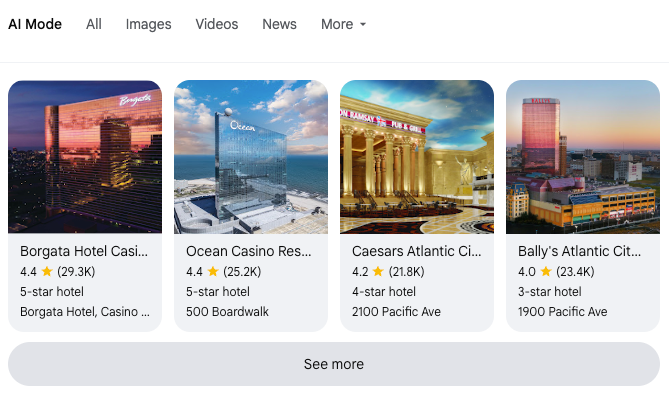
Businesses with higher ratings and positive feedback are more likely to be highlighted in AI-generated summaries. Google AI Mode, for example, may categorize businesses by rating and often displays clickable Google Business Profile cards showing both ratings and the number of reviews. ChatGPT can also pull top-ranked hotels or restaurants from third-party lists and awards, helping users quickly identify highly rated options.

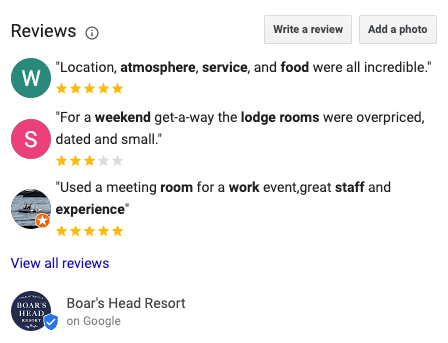
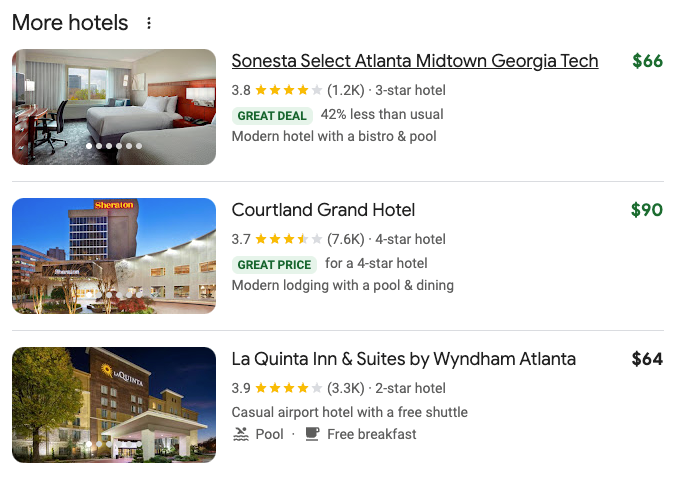
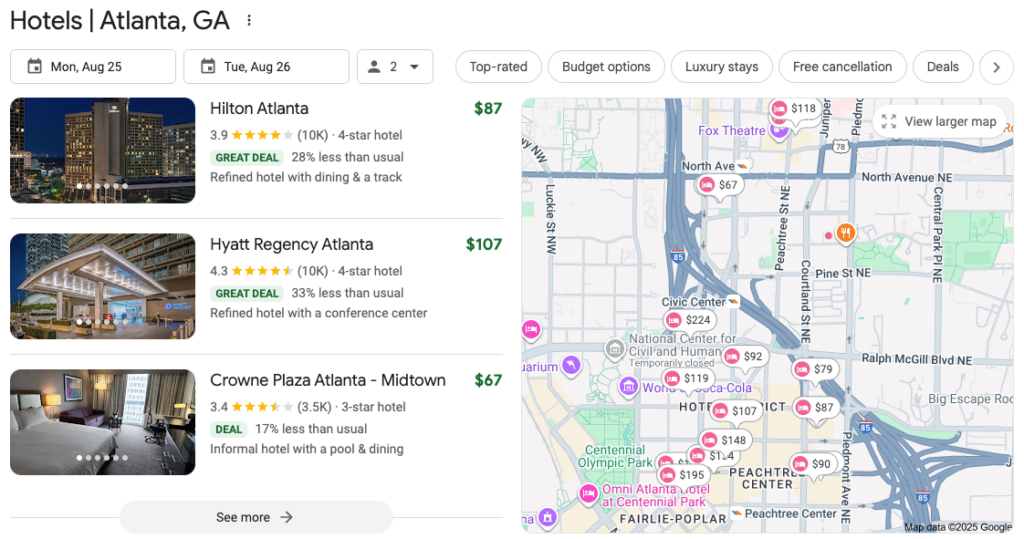
Here are a few examples of hotel reviews appearing within search results:

Google Business Profile

Local map pack within Google search

Local map pack within Google Maps

AI Mode results showcasing review content

AI Mode cards featuring Google Business Profile

Why more quality reviews matter for your hotel in the age of AI

Increasing the number of high-quality, relevant reviews not only improves your hotel's credibility with potential guests but also strengthens its visibility in AI-powered search results. 

According to Google’s tips to improve your local ranking on Google, local search rankings are influenced by three primary factors: relevance, distance, and prominence. 

Prominence refers to how well-known a business is, and includes factors such as the number and positivity of reviews. As highlighted in Hospitality Net’s, "From Keywords to Conversations: The Ultimate Guide to Generative Search for Hotels," guest reviews are central to AI-generated rankings and should be actively managed to improve positioning across platforms like Google Search Generative Experience (SGE), ChatGPT, and Perplexity.

How to increase your hotel’s review count

A few key strategies to increase review count include:

  • Encourage customer feedback: Ask satisfied customers to leave a review shortly after a positive interaction while the experience is still fresh in their mind.
  • Simplify the process: Share direct links to Google or industry-specific platforms in follow-up emails, receipts, or text confirmations. The easier you make it to leave a review, the more likely people are to follow through.
  • Use signage and reminders: For in-person businesses, display QR codes at checkout counters to make the process seamless.
  • Give incentives with caution: Discounts, loyalty points, or giveaways can encourage participation, but must be used carefully and always within platform guidelines to avoid penalties or flagged reviews.

How to improve your hotel’s review ratings

High review ratings are closely tied to high-quality customer interactions. Delivering exceptional customer experiences will earn positive feedback and improve your rating. Thoughtfully responding to reviews by thanking customers for praise and addressing concerns in negative reviews can also improve sentiment and overall ratings. 

Our recommendations for how to respond to Google reviews may help your hotel utilize strategic responses that boost both ratings and search visibility. 

Local SEO and review management

Local SEO extends beyond guest reviews. AI tools and large language models (LLMs) evaluate both your hotel’s online listings and guest sentiment when determining visibility. Accurate, consistent listings across platforms like Google Business Profile, Yelp, and TripAdvisor build authority, while actively managing and responding to reviews helps strengthen your presence in AI-driven results. 

Read AI in hospitality marketing to learn more about optimizing local listings.

Conclusion

Reviews and customer sentiment are more important than ever for local SEO, especially in the age of AI-powered search. Actively managing your review rating by encouraging reviews, responding thoughtfully, and using feedback to improve business operations can enhance your hotel’s credibility, improve search visibility within both traditional and AI-powered results, and influence customer choices from the very first moment of search. 

Integrating review management into your marketing strategy is essential for staying competitive in today’s local and AI-driven search landscape.

To learn more about reviews, Local SEO, or AI-powered search, reach out to GCommerce today. 

Improving AI search visibility: A practical action guide for your hotel

SHARE:

We’ve all heard it by now. AI search is the future, and your hotel’s discoverability is becoming increasingly dependent on visibility within AI search results. But what can you do about it?

Like many other marketing channels, the factors that impact AI search visibility fall under a variety of categories and optimizations, requiring a comprehensive multi-channel strategy to achieve success. But don’t let that scare you! While AI search visibility isn’t an exact science, there are plenty of things you can do to improve your hotel’s standings.

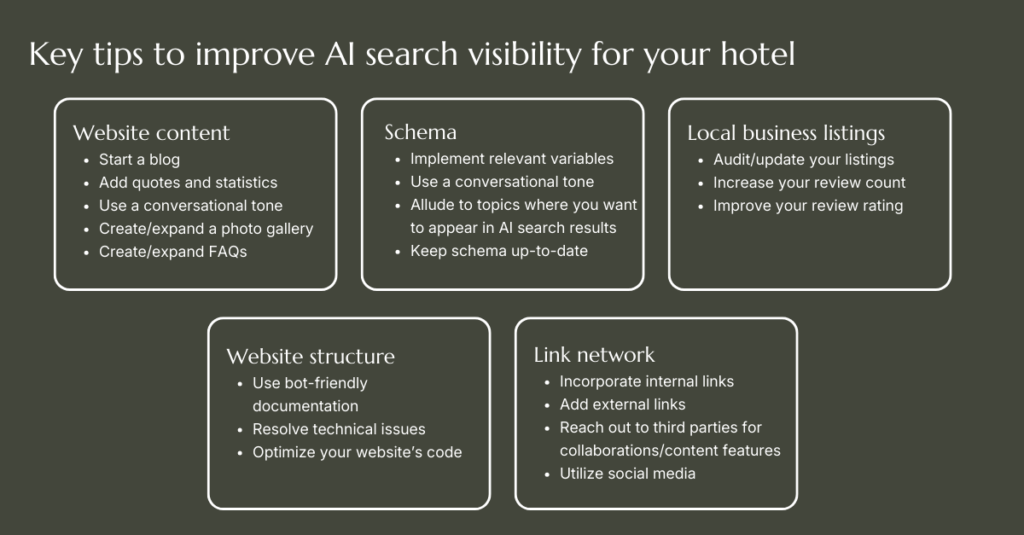
Here’s our list of the most important actions to take when trying to improve your hotel’s AI search visibility.

At a glance

There are 5 main categories where your hotel can optimize for improved AI search visibility:

  1. Website content
  2. Local business listings
  3. Schema
  4. Website structure
  5. Link network

We’ll dive into more detail with the rest of this article, but here are our top recommendations for each category:

Website content

AI models prioritize sources with a large volume and wide variety of content. Websites that cover a range of topics, and websites with a large amount of information to source from, are more likely to appear in AI search results. 

AI models also prefer page content that is reliable and thoroughly researched. Including links, quotes, and statistics into your web content can improve your website’s credibility, and therefore your hotel’s AI search visibility.

The contents of your website matter too. AI models prefer conversational, simple language to better align with their more casual search responses. They also prioritize easy-to-digest content, with a special preference towards high-demand items such as photos and frequently asked questions. 

Here are the immediate steps you can take to improve your hotel’s website content:

  • Start a blog to broaden your website’s scope and page count.
    • Cover topics around your hotel’s offerings and special features, things to do in the area, local events, and anything else that potential guests might be searching for.
  • Add quotes and statistics to your webpages.
    • For hotels, guest reviews and third-party articles are a great source of AI-friendly quotes.
  • Incorporate a more conversational tone into your content.
    • If formal language is a strong part of your hotel’s branding, consider simplifying some sentences to emulate a more casual tone without sacrificing brand voice.
  • Create or expand a photo gallery.
    • Prioritize high-quality imagery that features the most notable and unique aspects of your hotel. This may include dining options, waterfront views, or even amenities such as a pool or hot tub. 
  • Create or expand FAQs for your hotel.
    • Develop FAQs based on actual guest feedback and your own AI searches to determine what information your hotel’s potential guests are really looking for.
    • A standalone FAQ page is most impactful and may help your hotel’s visibility in traditional search, along with AI search results.
    • It’s also beneficial to add a set of 3-5 FAQs on topically relevant URLs. For example, add a few rooms-related questions to your hotel’s “Accommodations” page or include restaurant-related FAQs on the “Dining” page.

Local business listings

When recommending businesses, AI models tend to rely heavily on local listings such as Google Business Profile. Both business information and customer sentiment from these listings are used by AI models to offer the best options to users within AI search results.

Therefore, it’s incredibly important to optimize and maintain your hotel’s local listings over time. The following tactics are likely to increase your hotel’s AI search visibility, especially when completed on an ongoing basis:

  • Audit and update your hotel’s local business listings to ensure accurate and up-to-date information.
    • Be sure to prioritize listing accuracy on the following websites:
    • Sign up for a local listings management service to add and update your business information across hundreds of websites simultaneously, including those listed above. Examples of these services include:
  • Increase your hotel’s review count across various websites. Potential ways to generate reviews include:
    • Post on-property signage asking guests to leave a review.
    • Encourage guests to leave a review within post-stay emails or receipts.
    • Provide direct review links and QR codes to make the review process seamless for guests.
    • Be cautious with incentives such as discounts, loyalty points, or giveaways based on reviews. This may violate platform guidelines or terms of service, leading to penalties for your hotel’s listings.
  • Improve your hotel’s review rating across various websites. To achieve this, try the following:
    • Respond to your hotel’s reviews. For the most significant impact, follow the best practices outlined in our article on How to respond to Google reviews.
    • Provide an easy way for guests to offer negative feedback to your hotel directly. If guests can privately address issues with your staff or on your website, this may bypass the need to post a public negative review.
    • Take negative feedback from guests into consideration, and make an effort to solve recurring issues within your hotel’s operations.

Schema

Schema variables outline your hotel’s offerings and web content in a way that’s easy for AI models to read and digest. By incorporating well-structured, clean schema into your website, you increase the chances of showing up within AI search results.

Keep the following in mind when implementing schema variables:

  • For hotels, the following schema types are most beneficial:
    • Local Business schema outlines information about your hotel, dining establishments, and other offerings such as spas and golf courses.
    • Product schema can be used to describe room types, offers, and packages.
    • FAQ schema is an important element for hotels, especially when used in tandem with an FAQ landing page on your website.
    • Article schema highlights blog posts, press releases, and third-party buzz about your hotel.
  • Where possible, incorporate a somewhat conversational tone and allude to topics where you want to improve AI search visibility. Similar to on-page content, highly relevant and easy-to-use schema variables increase your hotel’s likelihood of appearing in AI search results.
  • Make sure to keep your schema variables up-to-date with the most recent information about your hotel. 

Website structure

AI models are fairly efficient at reading website content and understanding code. However, a clean and optimized website structure reduces friction, making it easier for AI models to digest your content correctly and thereby increasing your AI search visibility.

For optimal performance within AI search results, consider these website elements:

  • Add bot-friendly documentation to your website, including the following:
    • Implement an llms.txt document, used by Large Language Models (LLMs) to find your most important and relevant content.
    • Create a sitemap.xml file outlining all URLs on your website for maximum discoverability.
    • Highlight your sitemap.xml file in a robots.txt document so it’s easy for AI models to find.
  • Resolve technical issues such as:
    • Redirect 404 pages to land on live content.
    • Update outdated and broken links to include up-to-date URLs.
    • Remove and redirect outdated webpages to ensure fresh, accurate content.
    • Minimize duplicate content across webpages, title tags, and meta descriptions.
  • Optimize your website’s code, with a particular focus on the following:
    • Utilize a clean, intuitive, sub-folder structure so navigation of your website is seamless.
    • Ensure that website elements such as title tags, meta descriptions, and H1s are placed in the correct order and location of your code.
    • Improve your website’s average page speed to reduce friction for AI models.
  • The following tools may help you maintain your website’s technical health:
    • Identify potential issues with your website’s structure using site audit and SEO crawling tools from SEMRush and Screaming Frog.
    • Yoast SEO and RankMath offer creation and management features for llms.txt, sitemap.xml, and robots.txt files.
    • The WordPress plugin Redirection can assist in cleaning up 404 pages, duplicate content, and outdated webpages.

Link network

Incoming links, outgoing links, and brand mentions associated with your hotel can improve AI search visibility by boosting website credibility, streamlining discoverability, and increasing mentions of your website within AI model databases.

To improve your hotel’s link network, consider the following:

  • Incorporate internal links to other pages from your own website.
    • For example, link to your restaurant’s landing page when discussing the establishment in your FAQ or Amenities list.
  • Add external links to outside resources where applicable.
    • Highlighting your hotel’s third-party awards, press features, and partnerships is an easy way to boost your external link count.
  • Reach out to local businesses, blog owners, news sites, or even influencers to request a collaboration or content feature which includes a link to your website or otherwise mentions your brand.
    • Oftentimes, collaborations involve both websites linking to each other, providing the extra benefit of increasing your own website’s external link count.
  • Utilize your hotel’s social media to post blogs, press features, and other links to your website. Social media links still count towards overall link building.

Takeaways

Improving AI search visibility requires a well-rounded strategy across a variety of website elements and marketing channels. While no single change is likely to move the needle on its own, a number of small optimizations working in tandem will give your hotel the best chances of showing up in AI search results.

If you want to learn more about AI search visibility or you’re ready to get started, reach out to GCommerce today. We’d love to discuss your current AI search strategy and help set up your hotel for future success.

How data platforms turn brand authority into durable AI visibility

SHARE:

In the first two posts in this series, "Why AI visibility ultimately collapses back to data" and "AI doesn’t rank hotels. It learns which ones to trust," we reframed how AI visibility actually works.

We explored why AI-driven discovery collapses back to data, not prompts or shortcuts. We examined how brand authority is inferred from patterns in that data rather than declared through content or optimization tactics.

That brings us to the most practical question in the series:

If AI visibility depends on performance-backed authority, how do hotels actually improve the performance that creates it?

Brand authority isn’t created in AI. It’s earned in marketing.

Most hotels already generate demand.

They attract travelers.
They invest in media.
They drive traffic.
They convert bookings.
They earn repeat stays and reviews.

Brand authority isn’t missing. It’s being earned every day through marketing performance.

The challenge is that this performance data lives across many systems and is rarely analyzed together in a way that leads to better decisions.

AI doesn’t need perfect data from hotels. It simply observes outcomes.

Hotels, however, do need visibility into their own performance if they want to improve those outcomes intentionally.

What a data platform actually does

A data platform does not aggregate the signals that power AI results. It does not feed AI systems. It does not act as an intermediary between hotels and discovery engines.

Instead, its role is upstream and operational.

A data platform ingests a hotel or resort’s own marketing and performance data and turns it into insight that enables better optimization decisions.

It helps hotels understand:

  • Which channels are actually driving incremental demand
  • How different media investments affect direct bookings
  • Where pricing, availability, and messaging create friction
  • Which efforts are efficient and which are quietly eroding ROI

In short, a data platform helps hotels improve what they already control.

AI benefits later by observing the results.

Optimization is the mechanism that strengthens authority

Brand authority is inferred from outcomes, not intentions.

Those outcomes are shaped by everyday optimization decisions:

  • How budgets are allocated
  • Which channels are emphasized
  • How pricing and availability interact with demand
  • How effectively direct booking paths convert

When hotels lack a unified view of performance, optimization happens in silos. Channels are judged independently. Success is measured locally. Tradeoffs remain invisible.

A data platform breaks that pattern by connecting marketing performance across channels and tying it directly to business outcomes, especially direct bookings.

This doesn’t create authority. It amplifies the authority a hotel is already earning.

Why direct bookings are the clearest signal to optimize

In an AI-driven ecosystem, direct bookings matter for more than margin.

They represent:

  • Brand preference
  • Trust in pricing and availability
  • Confidence in the guest experience
  • Reduced dependency on intermediaries

By ingesting media, conversion, and booking data, it enables hotels to:

  • See which efforts truly drive direct demand
  • Identify friction in the direct booking journey
  • Optimize spend toward efficiency, not just volume
  • Reinforce patterns that consistently lead to direct choice

AI doesn’t see optimization decisions. It sees the outcomes of those decisions.

Repeated direct bookings are one of the strongest indicators that a brand is trusted and preferred. Smarter decisions = stronger visibility.

Where AEO fits, clearly and honestly

Answer Engine Optimization (AEO) is not where authority is created. It’s where authority is expressed.

AEO helps ensure that what a hotel has earned through performance and optimization is accurately represented in AI-driven discovery environments through structured content, schema, and distribution formats.

The data platform informs AEO by clarifying:

  • What actually performs
  • What positioning is reinforced by outcomes
  • What messages align with real demand

Without this insight, AEO risks amplifying assumptions. With it, AEO reflects reality.

Optimization strengthens authority. AEO communicates it.

From optimization tactics to durable advantage

AI-driven discovery hasn’t eliminated marketing fundamentals. It’s raised the stakes on them.

Content still matters. Media still matters. Distribution still matters.

But the hotels that win will be the ones that:

  • Optimize intelligently
  • Understand their performance deeply
  • Invest in direct demand
  • Reinforce what works over time

A data platform doesn’t change how AI works. It changes how well hotels perform.

And performance is what AI ultimately learns from.

Playing the long game

AI will continue to evolve. Interfaces will change. Discovery paths will shift.

What won’t change is this: AI infers trust from outcomes. Outcomes are shaped by optimization. Optimization depends on insight.

The hotels that win in AI-driven discovery won’t be chasing visibility directly. They’ll be investing in systems that help them make better decisions, drive more direct bookings, and strengthen the authority they already earn every day. AI visibility may feel new, but durable advantage still comes from performance.

Contact GCommerce Solutions to start connecting your AI visibility with your data.

Keep Reading