The digital world is always changing and evolving and, as digital marketers, we get to be the trail blazers on how to use new channels, technologies and techniques.
In our latest ebook, we've compiled the top digital changes of 2022 so you too can leverage the latest and greatest tools in our space.
Introduced only in 2017, Google Business posts are fairly new to the search marketing scene. But don’t let that fool you. Google Business posts can be an incredibly valuable tool for local SEO, and they shouldn’t be overlooked.
Many businesses ignore or give up on Google Business posts due to their lackluster performance when it comes to direct views and click throughs. However, there’s a hidden benefit to sticking with it. While Posts may not be overwhelmingly successful on their own, posting somewhat regularly can improve your rank in Google’s algorithm, causing your Google Business Profile to be shown more often and generating awareness for your business.
What Are Google Business Posts?
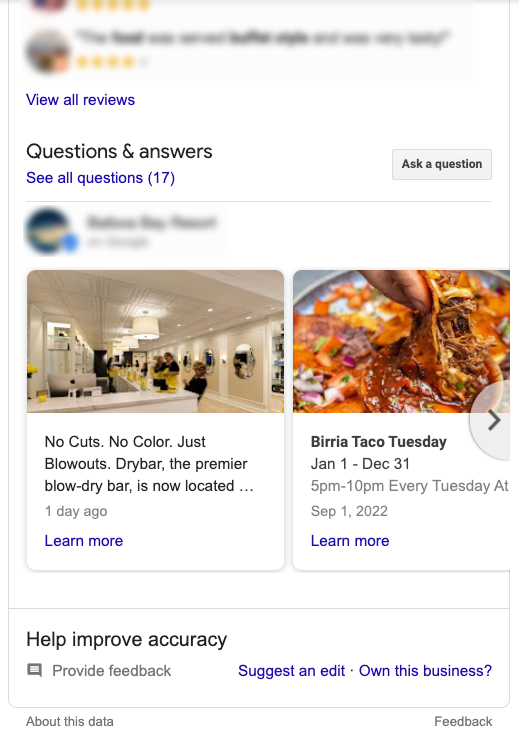
Google Business Posts can cover a variety of topics, with post types including “Events,” “Offers,” the open-ended “What’s New,” and more. These posts appear as part of your Google Business Profile listing, showing in both Maps and the standard Google results page.
Here’s an example of a “What’s New” and “Events” post on the general results page.
Every post type is a little different, but each one offers a number of optional call-to-action buttons, such as “Learn more” and “Order online,” as well as the option to add an eye-catching image.
All post types will disappear from your Google Business Profile eventually, which is why it’s so important to post regularly.
Putting Google Business Posts To The Test
Below, we’ve compiled data to help determine whether Google Business posts are worth the time and effort.
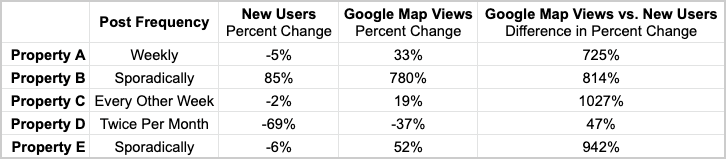
This test was conducted across 5 boutique hotels, comparing user metrics between the 3 months before and after we started using Google Business Posts. While exact post frequency varied, each property posted at least once per month during this test, using a variety of “What’s New” and “Event” posts.
“New Users” was pulled from Google Analytics, and only includes traffic from the Source/Medium combination of google / organic. Google Map Views was provided by Yext, a platform for managing Local SEO listings.
While “Google Map Views” did not always increase (likely due to external factors such as seasonality and search volume), the change in performance for this metric was significantly better across all 5 properties than the change for “New Users.” These differences are not insignificant either, providing fairly convincing evidence that regular Google Business posts will increase your standings in the Google algorithm and lead to more awareness.
Key Takeaways About Google Business Posts
If you aren’t using Google Business posts, you should start now. While they may not bring in a ton of traffic on their own, they’re an incredibly effective, and fairly easy, way to increase your business’ visibility on Google.
GCommerce Solutions has already incorporated Google Business posts into our arsenal of standard Local SEO tactics, and we encourage you to do the same. If you’re interested in learning more about Google Business posts or other Local SEO tips, check out the rest of our digital marketing blog or contact us below.
Earlier this year, GCommerce Solutions polled several thousand hoteliers and learned that very few were aware that metasearch advertising campaigns can be managed and optimized similarly to paid search campaigns.
3 things attendees can expect to learn:
How to ensure your metasearch connections allow for strategy and optimization
Bid modifiers and how to use them
How to use custom audience on Google to enhance the targeting capabilities of your metasearch marketing campaigns
Watch the replay by submitting the form below.
Access Webinar
Metasearch is one of your best tools for increasing direct traffic and recapturing market share from OTA’s, but only if you’re optimizing your metasearch advertising campaigns.
Learn how to harness the power of metasearch advertising to support your property’s unique needs.
Google's big push with it’s latest algorithm update, named the helpful content update, is taking aim at pages that are solely produced for search engines and not users. A lot of this targets pages with content auto-generated by AI writing apps or not providing original content/value on whatever the page topic is about. GCommerce’s SEO and content recommendation focus has always been with an emphasis on creation for people but making sure to use SEO best practices as outlined by Google. I think this article by Google really outlines how any website should think about Google’s helpful content update in an easy-to-understand format.
Our suggestions remain the same as they have been. That pages should have rich, original content, and then the content provided should also integrate SEO optimization best practices based on Google's guidelines to position the page in the best way to achieve success in the SERPs (and avoid crazy performance issues when algorithm changes occur). We never attempt "black hat" tactics or tactics geared solely at search engines without first considering the value to someone coming to the site looking for the type of product or search topic we are optimizing that page for. If you have used auto-generated/AI content or simply created pages with low-value content for the sake of search engine ranking and it doesn't provide value to someone researching that topic, then we would recommend updating it or removing it from your site.
Want to understand if your site is impacted by Google’s helpful content update as it rolls out over the next couple of weeks? Since it is an update that adds the signal as one of the many signals Google uses in the algorithm. The best place to monitor overall performance continues to be within Google Search Console performance reports. You can also add another layer of reporting by monitoring your positions through a platform such as SEMRush and keeping an eye on your Analytics organic traffic.
This update by Google was maining focused on eCommerce product sites and entertainment-related sites as you can tell by some of the language used in it’s Google update/release article, but I think it's a great reminder for all businesses across any industry that it's important to optimize their site experience and content for users while also making sure to follow SEO best practices for optimization. We’ve always viewed the two (optimizing for people and great SEO best practices) to have a ton of overlap if done correctly.
Have questions or think your site may have been impacted? Please reach out to our search experts with any questions.
The number one rule of search marketing is to never stop testing. You never know where you’ll find the next golden goose, so it’s important to try new things and reach outside of your comfort zone. GCommerce Solutions knows this, and we’re not afraid to experiment with lesser-known optimization methods to make sure we’re achieving the best possible results.
Below, we’ve compiled test data for 3 often underutilized Google Ads optimization techniques. These tests were conducted over 2-3 months each, using data from 9 boutique hotels spread across the United States.
Implement A Paid Search Ad Schedule
Consumers don’t interact with your business the same way all the time, so it’s a good idea to tailor your hotel’s paid search ads to your audience’s schedule.
While the data below measures account-level changes, paid search ad schedules work best when tailored to an individual campaign’s performance. This is how paid search ad schedules were implemented for these 3 hotels:
Branded Terms:
+10% bid adjustment on days/times with high conversions
-50% bid adjustment on days/times with low clicks and low conversions
0% bid adjustment on all other times, so ads always have the potential to serve
Non-Branded Terms:
+10% bid adjustment on days/times with high clicks/impressions
-50% bid adjustment on days/times with high average CPCs but low clicks and low impressions
0% bid adjustment on all other times, so ads always have the potential to serve
Percent Change By Paid Search KPI:
Account-Level, Period Over Period
Overall Paid Search Ad Schedule Results:
All Key Performance Indicators (KPIs) saw an average increase in performance.
Conclusion:
Regardless of your hotel’s marketing goals, an ad schedule can be a helpful addition to your Google Ads campaigns. If you’re willing to put in the time and effort to create and monitor an ad schedule based on individual campaign performance, this is a great way to give your KPIs a boost.
Keyword Optimize Your Paid Search Ad Paths
Ad paths are an often overlooked part of paid search marketing, but it’s worth taking the extra step to optimize them and make your ads more relevant.
Paid search ad paths show up as part of the display URL of an ad. In this example, “hotel” is display path 1 and “digital-ads” is display path 2.
This test was performed using single keyword ad groups. Every single ad in the account received optimized ad paths based on the ad group’s associated keyword.
Percent Change By Paid Search KPI:
Account-Level, Period Over Period
Overall Keyword Optimized Paid Search Ad Paths Results:
All KPIs saw an average increase or no significant change in performance.
Conclusion:
This is another helpful optimization tip for various paid search account goals, and requires far less maintenance than an ad schedule. Editing ad paths can be tedious, but it’s worth using every single inch of space you’re given to optimize performance. Just be sure to keep up with paths, adjusting as needed when creating new ads or copying existing assets.
Don’t Neglect Negative Keyword Research
Positive keywords can help you reach new people, but that doesn’t mean they’ll be new customers. Negative keyword research is an effective safeguard to ensure you’re not putting paid search budget towards the wrong audience.
This test included generalized keywords like “X Rated” and “Apartment,” as well as hotel-specific keywords such as competitor names and inaccurate locations. Every negative keyword was added with an “Exact” match type.
Percent Change By Paid Search KPI:
Account-Level, Period Over Period
Overall Negative Keyword Research Results:
Raw actions and revenue saw an average decrease in performance, but interaction rate and comparative revenue saw an average increase.
Conclusion:
Depending on your goals, well-thought-out negative keyword research can be incredibly effective for paid search campaigns. By design, negative keywords decrease the visibility of your ads, so they can lead to less overall traffic. However, this traffic is often very qualified, and will interact with your business at a higher rate to maximize your account budget.
Key Takeaways
There are so many available paid search optimization tools, and it’s a shame to see them go to waste. If you’re willing to put in the work, the above Google Ads optimization tips are likely to work in your favor, despite their somewhat uncommon utilization. Results are never guaranteed, but tailoring these changes to specific campaign performance is a great opportunity to push your KPIs in the right direction.
If you’re interested in learning more about paid search for hotels, check out the rest of our digital marketing blog or contact us below.
What Hotel's Should Know About Cookieless Tracking & Google Analytics 4
We’ve recently written about Google’s latest iteration of Analytics and important things hotel’s should know about Google Analytics 4 (GA4). In this post, we will go into a bit more detail on how the change to cookieless tracking might impact your hotel’s digital marketing efforts.
What are Cookies and Why Do They Matter?
Cookies are small pieces of data stored on your computer by the web browser. What they are isn’t so important as to what they are used for, which is to track individual users. By dropping a unique cookie or pixel onto your browser, a website can then track behavior outside of your website.
Are Cookies An Invasion of Privacy?
This is the big debate currently being waged and many people would say yes. Legislations like Europe’s GDPR, California Consumer Privacy Act, recent updates to Apple’s IOS to block more 3rd party tracking are all efforts to protect user’s individual privacy by making it harder to identify those individuals. At the heart of this debate is cookieless tracking. While cookies are not banned or illegal, a lot of browsers, plug-ins and software help to block cookies and there is evidence the cookies are becoming a less viable way to track users.
What does this mean for Google’s Universal Analytics?
Google’s current and most popular iteration of Analytics, Universal Analytics, uses first-party cookies to determine a number of variables within their tracking. Already, digital marketers are reporting gaps in data based on people that are actively blocking cookies and tracking. Within our own data, we have noticed certain instances where traffic from California has decreased, while traffic from locations not tracked has increased. This change is very likely indicative that California’s privacy laws are having an impact on our ability to track.
Why is Google Analytics 4 A Solution To A Cookieless World?
Despite what the name suggests, GA4 isn’t actually more robust tracking, it is actually less tracking on individual users. This is because GA4 is not tracking every pageview. Rather than rely on cookies and javascript variables to track every pageview, GA4 is tracking based on specific events that are built and established. Google then applies advanced models to fill out data for traffic and behavior. What Google Analytics 4 lacks in individual tracking it makes up for with the robust tools of their machine learning algorithms. The need for something like GA4 comes from the new privacy laws and public awareness around data collection.
What Should Your Hotel Do About Google Analytics 4?
While GA4 definitely seems like the exclusive tracking platform that Google will be supporting in the near future, Universal Analytics is still your most valuable tracking tool, for now. As we discussed above, changes to the way users view their privacy will make Universal Analytics less and less reliable as time goes on. The unfortunate aspect of this is that there is no published timetable for when GA and other tech companies will implement changes. The earlier that your hotel starts to utilize GA4, get familiar with it and start to utilize data from it, the further ahead of the curve your hotel will be when Universal Analytics comes to a point it is no longer recommended to utilize. There is no other time like now to start preparing for the future.
How To Get Started With Google Analytics 4?
After my father got a debilitating injury trying to build a retention wall in our backyard at the ripe-young age of 56, he decided it might be better to trust the experts. In this situation, we would also recommend utilizing an expert to help install GA4 for your hotel’s website. The truth is, GA4 is a completely novel way of tracking that does not rely exclusively on individual user data. Instead, it relies on event signals that are built and established based on the functionality and goals of your website.
Google Analytics 4 Tracking From GCommerce
If you’re interested in having the experts at GCommerce help establish GA4 tracking and reporting for your hotel website, contact us today!