As search marketers, we’re always trying to push the limits of optimization and squeeze our clients’ websites for every ounce of performance we can. GCommerce Solutions recently wrote SEO-friendly image descriptions for a client’s gallery pages, and we used the opportunity to learn more about on-page SEO by testing the descriptions’ effect on site performance.
The SEO Image Optimization Test
All performance data for this SEO image optimization test was collected from a single website domain, across three separate gallery pages on the site. Each image on these pages had an existing description, but we updated them with SEO keywords present in the corresponding page’s title and meta description. No other variables were changed.
This test lasted around a month, starting the day after optimized SEO image descriptions were implemented on each page. Impact on performance was measured period-over-period, using data from Google Analytics and Google Search Console.
SEO Image Optimization Test Results By Page
Percent change, period-over-period.
Page 1 performed the best, with increases across the board.
Page 2 performed poorly, with a decrease in all metrics.
Page 3 was evenly split, with flat pageviews, increased entrances, and decreased SERP impressions.
Overall SEO Image Optimization Test Results
The test didn’t have a strong impact on total pageviews, but entrances did increase. However, total SERP impressions decreased during this test.
Conclusion
The results of this test are fairly inconclusive. We’ll continue to experiment with SEO image descriptions, but we’ll need a larger data set over a longer period before we can draw a conclusion on their impact.
Though I wouldn’t say SEO-friendly image descriptions are a priority, they’re still worth a shot. There’s a lot of potential with the right page and smart optimization. If you’ve got a fairly optimized website but want to try something new, I definitely recommend testing SEO image descriptions. To learn more about SEO or see what we’re currently testing, check out the rest of our digital marketing blog or contact us below.
Should You Be Using Google Hotel Ads Bidding Adjustments?
To get the most out of Google Hotel Ads, your hotel metasearch campaigns require the same level of attention as any other hotel marketing. This includes a dedicated budget, performance monitoring, and most overlooked, campaign optimization. Bid adjustments are some of the most common optimizations for many search marketing campaigns, so we put them to the test on Google Hotel Ads to see if the same technique would also work for metasearch.
The Google Hotel Ads Bidding Test
This test was conducted over a period of 3 months (3 weeks for “Hotel 2”), using period-over-period data from Google Hotel Ads to compare results.
In this case, we were testing reduced bids on longer stays, with little to no change in total spend. In Google Hotel Ads, Cost per Click (CPC) is duplicated per night, which quickly adds up. A bid of $1 becomes $4 for a 4-night stay, and goes up to $7 for a week-long guest.
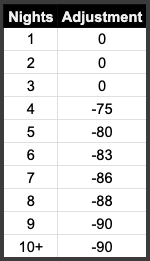
To combat this, we used negative bidding adjustments to minimize CPC bids and reduce unnecessary spending. In the case of our 4-night stay, we used a -75% adjustment to better match our base bid, effectively aiming to reverse the 4-times duplication.
We did not adjust 1-3 nights, since these lengths were both reasonably priced, and our best performers for each hotel.
See the chart below for the exact bidding adjustments we used in this test.
Google Hotel Ads Bidding Test Results By Hotel
Percent change, period-over-period.
Hotel 1 saw an improvement to all metrics.
Hotel 2, the shortest test, saw a decrease to most metrics, with CPC, Revenue/Click, and ROAS remaining flat.
Hotel 3 saw an improvement to most metrics, with the exception of increased CPC and flat Clicks.
Overall Google Hotel Ads Bidding Test Results
The following metrics were inconclusive, as the test produced one increase, one decrease, and one flat result for each:
Average CPC
Clicks
However, every other metric saw an overall increase from this test:
Revenue per Click
Conversion Rate
Return on Ad Spend
Revenue
Bookings
No metric decreased overall.
Conclusion
Using negative bidding adjustments on Length of Stay led to a far more efficient use of our metasearch budget overall, stretching our dollar further and allowing us to increase conversion metrics without a significant increase to spend. While this specific test only adjusted bids for one variable, it still proves that Google Hotel Ads bidding adjustments can lead to improved performance, strongly supporting their value.
Like any optimization technique, bidding adjustments aren’t foolproof. Even in our test, Hotel 2 did see a dip in performance as a result of these adjustments. However, it’s still an optimization technique we wholeheartedly recommend. If you keep your customer in mind and pay careful attention to the performance of your specific hotel, Google Hotel Ads bidding adjustments have the potential for a great payoff.
If you’re looking to get started with Google Hotel Ads bidding adjustments, contact GCommerce Solutions below for more information.
2023 Digital Marketing Trends from the GCommerce Marketing Experts
Short form video really took off in 2022 due in large part to TikTok and Instagram Reels, but 2023 will be the year that short form dominates over all other digital marketing ad types. Otherwise known as “snackable” content, short-form videos meet the needs of consumers by providing relevant content in a more digestible format that only needs to be about 15-60 seconds in length. These videos are more authentic than previous forms of video advertising, often being shot from the creator’s phone and including subtitles to be more inclusive.
One platform to focus on in particular is YouTube Shorts. According to Google, YouTube Shorts has over 1.5 billion active monthly users and are already being dropped in search engine results, making this a massive opportunity to reach new and current consumers. The best part is that like TikTok and Instagram Reels, these videos can be shot, edited, and put into a template all from the convenience of your phone.
Trend #2 - A More Visual Search Experience
By Lisa McGivney, Director of Marketing
Call it the “TikTok effect” but in 2022 Google announced changes to make it’s search results experience more visual, and I think this will continue to impact things like organic and paid search in 2023. In recent years Google has also released products like Google web stories to help brands focus on more visual story-type and content creation for it to use in search results. We even saw Google test adding story content from sources around the web to destination knowledge panels. I think adoption of this product has been slower but there are also features like image extensions for paid search and new search layouts that include more visual elements that brands need to really think about in 2023.
How can your hotel prepare for a more visual search engine experience? Make sure your hotel’s digital marketing budget includes line items for new image and video assets quarterly or at least annually. Visual content is going to continue to be important in 2023, and this extends beyond the channels you typically associate visual assets with like social media - it will expand to be even more important in search results too.
Trend #3 - A Shift To Engagement & Community Marketing
By Alex Scharpf, Search Marketing Strategist
As the next generation takes over, the marketing landscape is moving towards more personal and individualized audience interactions. Consumers are shifting away from feature-based transactions, instead craving authentic connections with unique and creative brands. Data tools are reflecting a similar change, deprioritizing quantitative metrics like website sessions in favor of engagement metrics such as click through rate and customer lifetime value. As we move forward, shallow marketing designed for maximum volume will no longer work. Instead, marketers will need to focus on creating deep, meaningful connections with their audience.
To make these connections, brand communities will become a vital tool for effective marketing. Building these communities will require creative storytelling, comprehensive first-party data, and a strong understanding of personal brand. To get started, drop the generic ad language, focus on your most loyal audiences, and set up a GA4 account. Check out our community marketing guide for more tips.
Trend #4 - TikTok Continues to Drive Authentic Advertising
By Stephanie Lutz, Digital Marketing Specialist
Formalized TikTok advertising really began to take off in 2022 and it doesn’t look like it’ll be slowing down in 2023. TikTok is beginning to reach the older audience with almost 37% of TikTok users being 35 and older, according to marketer Ayan Chakraborty. It opens many doors for reaching consumers as users typically spend an average of 45 minutes on the app per day and it is one of the only apps where users have to have their volume on to use it, and don’t mind!
In terms of advertising, TikTok generated $4 Billion in advertising revenue in 2021 and it is expected to double by 2024 and is now outperforming all other social media platforms. Because of how engaged TikTok users are due to the nature of the platform, advertising on TikTok is increasing consumer spending. Advertising on TikTok is less expensive in comparison to more traditional types of digital advertising.
Trend #5 - Increased Usage of LinkedIn Advertising
By Kristina Moon, Digital Marketing Specialist
As we shift into 2023, LinkedIn will be the platform that businesses will turn to for their specific business-travel goals. Properties will need to move away from pushing constant sales ads and shift to creating ads that engage and create connections. There is a big shift happening on LinkedIn where users want to see new and thoughtful content. As businesses shift to using LinkedIn more often, using content that is informative and insightful will be a powerful tool to gain the audience's trust.
To make these ads effective and less about sales, businesses will have to create their own unique content and find their brand voice. Users are wanting to see more authenticity on the platform and personality. Utilizing curated content will be big going into the new year because that shows customers that you are connected and paying attention to trends happening. This also shows potential customers that you are part of the community and have value to offer. Businesses will have to think outside the box when it comes to reaching users on how their products or services align with their audience’s values.
Trend #6 - First Party Data Taking Center Stage
By Jael Dugdale, Search Marketing Strategist
As we say goodbye to 2022, we welcome 2023 and all its upcoming or impending changes. The clock is ticking on third-party cookies, with the concern of privacy regulations such as GDPR, CCPA, and iOS14, data is now being muted and we see the impact throughout our marketing efforts:
Ad campaign performance
Facebook event match quality
Custom audience match rates
ROAS
With third-party cookies being deprecated, first-party data will be stepping up in the form of surveys, forms, questionnaires, and email collections. They will play a more prominent role on your website and in your marketing strategy. It will be critical to cultivate this data to analyze consumer interactions rather than through third parties. This goes hand in hand with Google's push for authentic experiences. This data collection will allow us to connect with existing consumers and build relationships to drive revenue growth. For 2023 investing in first-party data should be on your agenda so you are ready for the change in the second half of 2024.
Trend #7 - Give Before Take - The Growth of Education Content
By Morgan Tuohy, Digital Marketing Specialist
2022 was one of the first years we saw widespread education content promoted by brands. With the prevalence of short form video, what once took the form of carousel ads on Instagram can now become viral content on Instagram reels or TikTok.
Travel and hospitality brands have long been pioneers in this genre of content; top 10 attraction blog posts, emails containing local’s secrets, and more. However, few hospitality brands are taking advantage of their travel expertise through the short-form video format. As short-form video platforms become search engines, this content becomes more and more valuable. 2023 will be the year that educational content becomes a primary way to reach new customers interested in traveling to your destination.
Trend #8 - The Shift To GA4 & How It’ll Help Grow Your Brands Reach
By Moses Centeno, Search Marketing Specialist
As web browsing and Social Media evolve into a less intrusive, more privacy-focused experience, the use of third-party cookies and hyper-specific retargeting comes to an end. As previously mentioned, the next generation of digital consumers holds brands to a higher standard, not only in data protection, but they expect a more personalized brand experience and values that align with their own. With the sunsetting of Google Analytics 3 and forcing website owners to embrace Google Analytics 4, Google’s answer to a more privacy-centric data collection tool. GA4 offers more interactive-based reports or metrics that can help marketers develop a better understanding of the type of content their consumers want.
For example, engagement rate is one of the new GA4 metrics enabling you to identify how your customers are interacting with your content. By analyzing your organic traffic landing page report, you’ll gain insight into the first impression users have of your website. This helps you to understand what areas (the type of content) they pay more attention to, which helps us find opportunities to grow traffic. Now, we can go one step deeper by analyzing the engagement rate of these pages & determine the type of content our consumers are actually interested in and continue to build on what’s working, and discontinue what isn’t - even influencing the type of ads we create.
Trend #9 - How Microsoft’s Investment In AI May Lead To Greater Competition For Google
By Patrick Buckner, Search Marketing Strategist
By now many of us have heard of OpenAI’s Chat GPT, an advanced chatbot that can write speeches, create poetry, and even help kickstart marketing copy. What you may not have heard is that Microsoft is considering investing $10 Billion in the company in an attempt to help them even the playing field with Google. The hope is that by incorporating the latest AI technology into their search engine, the results will be more accurate, more engaging, and more helpful to the searcher.
Given that Google has already begun to lose some market share to competitors (they still capture 28.8% of all U.S. digital ad revenue, but that is down from their peak of 34.7%), it’s possible that with the implementation of the OpenAI technology Microsoft could become a bigger player in the advertising game. Will Microsoft’s early adopter strategy pay off long term? It’s tough to say, but it’s something that we’ll be watching closely throughout the 2023 and beyond.
So, what now?
Armed with the knowledge to set you forth into an ever-evolving world, GCommerce is here to help you reach your goals in 2023! Contact us today to learn more about our marketing services.
These days it feels like mentioning the “R” word is tantamount to saying Voldemort’s name out loud. We all know it's here, but maybe if we refuse to acknowledge its arrival, it’ll somehow spare us the battle ahead. Sorry to burst that bubble, but the battle is about to begin.
Reading the Tea Leaves
GCommerce provides real time reporting to our hundreds of clients; meaning we sit on a metric-ton of data. In the last 90 days:
Website conversion rates dropped 36.5% in November 2022 versus October and 26% over November 2021.
Portfolio wide ADR in November increased by $50, while overall revenue dropped an astonishing 46%,
Look-to-Book ratio has been cut nearly in half.
Return on Ad Spend (ROAS) has actually improved in Q4, but impressions and volume are down. Simply put, less people are shopping.
Call this the canary in the mine, but we aren’t the only ones seeing the hotel digital marketing trends. Hotel clients are reporting declines in overall market demand, especially in city center destinations.
So regardless of your own prognostication on the health of the travel economy in 2023, let's assume that we are about to see a downturn. Hopefully a mild one.
What Happens Next For Hotels
As is so often the case, history instructs the future. When the hospitality industry experiences a downtown, a number of patterns repeat. Not to sound self-serving, but most hotels cut marketing spend, retrenching to their most basic programs in an effort to cut costs. Seems reasonable, but there is a more intelligent, less reactionary way to rebalance spending. Unfortunately, many hotels will eschew a methodical approach in favor of arbitrary cuts to all spending. There’s a reason that OTA’s have used recessionary periods to grow their share and influence in the industry. They become a more important revenue lifeline when hotel’s cut their own digital marketing.
Beyond hotel digital marketing activities, if history is a guide, hotels will fall into a few categories (with clear winners and losers).
RETREAT IS DEFEAT
2021 was the year of historical gains in ADR. Seriously, some of our client’s have increased their rates 300%+ over previous highs, and we all know rate flows. It can be addicting. As headwinds start to blow, some hotels will refuse to sacrifice their rate gains. They’ll argue that with inflation and rising labor costs, the rate is necessary to maintain profitability. They’ll point to studies that say that dropping rate in a recession does more harm than good. True, and we’ll reference those same studies in just a minute. But hotel rates in many markets have grown to unsustainable levels (300% over previous highs in less than 2 years is not “normal.”) Finding a more historically grounded hotel rate strategy is not the same as fire selling your property. Hotels in this category will see occupancies fall as more aggressive competitors win share. They’ll watch loyal hotel customers give less expensive competitors a try, opening the possibility that they lose them forever. Not good. Ultimately, these hotels will succumb to market pressure and reduce their rates, but harm will have been done.
PANIC!
Bookings have fallen off a cliff, cancellations have increased, market wide demand is down….react react react. This category of hotels does not lead their comp set in RevPar share. They’re not usually in second place either. They take pride in their ability to pivot quickly by pulling on the pricing and merchandising lever. They’ll drop rate, run flash sales, snuggle up to OTA’s and cut more proactive digital marketing for their hotel as their profitability plummets. It's a race to the bottom, and they’ll be determined to get their first. As mentioned previously, this course of action was well studied after the recession of 2008. It boils down to this - outsourcing your demand to fickle customers who will only do business with you if you’re “on sale” is a tough place to come back from. Hotels in this category experience the most significant declines in profitability during a recession, and they’re the slowest to recover on the back end. Long story short…don’t be this.
PLAY CHESS NOT CHECKERS
The last category of hotels will be a little more thoughtful, a little more strategic, then their peers. It starts with a fundamental understanding that:
Price Elasticity of Demand = Percent Change in Quantity Demanded / Percent Change in Price
Our belief is that, in the early stages of this next cycle, prices will be very elastic. In other words, measured drop in prices will lead to increased demand. However, especially in a recession, that curve flattens at some point (and often rather quickly). When the curve flattens, dropping your rate by $20 doesn’t result in more room nights, it just means that people spent $20 less on rooms they were already going to book. Smart hotel revenue managers will find that inflection point, and find it quickly (60-90 days). Once there, these hoteliers will establish something of a floor for their pricing, regardless of the insane actions of their bottom dwelling competitors.
What, then, for their hotel’s digital marketing. Rebalance, not eliminate. First and foremost, these hotel’s will focus on their past/loyal guests. Those guests have pre-existing price expectations, meaning they will be less likely to shop around if they see the property offering a competitive rate vs what they paid previously. Any discounts the property offers to stimulate demand will go to this cohort, rewarding them for their loyalty and continued business. They know that these past guests will be the key to their accelerated recovery on the back end of the recession.
What Are We Doing at GCommerce?
We’re rebalancing our marketing.For the last decade+ (with the exception of the pandemic), hotels have been focused on new client acquisition. They’ve been in the driver seat with OTA’s and flooded with demand from a well-heeled consumer. Our efforts were focused on efficient new-customer acquisition. Going forward, acquiring customers will still be important, but a renewed emphasis on building, nurturing and growing a loyal brand community will win the day for our hotel clients. That's a fancy way of saying that smart operators will want their hotel marketing to focus on their past guests in new and innovative ways. At the recent Historic Hotels and America annual conference, we unveiled Community Marketing, a new paradigm in hospitality digital marketing. It posits that programs devoted to developing a loyal and growing brand community is not only timely, it’s timeless. To do so, we must build a narrative around our brands, telling stories in compelling new ways. We have to focus on the new gold standard of first party data, and wean ourselves off of third party data that is increasingly disappearing. During boom times, demand is cheap and profitability is high. It’s hard to justify the extra effort required to make this kind of pivot. In a recession…
At the same time, smart revenue managers will want to do everything in their power to resist the allure of OTA demand. That battle is being fought through metasearch. Make no mistake, the OTA’s are geared up and ready to fight tooth and nail for those customers, but for the first time since OTA’s became a thing, hoteliers have a way to even the playing field. We expect budgets will increasingly rebalance away from traditional digital media, and towards metasearch advertising for hotels. With the launch of MetaDesk, GCommerce is poised to lead the fight for our clients. By a large measure, MetaDesk is more feature rich; more result focused than any metasearch platform in the industry. It's time to finally win a recessionary war against OTA’s instead of relinquishing ground.
Down markets are difficult, but they follow a pattern. Your hotel’s outcome is more dictated by marketing than in any other economic cycle. If you hold a strategic, long view, you can set yourself up for a decade+ of success. We’ve spent the last year getting ready, so let’s go win the day.
6 Ways Hotels Can Utilize Facebook's Lead Generation Tool in 2023
New year, new ways to utilize Facebook advertising for hotels. When you think of Facebook advertising, most of you probably think about ads aimed at driving awareness, website traffic, or online purchases. What if we told you that Facebook can also serve as a key component to collect first-party data for your hotel in a world where we so desperately need it?
Facebook’s lead generation tool has been around for years, but it’s been getting a “glow-up” in recent months and is now one of the primary ways we drive leads and collect email data for hotel clients at GCommerce. New functionalities continue to release as we enter 2023, but one thing that hasn’t changed is the tool’s ability to put first-party data in our clients’ pockets.
Here are six ways your hotel can utilize Facebook’s lead generation tool in 2023.
Increase Your Hotel’s Email Database
Are you looking for easy ways to increase the size of your hotel’s email database and create cohesive hotel marketing strategies across multiple channels? Utilizing the lead generation tool on Facebook can quickly help you build up your databases with qualified users.
See It In Action
Prompt users to enter their information with messaging centered around staying up to date with the property, new available offers and promotions, or offer a special incentive to sign up and subscribe. From there you can download the leads directly from the Instant Forms section or utilize a third-party platform like Zapier to send leads straight to your email.
Further Qualify Your Hotel’s Remarketing Audiences
Lead generation isn’t only good for your email marketing, it can also be utilized to bolster your hotel’s remarketing efforts. While you could just re-upload your leads list as a custom audience, you would need to be constantly updating it. Instead, set up a new audience based on Lead Generation data within your remarketing adsets to keep the audiences fresh with any additional work.
See It In Action
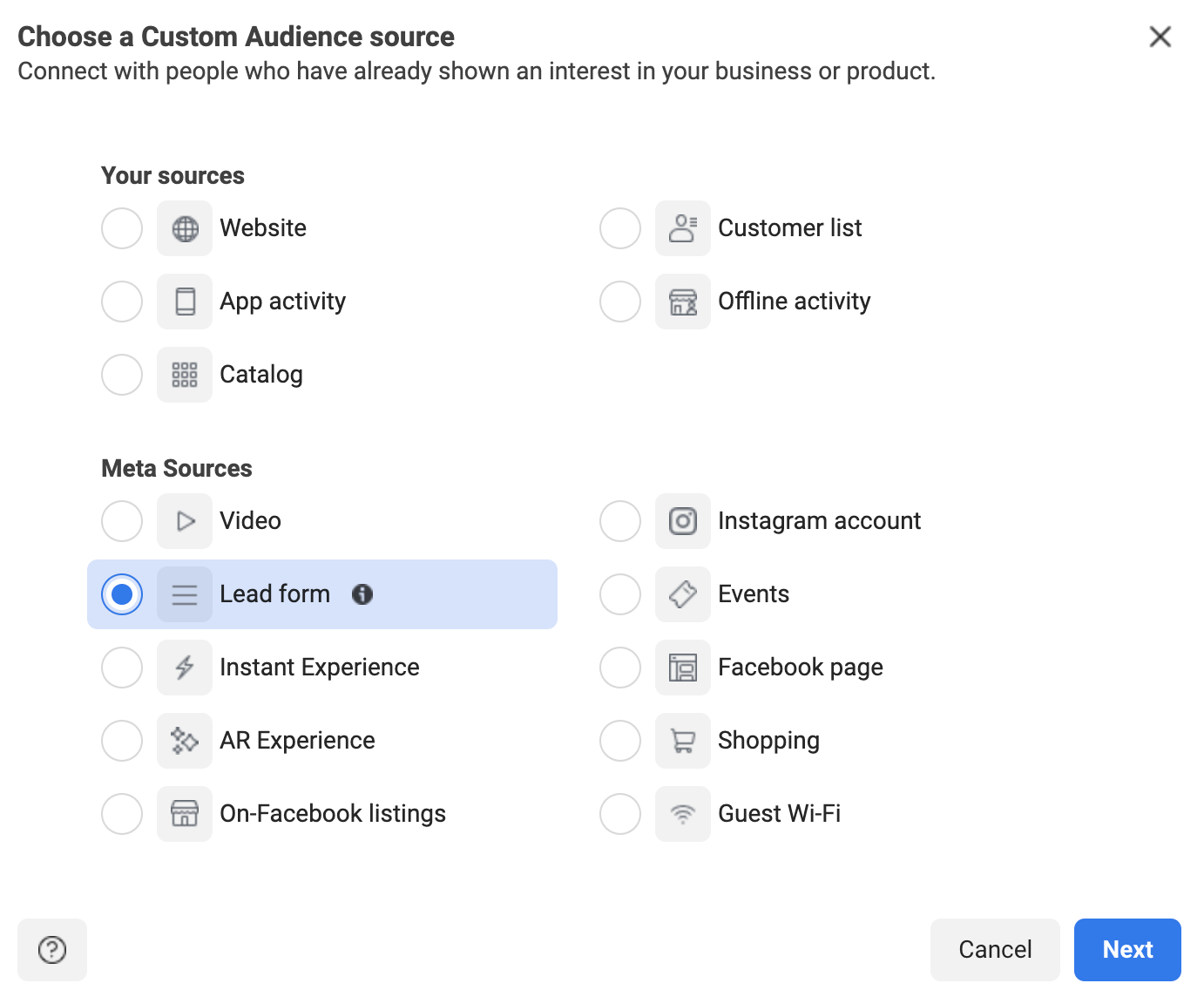
Under the custom audiences section, select Lead Form. From there you’ll want to include anyone who opened and submitted a lead within your desired timeframe (we recommend 90 days). Voilà, you will now be incorporating active lead data into your hotel remarketing campaigns.
Pro Tip: If you are going to utilize your leads for multiple purposes, such as Facebook remarketing and adding them into an email list, make sure you disclose this in the lead form settings.
Support and Grow Your Hotel’s Wedding Business
What better way to find real-life engaged couples for your hotel’s wedding space than by reaching them where they already spend large amounts of time each day–social media. Facebook lead generation forms are one of our favorite ways to advertise wedding spaces for our clients at GCommerce because it’s easy and effective. Not only can you directly target engaged people, newly engaged people, and even friends of engaged people, it also allows the couple to fill out a lead form to receive more information or a quote.
See It In Action
When creating your lead forms, think about the goal of your hotel’s wedding campaigns. Do you want to qualify guests before sending them more information? Use questions such as wedding size, potential wedding dates, and even wedding budget if you have a higher-end wedding space. If the goal is to simply get your wedding venue out there, keep your form questions simple and opt for name, email, and wedding dates.
Increase Business Travel and Showcase Meeting Spaces At Your Hotel
Similar to the wedding business above, using lead generation is also a great way to gather quotes and potential leads for your hotel’s onsite meeting rooms. This strategy is great for hotels also looking to increase their business travel segment in 2023.
See It In Action
While the setup will be similar to wedding lead generation, your form should include questions such as group size, reason for group meeting, and even information about catering. In the targeting section be sure to include specific job titles of people who might be planning these events, small business owners, and/or email lists of past and potential companies.
Drive More Visits to Your Hotel’s Blog and Grow Subscribers
Do you have a blog on your hotel’s website and struggle with growing your subscriber base? Facebook advertising is a great tool to drive both awareness and new readers. Use the on-Facebook forms to intrigue users into joining the subscription list.
See It In Action
This lead form will look similar to our first example for growing your hotel’s email database; keep the form simple with only name and email address. However, instead of reasons to join the email list entice users with excerpts from the latest blog post or offer them exclusive content only available to subscribers. Utilize the link at the end of the form to send users to your most recent blog or top ranking blog from the past year.
Once leads are created you’ll still need to manually add them into your blog’s subscriber list, but you’ll ultimately be gaining new readers you wouldn’t have had before.
Find and Convert Event Guests For Your Hotel
Facebook lead generation is an effective, and often overlooked, tool to advertise your on-property events and convert potential guests. Not only will you be advertising your hotel’s event to Facebook’s massive audience, you’ll also be ingesting first-party data for interested attendees that you can use for email marketing, Facebook remarketing, and much more.
See It In Action
Set up your hotel’s Facebook ad to introduce your event details before prompting users to sign up for event updates and news. Is your event not open for registration yet? Prompt users to get on the list now and be the first to RSVP when registration opens up. Once your event is over, utilize your list for remarketing future events or to convert event guests into hotel guests.
There you have it, six easy ways to incorporate Facebook’s lead generation tool into your 2023 marketing campaigns. Need help getting started? Reach out to the experts at GCommerce today for all your digital marketing needs.
That "brand X brand" construct is such a fun and effective way to inject fresh excitement into your established brand or borrow some instant equity/credibility for your new one. Collaborations can serve as badly needed awareness boosters and do wonders for expanding your natural marketing footprint.
Importantly, collaborations are particularly effective at both underscoring what your brand is all about (through the strategic platform and value alignment) or challenging folks to think about you in a whole new way (sometimes, value "misalignment" can really turn thinking upside down).
Last, they don't have to be forever. Sometimes "limited time only" messaging is great for forcing immediate consumer action.
We’ve been thinking a lot about collaborations lately. Our client, The Hermitage, has two significant platform-aligned relationships; one with Reese Witherspoon's Draper James brand and the other with Chef Jean-Georges. Both collaborations say a lot about what The Hermitage stands for and underscore its enduring relevance in a super-hot Nashville hotel market.
In fact, their collaboration with Draper James is all about burnishing their long-term rep as THE Nashville hotel, with a foot in both the past and present. Draper James' platform — classic Southern contemporary yet timeless Southern style — conjures up the kind of gracious living and Nashville legacy The Hermitage has always been about.
That it's also a feminine construct makes Draper James the truly perfect match for the hotel's unique-to-Nashville experience.
Then we ran across this terrific piece on the wisdom of collaborations written for the AMA by Jaime Klein Daley, VP of Strategy at NYC brand shop CBX: https://www.ama.org/marketing-news/from-gaga-to-goldfish/ Her piece is CPG-centric, but it's definitely educational and inspired us to go further down that rabbit hole. We thought we should share.
Another defining collaboration comes courtesy of our client Eau Palm Beach Resort & Spa. In reimagining what once was the Ritz-Carlton, they collaborated with designer Jonathan Adler to actively challenge how people thought about traditional Palm Beach luxury. Adler's "irreverent luxury that refuses to subscribe to established rules" design philosophy was the perfect take Eau needed to communicate their "new-fashioned" brand platform that promised prospective guests the chance to experience Palm Beach in a truly modern, unconventional way.
So, Eau Palm Beach Resort & Spa is a great example of using somebody else's brand equity to help you immediately communicate what your brand-new brand is all about.
There are so many ways for hotels to use a good collaboration that go even beyond The Hermitage's Draper James Afternoon Tea experience and specially designed ditsy floral pattern, and Eau's Adler distinctive room designs.
You can also create activations, adventures, curations, ongoing content plays, pop-ups, and packages. Or maybe a signature room or suite, music or movie playlists, cocktails, and itineraries at the property or for around town. The opportunities are seemingly endless, and we’re sure there are new ideas to be had that nobody has thought of yet. But here are a few links to articles we have saved over the last couple of years that lay out what some hotels are doing with their collaborations:
A last but really important thought here: the key to collaborations isn't just about the lift you get from surfing somebody else's equity wave. It's also about fully leveraging your partner's earned and owned channels to grow our clients' exposure, eyeballs, email lists, and advocacy.
It's a move we’ll call "Other People's Media" which is so effective in stretching a small marketing budget for no additional media investment. Therefore, getting meaningful access to their platforms and databases is a crucial point in any collaboration contract (folks sometimes forget that part).
Moves like securing real estate on their website, shared digital display, joint PR releases, and emails, ensuring your collaborator mentions your property in print and on TV and podcast interviews, all social platforms, signed influencers, POS display in retail locations, shopping bag stuffers, on-location catalog shoots, and a developing a dedicated line of merchandise named for the hotel. That integrated approach is really where you squeeze max value from these relationships (as is anything that can get first-party data).
That's a great — and fresh — marketing move that can reawaken the property's brand platform while extending the reach and efficiency of our marketing programs.