If you're not using hotel metasearch yet, you should be. A mind-blowing 94% of travelers reported using hotel metasearch sites to find the best hotel rates when planning travel. You should be valuing hotel metasearch on par with Google Search Ads and other channels in terms of brand exposure. And just like Google Search Ads, you're missing out on your best possible performance with a "set it & forget it" campaign management approach.
It's easy to think that once you've established your connection with your metasearch partner and your rates are being displayed that there's nothing left to do but wait for the bookings to roll in. However, the truth is that there are several bid adjustments that can be made to fine-tune your hotel's performance to ensure you're getting the best bang for your buck.
We all know seasonality can affect hotels to a greater extent than many other industries. What you may not know is that there are many bid adjustments that can be made in hotel metasearch to help account for those expected highs and lows.
Hotel Metasearch Seasonal Optimization Tip #1: Adjust Your Bids Based On Days To Arrival
Let's look at an example of a beachfront hotel in the Northeast United States. From 5/1/2022 to 8/31/2022, this particular hotel saw only 27% of their bookings as 30 days or more to arrival. 52% of all bookings fell in the 7-29 days to arrival range. When we compare that to 11/1/2022 to 2/28/2023, where guests were over 2x more likely to book 30+ days out (61% of all bookings), it's clear that seasonality can indeed have an impact on our hotel metasearch channels.
So, what can we do about it?
By taking the time to review the data and using the bid adjustment tools within Google Hotel Ads and other platforms, you can ensure your hotel is more likely to be visible to the guests that are most likely to book. In our previous example, bid adjustments were implemented to increase bids for potential impressions for the 1 to 3-week booking window during the peak summer season and reduced during the offseason. Similarly, higher bid adjustments have been put in place on the 30+ day window as guests begin to plan their summer travel during the colder months.
Hotel Metasearch Seasonal Optimization Tip #2: Adjust Your Bids Based On Check-In Day
Check-in day is another influenceable seasonally-based variable we can optimize for within hotel metasearch campaigns. Using the same example hotel, during the peak summer months, guests were more willing to arrive on nearly any day of the week, with roughly even distribution (except for Tuesday) at 21% (M), 0% (Tu), 12% (W), 15% (Th), 15% (F), 15% (Sa), 21% (Sun). But once we shift into our colder months, 55% of guests booked stays checking in on either Friday or Saturday. Again, we used this trend for data-driven optimization, this time by reducing bids for weekdays during the colder months and increasing bids for weekends.
Several other factors can be adjusted and dialed in, including the device type being used, length of stay, specific arrival date, and more. Reviewing all of this data, making bid adjustments, and staying up to date with the seasonality are all essential to ensure you are best positioned to drive bookings with guests who are most likely to book. It goes to show that even if you're connected and "running" hotel metasearch ads unless someone with expertise is taking the time to ensure all the campaigns are well-optimized, you're leaving potential revenue on the table.
Fortunately for you, GCommerce Solutions has that expertise. Contact us to learn more.
Google Ads extensions (now known as Associations) are optional add-ons for your hotel’s paid search advertisements. Extensions give you more space to add information about your hotel, often opening up unique messaging opportunities that aren’t available with standard ad copy.
Google Ads extensions occasionally show alongside the ads in your campaign, their placement dependent on extension type, search query, user history, and other algorithmic factors. There is no guarantee that a given extension will show, nor is there any way to force them to appear. However, they can still be a powerful addition to your hotel’s paid search account.
There are a number of extension types, and all are a great way to call out highlights of your hotel and entice users to convert. Below, I’ve gone into detail on some of the most common Google Ads extension types for hotels. Google offers more extension options than what I’ve listed, but these are the most relevant and efficient extension types when trying to attract hotel room bookings.
Google Ads Extension Types For Hotels
Each Google Ads extension type serves a different purpose, with unique strengths and limitations. When used right though, every extension type listed here has the potential to boost ad performance and increase key performance indicators. Below, we’ve provided a brief overview on each type with the most potential for hotel paid search, to help you get started with Google Ads extensions.
Sitelink
Sitelink extensions allow you to add multiple page links to your ad, occasionally with a short description of what each page contains.
Strengths
Sitelinks can be a great way to drive traffic to specific pages on your website, since they are prominently displayed with your ads. Sitelinks may also increase clickthrough rate, by offering multiple topic options to provide more relevant information and help users navigate your site quickly.
Restrictions
Character Restrictions
Link Text: Max 25
Description line 1: Max 35
Description line 2: Max 35
Other Restrictions
Link Text must be unique from other sitelinks
URL must be unique from other sitelinks
URL must match domain of the ad
Appearance
On desktop, sitelinks may display with a 2-line description to add more context. Sitelinks will never appear with just 1 description line.
Callout
Callout extensions are short additions that highlight key features or perks about your hotel.
Strengths
Callouts are a great way to emphasize key benefits of a stay at your hotel, without taking space away from your ad.
Restrictions
Character Restrictions
Callout Text: Max 25
Appearance
Callouts will display the same way on mobile and desktop, added to the end of your ad and formatted like standard ad copy.
Structured Snippet
Structured snippet extensions consist of a header and a static list of values relating to the header topic.
Strengths
Like callouts, structured snippets are a way to highlight hotel advantages without taking up ad space. However, they have the added benefit of organizing these advantages under a specific topic.
Restrictions
Character Restrictions
Value Text: Max 25
Relevant Header Types
Amenities
Destinations
Featured Hotels
Neighborhoods
Other Restrictions
Up to 10 values per extension
Headers can repeat, but values can not
Appearance
Structured snippets will show up the same way on mobile and desktop, added to the end of your ad and formatted like standard ad copy.
When a structured snippet extension does show, all values will show in the same order you choose when setting up the extension.
Call
Call extensions add your phone number to an ad.
Strengths
Calls make it easy for users to contact your hotel, increasing the likelihood that they follow through. This is especially helpful if your hotel’s paid search account tracks phone calls as a conversion.
Restrictions
Other Restrictions
Must be verified by Google
Must be accurate and current
Appearance
Calls will appear differently on mobile and desktop.
However, the number will always be displayed with whatever formatting you choose at extension setup. In this example, we opted for something other than the traditional (XXX) XXX-XXXX format.
Promotion
Promotion extensions highlight monetary deals at your hotel.
Strengths
Promotions are an easy way to call out exclusive offers and persuade customers to book with you instead of your competition.
Restrictions
Character Restrictions
Text: Max 20
Format Options
$ off [text]
% off [text]
Up to $ off [text]
Up to % off [text]
Appearance
Promotions will appear differently on mobile and desktop, but will always follow the ad.
In this example, “Valet Parking” was the text.
Using Google Ads Extensions
Overall, Google Ads extensions are an efficient way to highlight benefits of your hotel without distracting from your core message. They’re a great way to grab the attention of customers, and can even increase clicks, conversions, and other key performance indicators when used correctly. They’re easy to set up, and don’t take much effort to maintain due to their simplicity.
So what are you waiting for?
Learn more about Google Ads extensions by contacting GCommerce Solutions below, and get started today.
Did you know that 2023 marks the 23rd anniversary of Google Ads? 🤯 Ad revenue now contributes 80% of Alphabet’s revenue and last year that totaled around $54 billion. Over the past 20+ years Google paid search has become an almost guaranteed budget line item for pretty much every business that is looking to advertise, reach customers, and drive revenue. Chances are, your hotel has been a loyal customer of this ad type for years. But did you know there’s a type of Google search ad that is helping hotel’s drive 5%+ of total website revenue that can’t be accessed via the standard keyword focused Google paid search campaign type?
If you’ve been a loyal Google paid search advertiser all these years and you’re not running Google Hotel Ads via metasearch advertising then you’re losing out on a very large portion of the Google hotel search ecosystem. One that could be driving a substantial amount of direct revenue for your hotel. One that the OTAs have been using to STEAL MARKET SHARE the past 10+ years.
A Brief Overview of Google Hotel Ads
Did you know the first ideation of Google Hotel Ads technically launched back in 2010? Up until 2018, hotel inventory partners running these sponsored placements had to manage them in a completely separate platform from Google Ads. When Google moved Hotel Ads into the Google Ads platform in 2018, it made it easier for advertisers to manage alongside their standard keyword based paid search campaigns. The caveat though, is that in order to run these Google Hotel Ads placements the hotel advertiser still has to rely on a Google connectivity partner to feed rates/inventory into a separate campaign type.
To clarify, just because you are running Google paid search, doesn’t mean you are live on Google Hotel Ads.
How are Google Hotel Ads Different Than Google Paid Search Ads?
There are quite a number of differences between Google Hotel Ads and Google Paid Search Ads. Understanding these differences will help you navigate between the Google search ecosystem for hotels and set your hotel up for success by best utilizing these different campaign types.
Google Hotel Ads require a direct feed to your hotel’s (or an OTA’s) rates and inventory
Unlike Google paid search campaigns, Google Hotel Ads require a direct feed to your hotel’s rates and inventory via your CRS or booking engine. A huge factor in hotel ads campaigns quality score comes down to the accuracy of the price in your feed to the price that is shown on the booking engine landing page. Since these rates and inventory fluctuate constantly based on your inventory and revenue management, it’s a requirement by Google that there is a feed in place to keep your campaigns updated with the latest rates and inventory information. You also must use a Google technology partner that offers the ability to connect your hotel’s rates and inventory to Google Ads. This list is limited but can include booking engine/CRS companies as well as technology providers such as WIHP and Derbysoft.
Google Hotel Ads appear in different places in Google’s search ecosystem
Let’s look at some examples of where Google Hotel Ads and Google Paid Search Ads appear within Google Search.
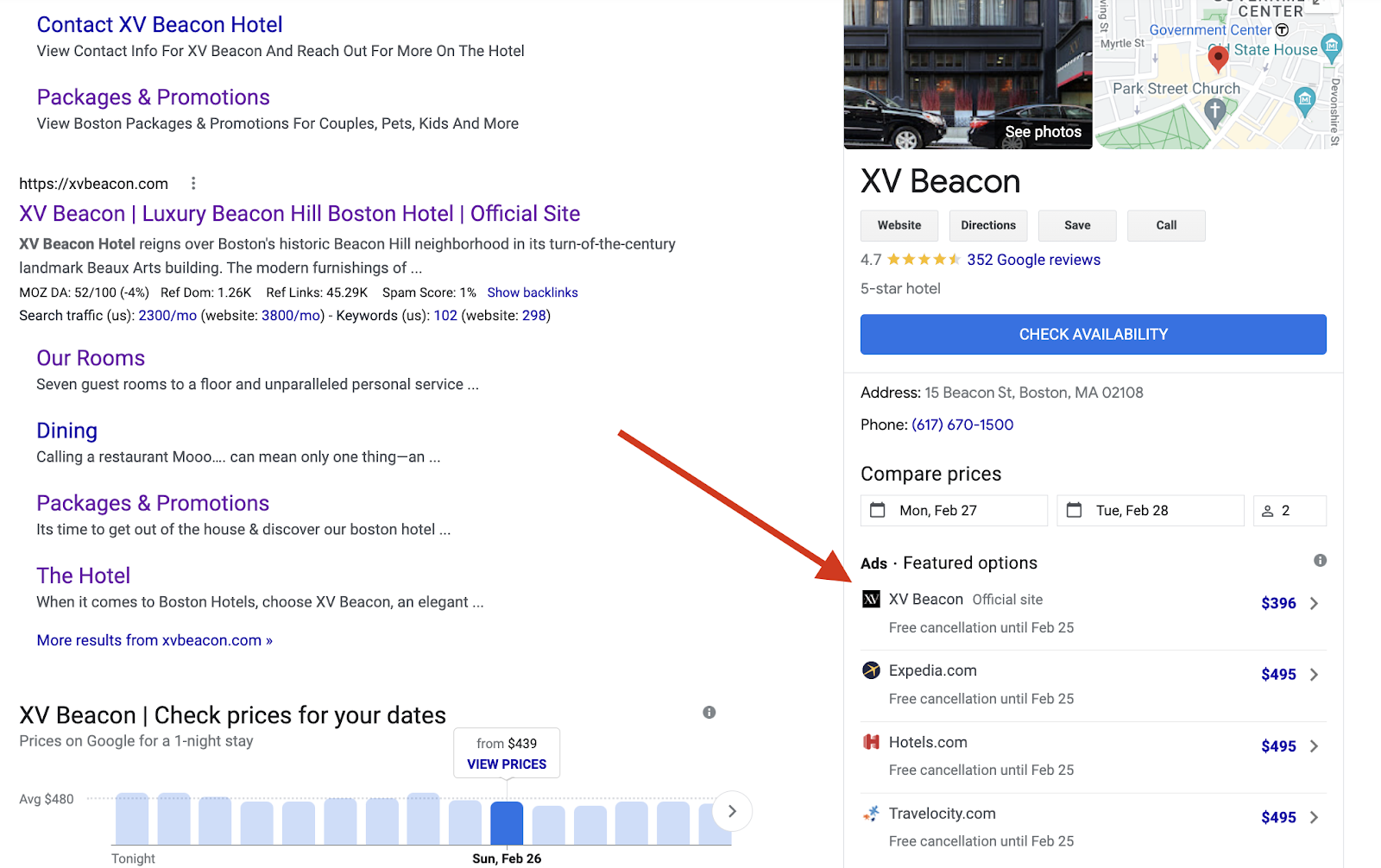
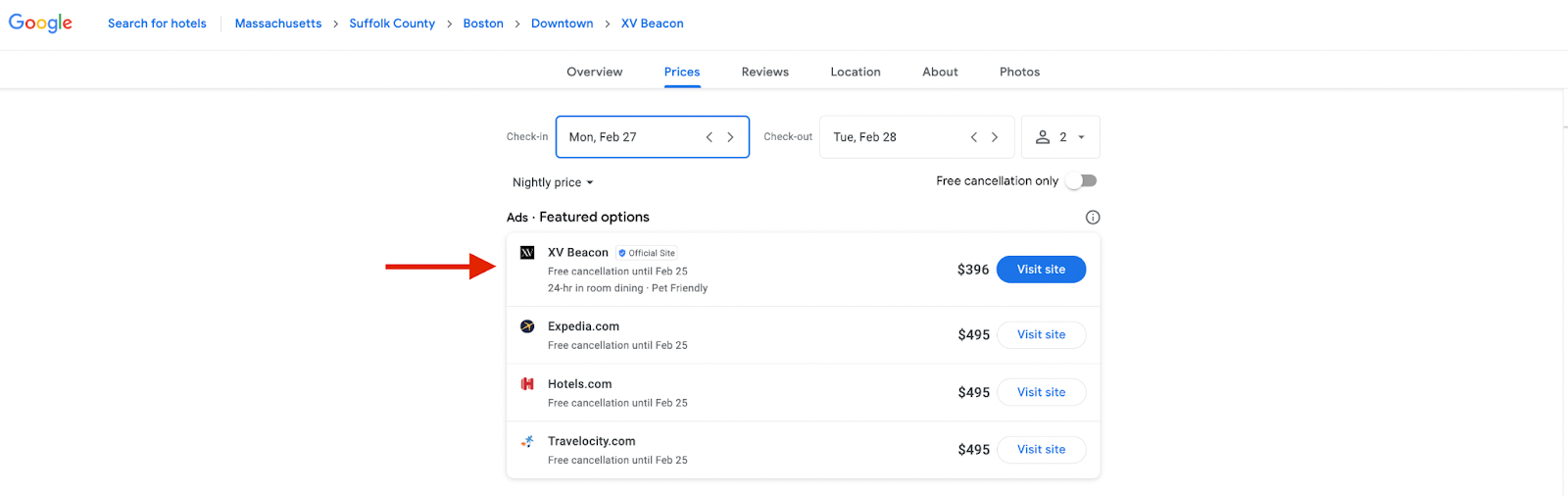
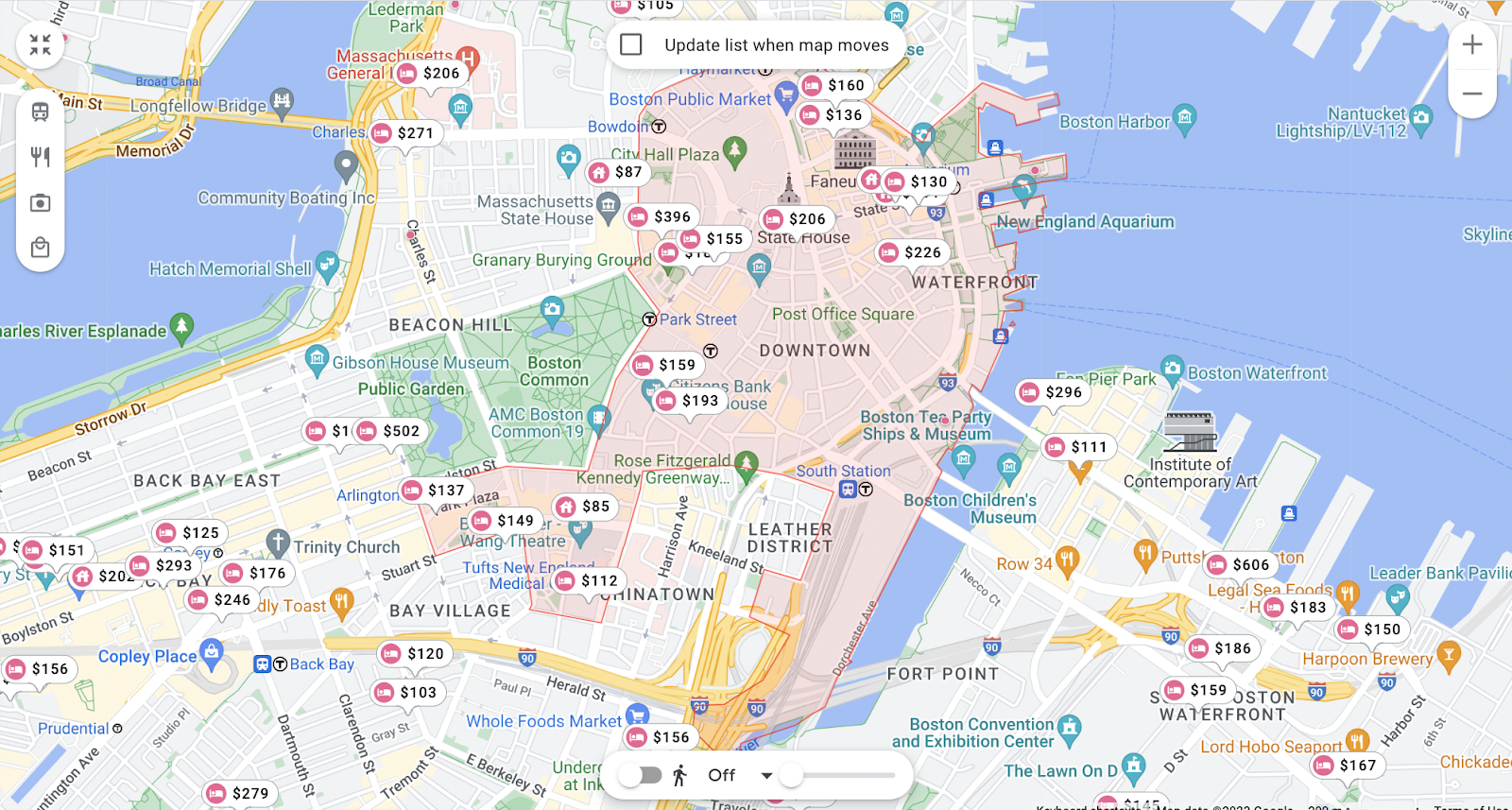
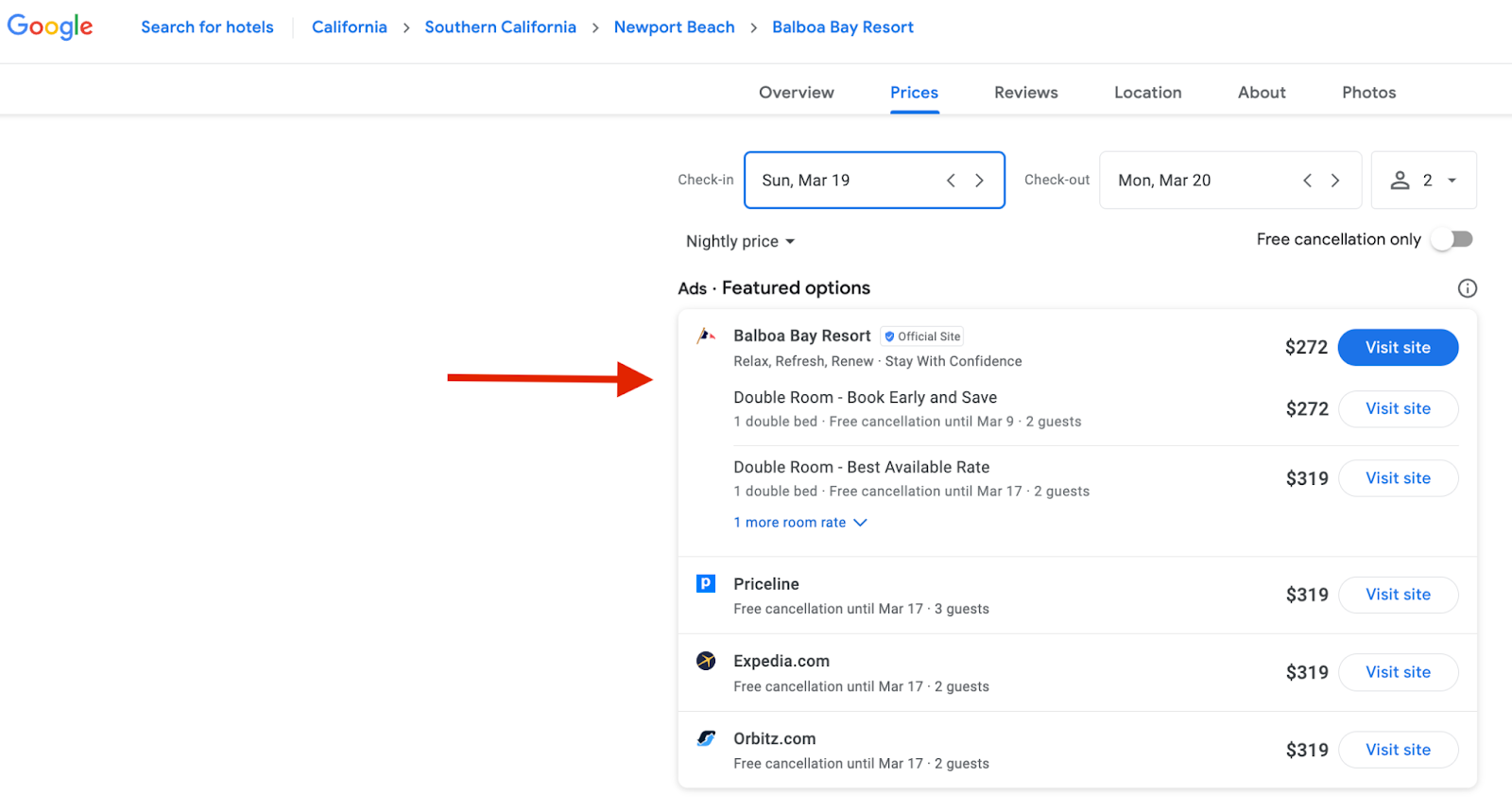
Google Hotel Ads can be found under the knowledge panel in the main search engine results page (SERP), within Google’s travel planner and within Google Maps/Local Map Packs.
Google Hotel Ads in Knowledge Panel on SERP Shown Below:
Google Hotel Ads in Google’s Travel Planner Shown Below:
Google Hotel Ads in Google Maps Shown Below:
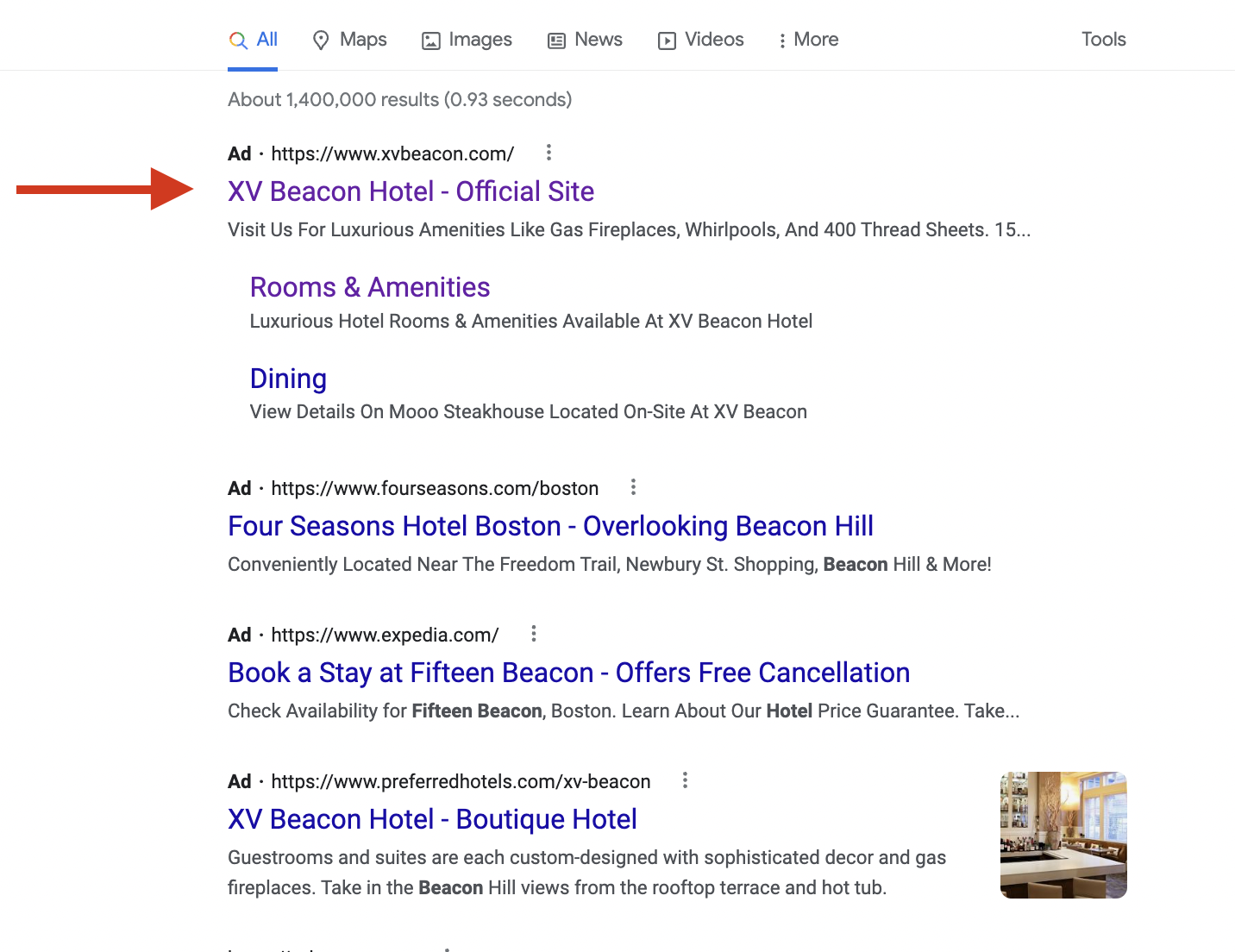
Google Paid Search Ad placements only appear within the Google SERP at the top and sometimes bottom of the page: (unless you are opting to advertise on Google’s Search Partner Network then they can appear on a number of other sites OR if you’re participating in local search campaigns that can appear on Maps)
Google Paid Search ads in Google’s SERP Shown Below:
Google Hotel Ads campaign types don’t use keywords for targeting
Unlike standard Paid Search campaigns, there is no keyword targeting option associated with Google Hotel Ads campaigns. You’re limited to geographic targeting, some different bid modifier options and 1st part audience targeting options.
Google Hotel Ads campaigns can’t utilize Google’s in-market and affinity audiences
One feature that Google has enhanced within Google Ads over the years (to compete with Facebook audience targeting) is a robust list of in-market and affinity audiences. These audiences group users together that have shown intent to be in-market to purchase something (like travel to San Diego) or have an affinity (like for outdoor sports) based on their online behavior. While Google paid search campaigns allow you to target or exclude in-market, affinity and 1st party audiences (website visitors, customer database lists), Google Hotel Ads only give you the option to target/exclude your 1st party audience lists.
There are workarounds on using 3rd party data providers as audience lists but they must be imported as a 1st party audience type. Our hope is that this changes in the future but for now it’s limited.
Google Hotel Ads has different bid modifier options
Google Hotel Ads offers bid modifications on different segments than standard paid search campaigns. Since it’s specific to hotel accommodations inventory searches bid modifiers in Google Hotel ads campaigns includes:
Geo-Location
Device
Length of Stay
Check-in day of week
Date Type
Advance booking window
Audience lists
Check-in date
Out of the above list, the only overlaps with Google Paid Search Ads are geo-location, device and audience lists
Google Hotel Ad types contain different content
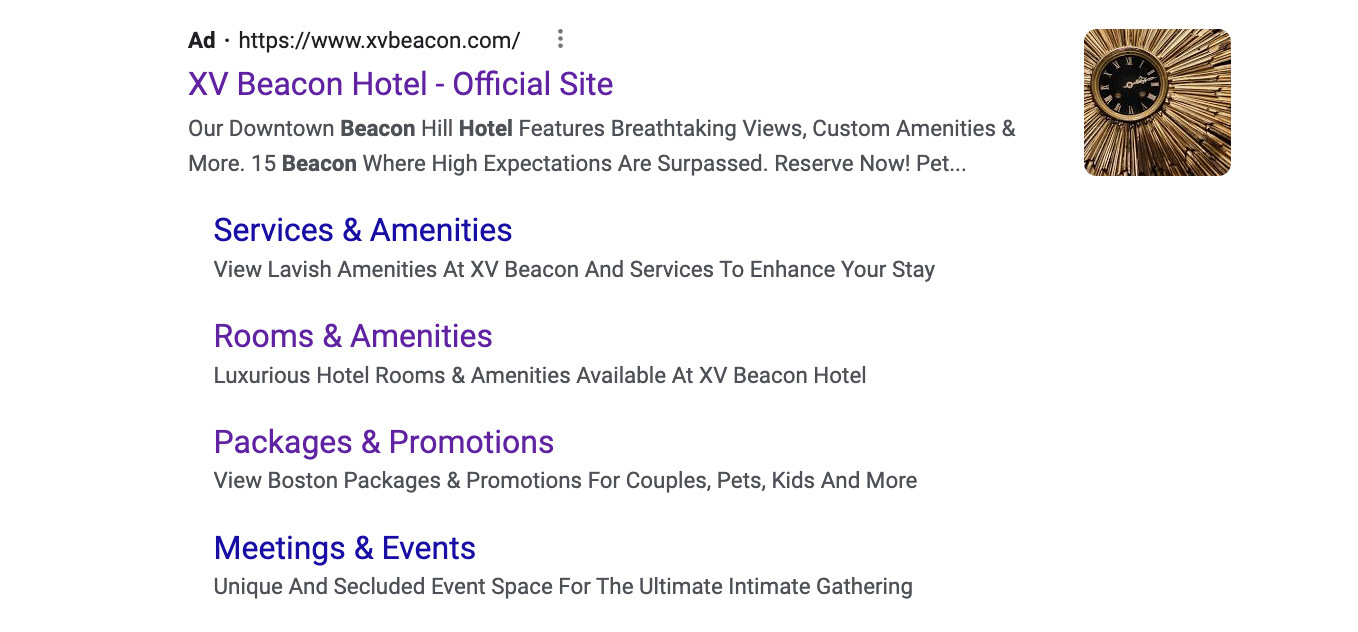
As you can tell from the screenshots in #2 above, visually Google Hotel Ads and Google Paid Search ad types contain different content. The components of a Google Hotel Ad are different than a Google Paid Search Ad.
Google Hotel Ads contain:
Rates/Prices
Call Outs for Marketing Messaging (via Call out Extension)
The example below for Camelot Inn & Suites shows Family Friendly and Scooter Rentals for the official site ad and Free Cancellation for the OTA ads
Room Type Bundles (sometimes)
Sometimes, if Google decides and you’re in the top position they will show room type bundles with different room types/rates
Google Hotel Ad example:
Google paid search ad components that are most applicable to hotels include:
Headlines
Descriptions
Display URL
Extensions that can include
Image (seen below)
Sitelinks (seen below)
Promotions
Structured Snippets (amenities list)
Call outs (same as seen in hotel ads)
Location
Call
Lead form
Google Paid Search Ad example:
Google Hotel Ads uses a completely different quality score rating system
Google Ads quality score is what all great account structures are built around. It is the holy grail of optimization. For keyword based Google paid search campaigns quality score is calculated based on 3 components: Expected click through rate (CTR), Ad relevance and landing page experience. Improve your scores in these three areas and the reward is lower CPCs. When you are limited on budget, it’s imperative to have it go as far as possible and by lowering CPCs and driving more clicks you’re giving your client more clicks with chances for more conversions.
Google Hotel Ads relies on different components for quality score rating. Price accuracy and price competitiveness factor into Google quality score calculation for Google hotel ads. Price accuracy comes down to making sure the rates and inventory feed from your booking engine/CRS to Google ads is as accurate as possible. If the rate shown in the ad doesn’t match the rate shown on the booking engine landing page then your price accuracy score will be negatively impacted. If Google continues to see issues with price accuracy, you risk your hotel ads campaigns being turned off. The other piece is price competitiveness. The less competitive your price is compared to OTAs, the more it will cost you for the same placements. Parity is important for all direct booking strategies but takes center stage in Google Hotel Ads.
How Can I Tell if My Hotel is using Google Hotel Ads?
Not sure if your hotel is currently using Google Hotel Ads? I recommend reaching out to your digital marketing agency or booking engine/CRS to inquire. Not all searches for your hotel will show an “official site” Google Hotel Ad, even if your hotel is currently live on Google Hotel Ads. This comes down to impression share and optimization focus. Not all impressions are created equal and you want to optimize your campaigns to prioritize impressions to those more likely to convert. You can go to your hotel’s listing in Google Travel Planner to try and view your official site ad. If you do see it, it will show with the default Google Hotel Ads green icon or preferably, your hotel’s own logo.
Should my hotel be advertising with both Google ads campaigns and Google Hotel ads campaigns?
The answer is Yes! If your hotel isn’t present on both Google Hotel Ads and Google Paid Search Ads then you’re missing out a huge opportunity to drive more direct bookings for your hotel. If you’re not advertising here, the OTAs already are and they are capturing the wealth of bookings that are driven from these campaigns. Participating with both of these campaign types also makes sure you are visible throughout the Google ecosystem where travelers are searching for hotel accommodations.
Do you have questions on how you can get started with either Google Hotel Ads or Google Paid Search Ads? Reach out to one of the GCommerce experts today for a consultation.
Digital Marketing 101 Series: What is SEO & Paid Search?
SEO and paid search can be complex and difficult to understand. In this article, we will cover the differences and similarities between the two.
Let's first get an understanding of what each of these terms means.
What is SEO?
SEO (search engine optimization) is used to increase a website's page ranking (visibility) and conversion value within the organic listings in the search engine results page. Having your website rank high within the search engine results page doesn't come easy. However, as there are a wide variety of competitor websites that are also manipulating components that help to improve page rank. Moz explained how this is done in their "Mozlow's Hierarchy of SEO Needs." In it, they explain that:
1. Crawl accessibility is the most important because if your website can't be indexed, then it can't be seen by Google or searchers.
2. You must have relevant, accurate & high-quality content on your website.
3. You should optimize your content with high search volume keywords that are accurate to what your website is about.
4. The website should offer a great user experience, from page load speed to ease of use.
5. Your website should include content that people will share or use in their own posts, websites, etc. This helps to produce links to your website.
6. You should optimize your page titles, meta descriptions, h-tags & more with specific keywords that have a decent amount of search volume that are relevant to what is on the web page.
7. Last are structured snippets. These allow you to stand out in the search engine results page.
What is Paid Search Marketing?
Paid search marketing ads use keywords to target a specific search intent but are paid for by the companies that are posting the ads. These ads are composed of carefully crafted headlines, 90 character descriptions & ad extensions.
What are the differences between SEO & Paid Search?
Now let's discuss the differences between the two areas of digital marketing.
Where Do Organic Listings and Paid Search Ads Appear on the SERP?
The first major difference is where and how each of the listings shows up on the search engine results page. Organic listings appear below the ad section on the search engine results page. Where they show up after the ads are based on a variety of ranking signals that search engines use within their algorithms. An ideal organic listing looks like this:
Paid search ads will normally appear in the top 3-4 positions on the page, if there is sufficient competition to warrant that many positions, and the bottom 2-3 positions. The ads rank (position on the page) and number of times that it is shown are determined by Google through something called quality score, which you can learn more about here, and how much each advertiser is willing to bid on the keywords. An ideal ad looks like this:
How Long Does it Take To See Performance From SEO and Paid Search?
Another major difference is the amount of time it takes to see an impact on website performance.
It can take 4-6 months or more after implementing SEO changes to see an impact on performance, but even this can't be guaranteed. While no one knows exactly how Google's algorithm works, we know that Google has to discover your new page content and analyze numerous other ranking signals to understand your page's authority on the topic versus all over pages on the web. This process takes time, and even after all of that, it can still be hard to see results since there are so many outside factors to take into account, such as competition, property changes, consumer reviews, and more.
On the other hand, paid search ads can show results the moment that you create them, just as long as there is a budget in your account. This is because ads are instant. They can instantly appear at the top of the search engine results page, are instantly accessible, and accurately track impressions, clicks, etc., back to the keyword that triggered the ad.
What are the similarities between SEO & Paid Search?
On-Page SEO & Paid Search Ads Share Messaging Components
SEO elements and paid search ads share similarities as well as differences when it comes to the actual content. A similarity between the two is that they should highlight key competitive advantages that your property has over its competition. This could include anything from an award-winning spa experience to the hotel's location. Maintaining a consistent, unified message across all channels is an important marketing strategy.
SEO & Paid Search Can Share Keyword Focus
Each of these marketing methods uses the same keywords, which are aimed at directing searchers to your website. Keywords used in Google Ads are implemented through headlines and descriptions that give you results almost instantly. Keywords used in SEO are implemented through page titles, meta descriptions, alt tags, etc., and as far as we know can take up to 6 months to show an impact on performance. This is where keywords from Google Ads can be helpful to your SEO efforts. You can test keywords in your ads, see how they perform and then use the best-performing keywords in your SEO. By doing this, you will also begin to match your keyword focuses on your page to that of your ads which improve your landing page experience and ad relevance. This, in turn, improves your quality score and helps you achieve a lower CPC.
Conclusion
Paid Search and SEO are two search engine marketing methods used to produce visibility for a given company's website by catching its audience's attention. Still, they also show up in different locations on the page and are monitored differently in terms of performance. Using these marketing methods hand in hand is a powerful tool, though, and should be used in order to improve a website's performance.
If a customer asked what your hotel’s story was, would your response include things such as a number of accolades, the year the hotel was built, or a number of high-profile guests?
Or, does your hotel’s story incorporate the customers that visit you every day, how they find you, and how you make their vacation unforgettable?
For years, our company’s stories have involved details about our history, who makes the decisions, and the thread count of our sheets. As community marketing changes to become more and more integral to a brand’s success, redefining our stories and the way we present them transforms alongside it.
First, we’ll start with redefining the focus of your story. Instead of placing your hotel at the center of the story, we’ll start with the customer. When we start with the customer, we begin to redefine the way we write facebook posts, talk to guests, and talk internally about the experiences we provide customers. By putting the customer at the center of your story, customers begin to see that your property cares about them and their experience first, over your own long standing history. Who is your customer? Why do they really visit your hotel?
Next, any good story involves a journey, or a problem to fix. In the “Bee Movie”, that problem was the theft of honey by humans. For your hotel, the challenge might be to find a secluded place that doesn’t feel all that different from home, even when your guest is all the way across the country from family. When defining your customer’s journey, think about the stories you’ve heard from customers, the things that have pleasantly surprised them, and the things that most often get talked about in reviews. These things are often insights into the true reason a customer visited you, and what problem you solved for them.
Finally, your main character needs a way to solve their problem. That’s where you and your brand come in - as the guide that shows them the way to where they need to go. As a guide, it’s your job to prove that you have the skills and experience to take the customer to the place they want to end up. Proving this reputability comes in the form of all the things we touched on in the first place – things like years of service, your fundamental advantages (LTSCAs), and accolades.
Through your expertise, you can now provide your customers with the roadmap to get to where they want to go, via booking a room at your hotel, calling to speak with reservation staff, or begin to browse room types and amenities. Providing this pathway gives your customers a clear direction to solve the problems they came to your hotel to fix in the first place – but now they feel as if they’re the center of your story and have a guide to take them to where they want to be.
How does this actually look in practice? It can be as simple as a rearranging of the words and concepts you use. Consider this example:
“Built in 1903 and a winner of multiple awards, our hotel is uniquely situated to provide a historic, yet luxurious getaway where you will feel your needs are not just met, but exceeded.”
“On your journey to find a hotel where your needs are not just met, but exceeded, our hotel’s 100-year history and reputation for service make us your only option for the getaway you truly deserve.”
Not only does this change of mind give a new lens to write material externally, but it also gives us an opportunity to redefine the way we talk about our customers and story internally as well. When customer-facing staff understand more about your brand’s story through the lens of the customer and your role in helping them arrive at their destination, it can help change the way our employees see their role.
By putting the customer first, we prioritize our connection with them and build long-lasting relationships that form the foundation of our community and drive our growth.
Not sure where you should start to define your hotel’s story? GCommerce is standing by to help guide you through this journey.
Have you been wondering about how to start advertising on TikTok and what your options are?
If so, then our recently released ebook A Crash Course To TikTok Ads, is just what you need. Inside, you'll find comprehensive answers to your questions.