The Power of Brand Collaborations

SHARE:

That "brand X brand" construct is such a fun and effective way to inject fresh excitement into your established brand or borrow some instant equity/credibility for your new one. Collaborations can serve as badly needed awareness boosters and do wonders for expanding your natural marketing footprint.

Importantly, collaborations are particularly effective at both underscoring what your brand is all about (through the strategic platform and value alignment) or challenging folks to think about you in a whole new way (sometimes, value "misalignment" can really turn thinking upside down).

Last, they don't have to be forever. Sometimes "limited time only" messaging is great for forcing immediate consumer action.

We’ve been thinking a lot about collaborations lately. Our client, The Hermitage, has two significant platform-aligned relationships; one with Reese Witherspoon's Draper James brand and the other with Chef Jean-Georges. Both collaborations say a lot about what The Hermitage stands for and underscore its enduring relevance in a super-hot Nashville hotel market.

In fact, their collaboration with Draper James is all about burnishing their long-term rep as THE Nashville hotel, with a foot in both the past and present. Draper James' platform — classic Southern contemporary yet timeless Southern style — conjures up the kind of gracious living and Nashville legacy The Hermitage has always been about.

https://www.nfocusmagazine.com/dining/the-hermitage-hotel-and-draper-james-form-a-splendid-partnership/article_acb26ef6-3608-11ec-9f7d-dfd8c288b596.html

That it's also a feminine construct makes Draper James the truly perfect match for the hotel's unique-to-Nashville experience.

Then we ran across this terrific piece on the wisdom of collaborations written for the AMA by Jaime Klein Daley, VP of Strategy at NYC brand shop CBX: https://www.ama.org/marketing-news/from-gaga-to-goldfish/ Her piece is CPG-centric, but it's definitely educational and inspired us to go further down that rabbit hole. We thought we should share.

Another defining collaboration comes courtesy of our client Eau Palm Beach Resort & Spa. In reimagining what once was the Ritz-Carlton, they collaborated with designer Jonathan Adler to actively challenge how people thought about traditional Palm Beach luxury.  Adler's "irreverent luxury that refuses to subscribe to established rules" design philosophy was the perfect take Eau needed to communicate their "new-fashioned" brand platform that promised prospective guests the chance to experience Palm Beach in a truly modern, unconventional way.

https://www.architecturaldigest.com/gallery/jonathan-adler-eau-palm-beach-resort-slideshow

So, Eau Palm Beach Resort & Spa is a great example of using somebody else's brand equity to help you immediately communicate what your brand-new brand is all about.

There are so many ways for hotels to use a good collaboration that go even beyond The Hermitage's Draper James Afternoon Tea experience and specially designed ditsy floral pattern, and Eau's Adler distinctive room designs.

You can also create activations, adventures, curations, ongoing content plays, pop-ups, and packages. Or maybe a signature room or suite, music or movie playlists, cocktails, and itineraries at the property or for around town. The opportunities are seemingly endless, and we’re sure there are new ideas to be had that nobody has thought of yet. But here are a few links to articles we have saved over the last couple of years that lay out what some hotels are doing with their collaborations:    

https://www.voguebusiness.com/companies/the-next-era-of-brand-hotel-partnerships-fila-byredo-frame-loccitane

https://www.lemongrassmarketing.com/brand-collaborations-luxury-hotel/

A last but really important thought here: the key to collaborations isn't just about the lift you get from surfing somebody else's equity wave. It's also about fully leveraging your partner's earned and owned channels to grow our clients' exposure, eyeballs, email lists, and advocacy.

It's a move we’ll call "Other People's Media" which is so effective in stretching a small marketing budget for no additional media investment. Therefore, getting meaningful access to their platforms and databases is a crucial point in any collaboration contract (folks sometimes forget that part).

Moves like securing real estate on their website, shared digital display, joint PR releases, and emails, ensuring your collaborator mentions your property in print and on TV and podcast interviews, all social platforms, signed influencers, POS display in retail locations, shopping bag stuffers, on-location catalog shoots, and a developing a dedicated line of merchandise named for the hotel. That integrated approach is really where you squeeze max value from these relationships (as is anything that can get first-party data).

That's a great — and fresh — marketing move that can reawaken the property's brand platform while extending the reach and efficiency of our marketing programs.
[E-book] 2022 Digital Marketing World Updates: Changes, What's To Come & Trends

SHARE:

The digital world is always changing and evolving and, as digital marketers, we get to be the trail blazers on how to use new channels, technologies and techniques.

In our latest ebook, we've compiled the top digital changes of 2022 so you too can leverage the latest and greatest tools in our space.

Click Here

Why You Should Be Using Google Business Posts

SHARE:

Introduced only in 2017, Google Business posts are fairly new to the search marketing scene. But don’t let that fool you. Google Business posts can be an incredibly valuable tool for local SEO, and they shouldn’t be overlooked.

Many businesses ignore or give up on Google Business posts due to their lackluster performance when it comes to direct views and click throughs. However, there’s a hidden benefit to sticking with it. While Posts may not be overwhelmingly successful on their own, posting somewhat regularly can improve your rank in Google’s algorithm, causing your Google Business Profile to be shown more often and generating awareness for your business. 

What Are Google Business Posts?

Google Business Posts can cover a variety of topics, with post types including “Events,” “Offers,” the open-ended “What’s New,” and more. These posts appear as part of your Google Business Profile listing, showing in both Maps and the standard Google results page.

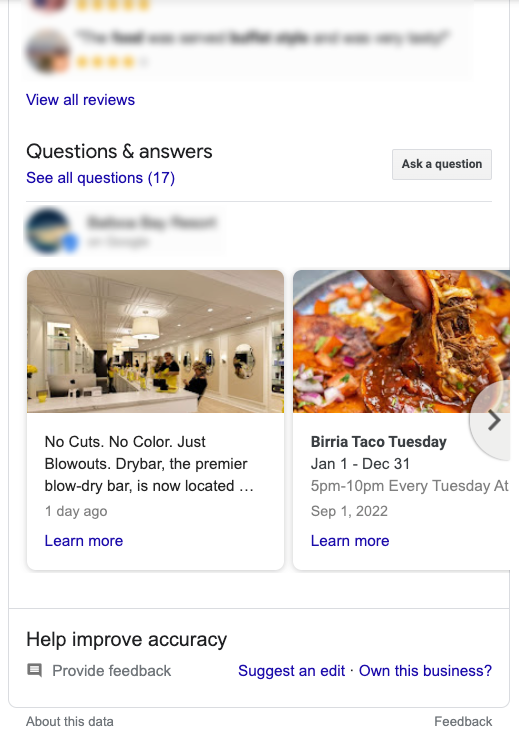
Here’s an example of a “What’s New” and “Events” post on the general results page. 

Every post type is a little different, but each one offers a number of optional call-to-action buttons, such as “Learn more” and “Order online,” as well as the option to add an eye-catching image. 

All post types will disappear from your Google Business Profile eventually, which is why it’s so important to post regularly.

Putting Google Business Posts To The Test

Below, we’ve compiled data to help determine whether Google Business posts are worth the time and effort. 

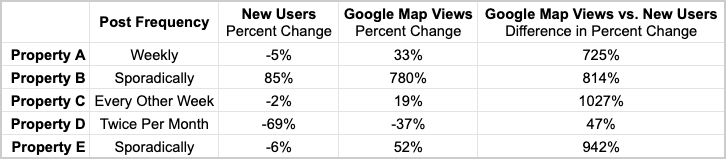
This test was conducted across 5 boutique hotels, comparing user metrics between the 3 months before and after we started using Google Business Posts. While exact post frequency varied, each property posted at least once per month during this test, using a variety of “What’s New” and “Event” posts. 

“New Users” was pulled from Google Analytics, and only includes traffic from the Source/Medium combination of google / organic. Google Map Views was provided by Yext, a platform for managing Local SEO listings. 

While “Google Map Views” did not always increase (likely due to external factors such as seasonality and search volume), the change in performance for this metric was significantly better across all 5 properties than the change for “New Users.” These differences are not insignificant either, providing fairly convincing evidence that regular Google Business posts will increase your standings in the Google algorithm and lead to more awareness. 

Key Takeaways About Google Business Posts

If you aren’t using Google Business posts, you should start now. While they may not bring in a ton of traffic on their own, they’re an incredibly effective, and fairly easy, way to increase your business’ visibility on Google. 

GCommerce Solutions has already incorporated Google Business posts into our arsenal of standard Local SEO tactics, and we encourage you to do the same. If you’re interested in learning more about Google Business posts or other Local SEO tips, check out the rest of our digital marketing blog or contact us below.

An Overview of Google’s Helpful Content Update

SHARE:

Google's big push with it’s latest algorithm update, named the helpful content update, is taking aim at pages that are solely produced for search engines and not users.  A lot of this targets pages with content auto-generated by AI writing apps or not providing original content/value on whatever the page topic is about. GCommerce’s SEO and content recommendation focus has always been with an emphasis on creation for people but making sure to use SEO best practices as outlined by Google. I think this article by Google really outlines how any website should think about Google’s helpful content update in an easy-to-understand format. 

Our suggestions remain the same as they have been. That pages should have rich, original content, and then the content provided should also integrate SEO optimization best practices based on Google's guidelines to position the page in the best way to achieve success in the SERPs (and avoid crazy performance issues when algorithm changes occur). We never attempt "black hat" tactics or tactics geared solely at search engines without first considering the value to someone coming to the site looking for the type of product or search topic we are optimizing that page for. If you have used auto-generated/AI content or simply created pages with low-value content for the sake of search engine ranking and it doesn't provide value to someone researching that topic, then we would recommend updating it or removing it from your site.

Want to understand if your site is impacted by Google’s helpful content update as it rolls out over the next couple of weeks? Since it is an update that adds the signal as one of the many signals Google uses in the algorithm. The best place to monitor overall performance continues to be within Google Search Console performance reports. You can also add another layer of reporting by monitoring your positions through a platform such as SEMRush and keeping an eye on your Analytics organic traffic. 

This update by Google was maining focused on eCommerce product sites and entertainment-related sites as you can tell by some of the language used in it’s Google update/release article, but I think it's a great reminder for all businesses across any industry that it's important to optimize their site experience and content for users while also making sure to follow SEO best practices for optimization. We’ve always viewed the two (optimizing for people and great SEO best practices) to have a ton of overlap if done correctly. 

Have questions or think your site may have been impacted? Please reach out to our search experts with any questions.

3 Underutilized Google Ads Optimization Tips For Hotels

SHARE:

The number one rule of search marketing is to never stop testing. You never know where you’ll find the next golden goose, so it’s important to try new things and reach outside of your comfort zone. GCommerce Solutions knows this, and we’re not afraid to experiment with lesser-known optimization methods to make sure we’re achieving the best possible results. 

Below, we’ve compiled test data for 3 often underutilized Google Ads optimization techniques. These tests were conducted over 2-3 months each, using data from 9 boutique hotels spread across the United States. 

Implement A Paid Search Ad Schedule

Consumers don’t interact with your business the same way all the time, so it’s a good idea to tailor your hotel’s paid search ads to your audience’s schedule. 

While the data below measures account-level changes, paid search ad schedules work best when tailored to an individual campaign’s performance. This is how paid search ad schedules were implemented for these 3 hotels: 

Branded Terms:

+10% bid adjustment on days/times with high conversions

-50% bid adjustment on days/times with low clicks and low conversions

0% bid adjustment on all other times, so ads always have the potential to serve

Non-Branded Terms:

+10% bid adjustment on days/times with high clicks/impressions

-50% bid adjustment on days/times with high average CPCs but low clicks and low impressions

0% bid adjustment on all other times, so ads always have the potential to serve

Percent Change By Paid Search KPI:

Account-Level, Period Over Period

Overall Paid Search Ad Schedule Results:

All Key Performance Indicators (KPIs) saw an average increase in performance.

Conclusion:

Regardless of your hotel’s marketing goals, an ad schedule can be a helpful addition to your Google Ads campaigns. If you’re willing to put in the time and effort to create and monitor an ad schedule based on individual campaign performance, this is a great way to give your KPIs a boost.

Keyword Optimize Your Paid Search Ad Paths

Ad paths are an often overlooked part of paid search marketing, but it’s worth taking the extra step to optimize them and make your ads more relevant. 

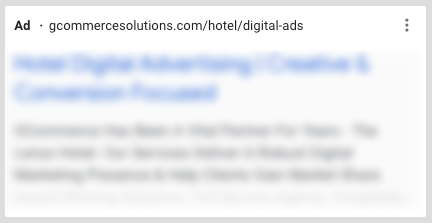
Paid search ad paths show up as part of the display URL of an ad. In this example, “hotel” is display path 1 and “digital-ads” is display path 2.

This test was performed using single keyword ad groups. Every single ad in the account received optimized ad paths based on the ad group’s associated keyword.

Percent Change By Paid Search KPI:

Account-Level, Period Over Period

Overall Keyword Optimized Paid Search Ad Paths Results:

All KPIs saw an average increase or no significant change in performance.

Conclusion:

This is another helpful optimization tip for various paid search account goals, and requires far less maintenance than an ad schedule. Editing ad paths can be tedious, but it’s worth using every single inch of space you’re given to optimize performance. Just be sure to keep up with paths, adjusting as needed when creating new ads or copying existing assets.

Don’t Neglect Negative Keyword Research

Positive keywords can help you reach new people, but that doesn’t mean they’ll be new customers. Negative keyword research is an effective safeguard to ensure you’re not putting paid search budget towards the wrong audience. 

This test included generalized keywords like “X Rated” and “Apartment,” as well as hotel-specific keywords such as competitor names and inaccurate locations. Every negative keyword was added with an “Exact” match type.

Percent Change By Paid Search KPI:

Account-Level, Period Over Period

Overall Negative Keyword Research Results:

Raw actions and revenue saw an average decrease in performance, but interaction rate and comparative revenue saw an average increase.

Conclusion:

Depending on your goals, well-thought-out negative keyword research can be incredibly effective for paid search campaigns. By design, negative keywords decrease the visibility of your ads, so they can lead to less overall traffic. However, this traffic is often very qualified, and will interact with your business at a higher rate to maximize your account budget. 

Key Takeaways

There are so many available paid search optimization tools, and it’s a shame to see them go to waste. If you’re willing to put in the work, the above Google Ads optimization tips are likely to work in your favor, despite their somewhat uncommon utilization. Results are never guaranteed, but tailoring these changes to specific campaign performance is a great opportunity to push your KPIs in the right direction.

If you’re interested in learning more about paid search for hotels, check out the rest of our digital marketing blog or contact us below.

The Cookieless World is already here. Are you ready?

SHARE:

Over the last few years, the big players like Google and Facebook have been warning that they will be moving to a cookieless world. And really, we are already living in a cookieless world when you consider the deprecation of 3rd party cookies on Mozilla and Safari as well as Apple’s iOS updates.

The way we measure performance has already changed to support the cookieless world. GCommerce has tested the difference between Google Analytics 4 and Google Analytics Universal in how it captures data, and on average Google Analytics Universal is missing about 40% of revenue data. This shows that the cookieless world is already here.

Read our eBook for specific action items you can do today to be sure your marketing doesn’t suffer.

Download E-Book

  • This field is for validation purposes and should be left unchanged.

Keep Reading