The hospitality data platform: What it means and why hotels should care

SHARE:

The hospitality data platform: What it means and why hotels should care

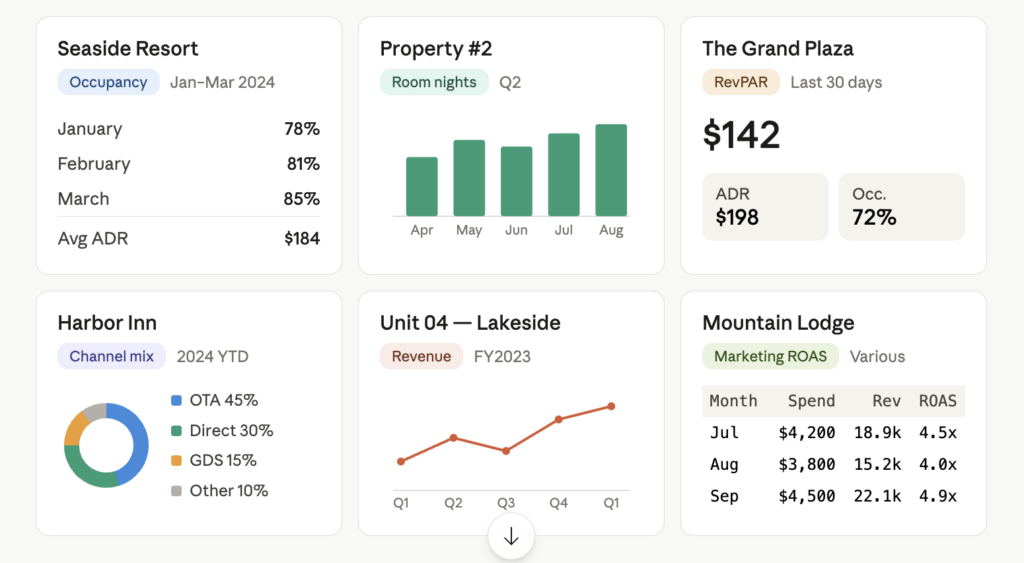
Every hotel marketer knows the challenge. There’s more data than ever, but it lives everywhere and connects nowhere. Media reports sit in one dashboard. Booking data is stored in another. Benchmarks arrive by email. Guest behavior is buried in CRMs. The result is a fragmented view that makes decision-making harder than it should be.

The hospitality data platform changes that. It is more than a reporting tool. It is an intelligent infrastructure built to unify the information that drives performance—media, bookings, operations, and market insights—into a single, connected ecosystem.

This is the difference between visibility and intelligence.

When data is fragmented, opportunities slip through the cracks. Without unified insights, a property might overspend on paid search while missing retargeting opportunities. Multi-property groups can struggle to see where one hotel is outperforming another. And without accurate channel attribution, bookings may be credited to OTAs that could have been direct.

A hospitality data platform eliminates that disconnect. It gives hoteliers a complete, actionable view of performance across every level of their business.

What a hospitality data platform enables

See the whole picture
Access every layer of performance, from individual campaigns to portfolio-wide insights, in one centralized view.

Benchmark with confidence
Compare performance against market peers, property types, and channels using real-time hospitality benchmarks.

Respond faster
Spot shifts in demand early, adjust campaigns automatically, and align spend with the channels that drive profitable bookings.

Forecast smarter
Use predictive intelligence to anticipate demand instead of reacting to it after the fact.

More than connection—activation

A hospitality data platform does not replace your agency, booking engine, or CRM. It amplifies them. It brings each system into a connected framework where data powers every decision.

When media, revenue, and guest data work together, the conversation shifts from “what happened last month” to “what will happen next—and how can we act on it?”

This is what turns information into intelligence and strategy into growth.

Why it matters now

Competition from OTAs is rising. Media costs continue to climb. Guest expectations are evolving. Hoteliers who rely on disconnected systems will fall behind, while those who invest in unified data will lead.

A true hospitality data platform allows hotels and resorts to move from fragmented reporting to proactive performance management. It empowers teams to make faster, smarter decisions—and to increase direct bookings with clarity and control.

The future of hospitality intelligence

The hospitality industry doesn’t need more tools. It needs better connections between them. That’s what the hospitality data platform delivers: one source of truth, purpose-built for hotels, management companies, and partners who want to understand not just what happened, but what to do next.

It is the foundation for how hospitality marketing, media, and data will work together in the years ahead. And it is how GCommerce is helping hotels turn data into growth.

Ready to unify your marketing data and uncover the insights driving your next direct booking? Connect with GCommerce to learn how our Hospitality Data Platform brings intelligence, transparency, and performance together for hotels and resorts. Get in touch today.

From chaos to clarity: The new era of hospitality data transparency

SHARE:

The data paradox in hospitality

Hotels have never had more data at their disposal. PMS reports, CRS exports, Google Ads dashboards, OTA extranets, the list goes on. But more data hasn’t meant more clarity. Instead, it’s created chaos:

  • Reports that don’t align
  • Spreadsheets that eat up hours
  • Conflicting KPIs that leave leaders second-guessing decisions

For ownership groups, this chaos multiplies. Each property reports differently. Each channel measures performance in silos. Benchmarking becomes guesswork.

The shift toward transparency

Hospitality is moving into a new era: data transparency. Rollup tools now consolidate results at the property, portfolio, and channel level. Instead of drowning in fragments, hoteliers gain one coherent story of performance.

Transparency matters because OTAs already use their data advantage to optimize in real time. If hotels want to compete, they need to level the playing field with equally fast, clear insights.

What transparency unlocks

  • At the property level — Managers can see where campaigns succeed and fix weak spots quickly.
  • At the portfolio level — Owners can benchmark properties consistently and act with confidence.
  • At the channel level — Marketers can identify waste, prove efficiency, and reallocate spend.

Transparency turns data into action. It shifts reporting from backward-looking to forward-driving.

From burden to competitive edge

With transparent, unified reporting, hoteliers reclaim control. They can compete on strategy, not just budget. They can move faster, invest smarter, and grow stronger.

The era of chaos is ending. For hotels ready to embrace transparency, clarity is now within reach.

Discover how GCommerce can take your property’s data from chaos to clarity. 

Seeing the whole picture: Why channel-level data matters for hotel marketing

SHARE:

The blind spot in hotel marketing

Every hotel marketer faces the same dilemma: where should we put the next dollar? Paid search, metasearch, social, display, retargeting, video — the options are endless.

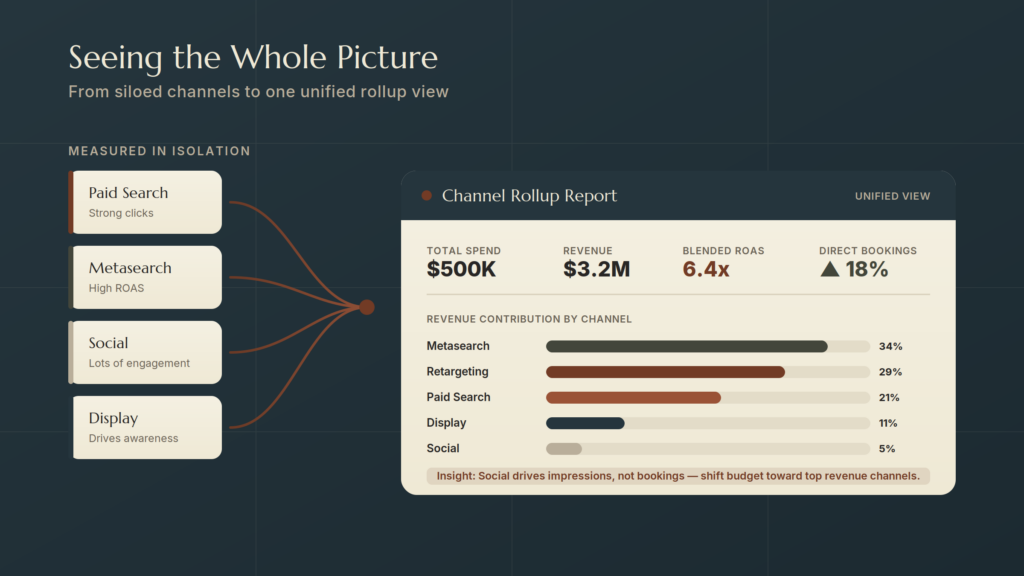
The problem is that channels are usually measured in isolation. Paid search may look strong on clicks, metasearch may boast high ROAS, and display may drive awareness. But without seeing all channels together, decisions are made in the dark.

Why channel rollups matter

Channel rollup reporting delivers the holistic view marketers need. By aggregating spend, clicks, conversions, and revenue into one clear framework, hotels can:

  • Pinpoint efficiency — Spot high-performing channels and amplify them.
  • Eliminate waste — Scale back underperformers draining budget.
  • Balance strategy — Ensure reliance on branded campaigns doesn’t mask gaps in unbranded visibility.
  • Test smarter — Evaluate emerging channels fairly against proven ones.

The impact in action

Consider a marketing director managing $500,000 in annual spend. On paper, social campaigns look strong — plenty of engagement. But when rolled up against other channels, social is driving impressions without bookings. Meanwhile, metasearch and retargeting are generating the majority of revenue.

With this insight, even a 10% budget reallocation could significantly boost returns.

Stretching budgets further

Hospitality marketing is under constant pressure to deliver more with less. OTAs are spending aggressively across channels, making efficiency critical for independents and groups alike.With rollup data, marketers no longer just ask “what happened?” They can finally answer: What should we do next?

Contact GCommerce today to take the next step and receive channel rollups for your property.

How hotel groups can unlock portfolio-level benchmarking

SHARE:

The challenge of fragmented data

Hotel ownership groups and asset managers are awash in data. Every property produces reports on occupancy, bookings, marketing, and revenue. But because each property tracks and reports differently, it’s nearly impossible to compare results in a clean, consistent way.

The reality is that most reporting still happens at the property level. While useful, this creates blind spots when owners need to see the big picture.

Why portfolio benchmarking matters

Portfolio-level benchmarking changes the conversation from individual performance to collective insight. With a unified rollup, owners can:

  • Spot outliers — Identify top performers and struggling properties instantly.
  • Compare consistently — Measure ADR, RevPAR, ROAS, and direct booking share apples-to-apples.
  • Reallocate resources — Direct capital, staffing, or marketing investment where it will drive the greatest impact.
  • Build accountability — Ensure each property is held to consistent benchmarks, not arbitrary local standards.

A practical example

Imagine a 10-property portfolio. Eight hotels are delivering a healthy marketing ROAS, but two are significantly underperforming. With rollup benchmarking, those underperformers don’t get hidden in averages — they’re flagged for immediate attention. Owners can investigate if it’s a budget issue, a market dynamic, or an operational gap.

Meanwhile, standout properties become models of best practice. If one property is generating exceptional direct bookings, owners can replicate that approach across the portfolio.

From reactive to proactive leadership

With portfolio-level data, ownership groups move from reactive reporting to proactive strategy. Decisions about where to invest, where to intervene, and how to grow are backed by transparency.

For hotel groups, the future is clear: portfolio-level benchmarking is no longer optional. It’s the foundation of profitable growth.
Contact us today to get started with your portfolio-level benchmarking.

Google Abandons 3rd Party Cookie Depreciation: What’s Next for Your Hotel

SHARE:

Updated: Instead of simply pushing the data for 3rd party cookie depreciation again, Google announced that they will no longer phase out third-party cookies in Chrome. While this may seem like a big sigh of relief for advertisers and publishers, it’s important to note that even though they are abandoning this move, Google is proposing a different approach that will also impact your ability to target users and track conversions. Similar to the move Apple made a few years ago, Google’s alternative plan is to give Chrome users a new, informed choice when it comes to their privacy settings.

Chrome users will get new privacy control options. “Users can set their privacy preferences to apply across their web browsing activities”. Although the full impact of this change is unknown, there is an assumption that as users are presented with more control options around their privacy settings, that more will opt-out of cookie tracking, and it will be harder to track and reach these audiences. Google continues to test Privacy Sandbox APIs, and in the long term, many still expect 3rd party cookies to phase out and be replaced by different technology. 

GCommerce recommends clients continue to focus on ways it can prepare for a more privacy centric web experience. As users opt-out of tracking and our ability to retarget and track all conversions continues to grow, it’s important to focus on growth strategies around 1st party data and truly understand where your audience is spending their time online to understand the best channels to buy media and gain awareness to potential guests. 

Here are a few things to consider for your hotel in a more privacy centric web:

1. Focus on 1st party data collection for retargeting - although conversion tracking gets harder as users opt-out of tracking, the larger concern falls around retargeting and getting your ads in front of the right audience. Consider Facebook lead gen campaigns and on-site email capture forms.

2. Dive into your guest CRM data and develop a robust customer profile to help guide your targeting and media placement decisions.

3. Set up a Consent Management Platform on your site - also known as a cookie banner, these ensure you can control how cookies track visitors on your site as they pertain to local privacy law compliance (think GDPR for European visitors and CCPA for California).

Tip: Go with a Google certified CMP like CookieYes or OneTrust to easily enable Google Consent Mode. This helps platforms like Google Ads and GA4 estimate and model conversions even as visitors opt-out.

Some of the links on this page are affiliate links. This means that if you click on the link and make a purchase, GCommerce may earn a commission at no additional cost to you. We only recommend products or services we believe will add value to our audience.

4. Use Keyword targeting intent across platforms on Google Search and beyond - continue to lean on the specific intent that keyword targeting in search provides. But did you know you can also use keyword targeting across other media types? Consider testing contextual targeting in display, and TikTok just rolled out search campaigns using keyword targeting on its platform. 

5. Test new audience targeting partners that generate audiences based on 1st party data, such as Adara, Azira, Navigator, and more.

Need help creating a privacy centric hotel marketing strategy? Reach out to GCommerce Solutions today.

Google Consent Mode Updates

SHARE:

In the coming weeks, Google will launch consent mode v2. This is an update to their consent mode tag setting that allows your website visitors' cookie preferences to be passed via their selections on your domain’s cookie banner/consent management platform to Google’s suite of ad products, such as Google Ads and Google Marketing Platform. You can learn more about the details of consent mode here

The update supports “Google’s ongoing commitment to a privacy-centric digital advertising ecosystem” and means that “advertisers must adhere to the EU consent policy to use ad personalization” to target visitors based in the EU and UK. If your website does not comply with the consent mode requirements, you can only continue to serve ads on Google platforms that are not personalized, such as remarketing ads, to people located in EU and UK countries. 

If targeting users in these countries is critical to your business, a thorough policy structure around GDPR and how to comply with advertising policies in these countries should be something you work through with your legal teams and roll out to any marketing providers assisting with your advertising.

How can I enable consent mode?

The first step to enabling Google’s consent mode is to set up a consent management platform on your site. A consent management platform, also sometimes called a “cookie banner,” allows website visitors to choose their preferences around what is collected via cookies and sent to Google platforms such as Ads and Analytics. 

Using one of Google’s certified consent management platforms means the platform's settings will be updated so you can enable consent mode across Google products.

If you already have a content management platform, make sure you go into settings and enable consent mode.

If you don’t already have a consent management platform, Google has a list of official providers that can support your domain’s consent management needs. You can find the full list of Google-certified CMPs here. GCommerce recommends OneTrust as a CMP and can assist with setting up/integrating it onto your site, but there are many choices available for you to select from to help with your company’s consent mode compliance needs. 

Once you’ve set up your CMP, work with the provider to enable consent mode settings and alert GCommerce so we can assist with any necessary Google Tag Manager steps.


You can learn more about Google’s updates to consent mode here.

Keep Reading