The hotelier’s guide to AEO: How hotels and resorts should approach AEO for real ROI

SHARE:

How hotels and resorts should approach AEO for real ROI

Answer engine optimization is changing how travelers discover hotels and resorts, often before they ever reach a traditional search result. As AI-powered tools increasingly summarize, recommend, and compare properties on a traveler’s behalf, visibility now depends on how clearly your property can be understood, not just how well it ranks. 

For hotels and resorts focused on increasing direct bookings, AEO is becoming a critical extension of hospitality marketing, hotel metasearch, and Google hotel ads performance. This guide outlines a practical approach to AEO that prioritizes clarity, consistency, and measurable ROI, helping properties influence AI-driven discovery while supporting stronger downstream conversion.

What is answer engine optimization (AEO) for hotels?

Answer engine optimization (AEO) is the process of structuring hotel content and data so AI tools, search engines, and answer engines can clearly understand and recommend your property.

Why AEO matters for hotels and resorts

  • AI tools now recommend and compare hotels before users visit websites
  • Visibility increasingly happens before a traditional search click
  • AEO supports:
    • Direct bookings
    • Hotel metasearch performance
    • Google hotel ads performance
    • Brand discovery
  • Hotels must focus on clarity, consistency, and structured information

How hotels should approach AEO: 10 practical steps

1. Start with accurate, structured property data

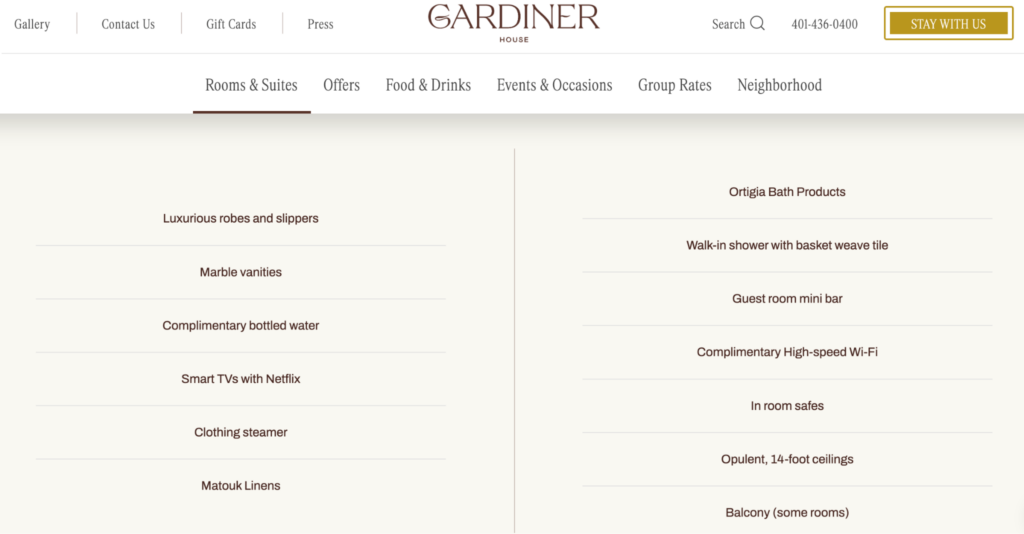
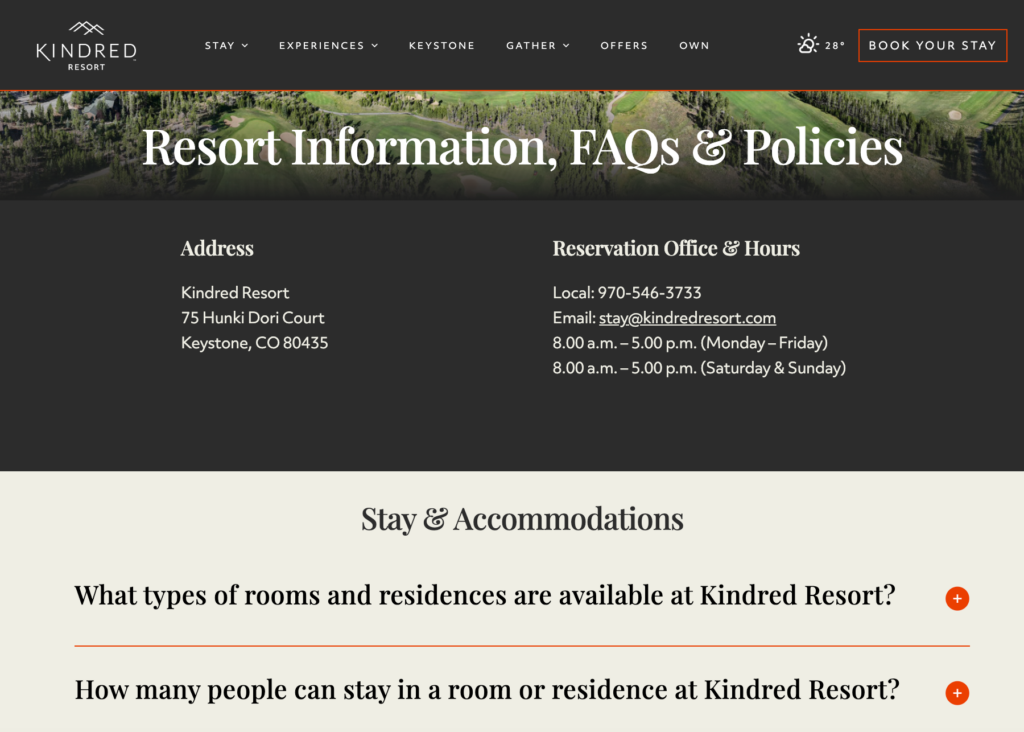
Hotels should ensure their core property information is consistent, complete, and well-structured across all platforms where they appear. This includes key details such as amenities, policies, location, room types, and booking information, all of which help AI systems understand and present the property accurately. 

Since AI tools rely heavily on structured data, inconsistencies can reduce visibility, while clean and reliable data increases the likelihood of being recommended in answer-driven search results.

Important property data for AEO

  • Hotel amenities
  • Policies (check-in/out, pets, parking, etc.)
  • Location and nearby attractions
  • Room types and bed configurations
  • Property descriptions
  • Booking engine information

Why this matters

  • AI tools rely on structured data
  • Inconsistent information reduces visibility
  • Clean data improves AI confidence in recommending your property

2. Optimize for AI answers, not just search rankings

Answer Engine Optimization (AEO) is about positioning your content so it’s directly used to generate answers, not just listed as a link in search results. Instead of competing purely for rankings on results pages, AEO prioritizes becoming the source that platforms like Google Search, ChatGPT, or Microsoft Copilot pull from when delivering concise, conversational responses.

How to structure hotel content for AI

  • Use clear headings
  • Answer traveler questions directly
  • Write clear, unambiguous descriptions
  • Avoid vague marketing language
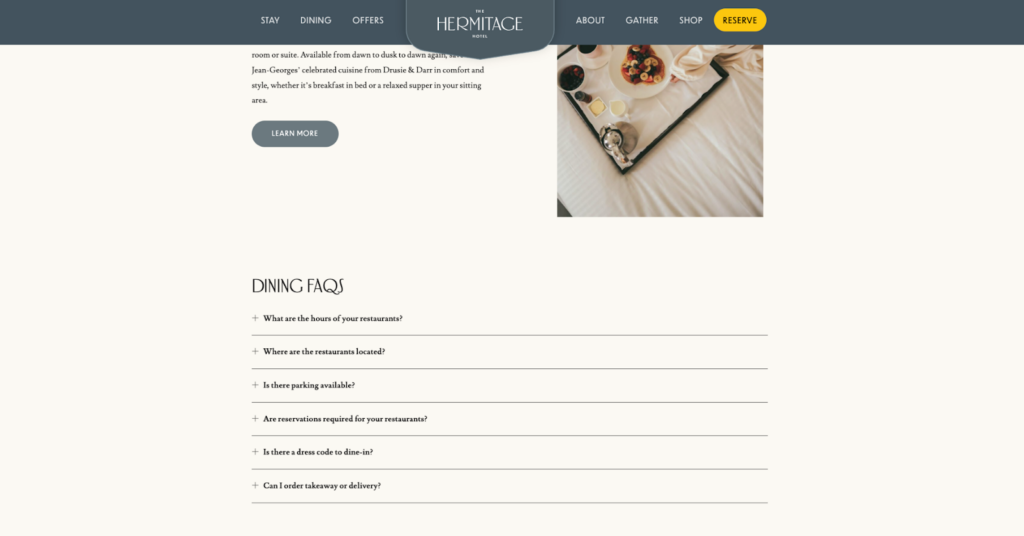
  • Use structured sections and FAQs

Why this matters

  • Visibility often happens before a click
  • AEO influences early discovery in the traveler journey

3. Prioritize high-intent traveler questions

Hotels should create content that directly answers the questions travelers are actively searching for, such as location details, amenities, policies, and who the property is best suited for. By addressing these high-intent queries clearly and directly, hotels can align their content with how people naturally search and how AI systems retrieve answers. 

This matters because answer engines prioritize content that resolves user questions efficiently, helping attract more qualified travelers who are closer to making a booking decision.

Common traveler questions to answer

  • Where is the hotel located?
  • What amenities are available?
  • What are the hotel policies?
  • Who is this hotel best for?
  • Is the hotel good for families, couples, business travelers, etc.?

Why this matters

  • Answer engines prioritize content that directly answers questions
  • High-intent content brings more qualified travelers into the booking funnel

4. Connect AEO with hotel metasearch performance

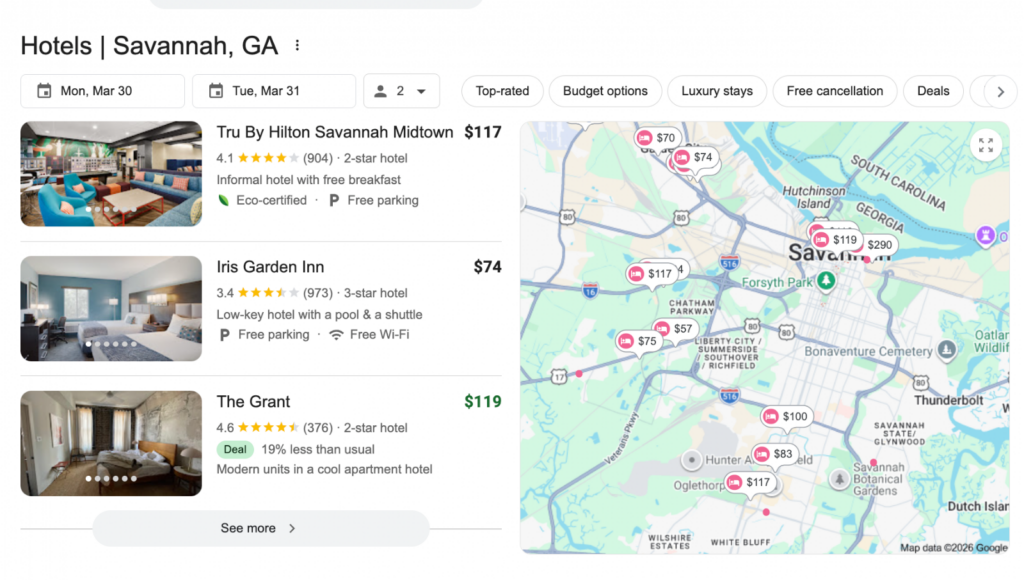
AEO and hotel metasearch should be viewed as complementary strategies, where visibility in AI-driven answers helps drive demand that metasearch platforms can capture and convert. 

When AI tools recommend a hotel, it increases brand searches, which in turn boosts engagement and performance across metasearch channels, including stronger results in platforms like Google Hotel Ads. This matters because AEO builds awareness and intent at the top of the funnel, while metasearch turns that demand into direct bookings and measurable revenue.

How AEO supports hotel metasearch

  • AI recommendations increase brand searches
  • Brand searches increase metasearch engagement
  • Metasearch performance reinforces visibility signals
  • Google hotel ads' performance benefits from stronger brand demand

Why this matters

  • AEO generates demand upstream
  • Metasearch converts that demand into direct bookings

5. Use structured FAQs to support answer engines

FAQs are one of the most effective AEO tools.

Hotel FAQ examples for AEO

  • What time is check-in?
  • Is parking available?
  • Is the hotel pet-friendly?
  • How far is the hotel from downtown?
  • Does the hotel have a pool or gym?
  • What type of travelers is this hotel best for?

Why this matters

  • FAQs provide clear answers AI can quote directly
  • Improves visibility without redesigning your entire website

6. Maintain consistency across platforms

Answer engines pull information from multiple sources. Maintaining consistency across platforms is critical because answer engines don’t rely on a single source; they aggregate, compare, and validate information from across the web.

Consistency goes beyond just name, address, and phone number (NAP). It includes how you describe your offerings, key amenities, brand positioning, and even the language used to answer common questions. The more aligned these elements are across platforms, the easier it is for AI systems to recognize your brand as a reliable, authoritative source.

Platforms that must stay consistent

  • Hotel website
  • Booking engine
  • OTAs
  • Google Business Profile
  • Metasearch listings
  • Social media profiles

Why this matters

  • Inconsistent information reduces AI confidence
  • Consistency improves accuracy and visibility

7. Treat AEO as ongoing infrastructure, not a one-time project

AEO should be treated more like infrastructure than a campaign. It requires continuous input, monitoring, and refinement to stay effective. Content that performs well today may lose visibility if it becomes outdated, less relevant, or is outperformed by clearer, more structured alternatives.

Ongoing AEO tasks

  • Update amenities and policies
  • Refresh FAQs
  • Add new traveler questions
  • Update location and attraction content
  • Monitor branded search growth
  • Review metasearch performance

Why this matters

  • AI visibility improves over time with consistent updates
  • AEO is infrastructure, not a checklist

8. Partner with hospitality-specific marketing expertise

Hospitality marketing is different from general digital marketing. That’s why GCommerce Solutions has been a trusted digital marketing agency exclusively for the hospitality industry. 

Why hospitality expertise matters for AEO

  • Hotel distribution is complex
  • Metasearch and booking behavior are unique
  • Direct booking strategy matters
  • Data and performance signals influence visibility

Why this matters

  • Generic AEO strategies focus on visibility, but miss how that visibility converts into bookings and revenue
  • Industry-specific data signals, like pricing, availability, and reviews, directly impact how answer engines determine relevance and visibility

9. Measure AEO success using downstream performance metrics

AEO performance should be measured by business results, not vanity metrics. Focus on indicators like qualified traffic, conversion rates, direct bookings, and revenue impact to understand its true value.

Key AEO performance indicators

  • Growth in branded search
  • Hotel metasearch performance
  • Google hotel ads performance
  • Direct booking conversion rate
  • Cost per booking
  • Revenue from direct channels

Why this matters

  • AEO influences booking behavior indirectly
  • Success shows up in revenue and performance metrics

10. Build for clarity, not hype

The best AEO strategies focus on clarity and structure. Content that is straightforward, well-organized, and easy to interpret is far more likely to be selected and used by answer engines than content that prioritizes buzzwords or complexity.

AEO principles for hotels

  • Clear data
  • Structured content
  • Consistent information
  • Useful answers
  • Traveler-focused content
  • Ongoing updates

Why this matters

  • AEO rewards clarity and structure, not marketing buzzwords
  • Clear, well-structured content makes it easier for answer engines to extract, trust, and surface your information in high-intent traveler queries

Ready to improve how your property shows up in AEO-driven discovery?

An AEO strategy only works when it is grounded in accurate data, clear content, and hospitality-specific expertise. GCommerce’s  AI Visibility Audit helps hotels and resorts identify gaps in visibility, consistency, and structure across their digital presence, with clear recommendations tied to direct bookings, hotel metasearch, and Google hotel ads performance. Submit your audit request now.

Frequently asked questions about AEO

What does (AEO) look like for hotel marketing?

Answer engine optimization (AEO) for hotels and resorts is the process of structuring the property’s website content, property data, and FAQs so AI tools and search engines can clearly understand and recommend the property in generated answers. Unlike traditional SEO, which focuses on ranking pages, AEO focuses on being included in AI-generated answers, travel recommendations, and conversational search results.


How is AEO different from SEO for hotels?

SEO focuses on improving rankings in traditional search results, while AEO focuses on helping AI tools and answer engines understand and summarize your property information. Hotels need both SEO and AEO. SEO drives website traffic, while AEO improves visibility in AI-generated answers, travel-planning tools, and conversational search results that often appear before users click through to a website.


How can hotels optimize their website for AEO?

Hotels can optimize for AEO by structuring their website content clearly, answering common traveler questions, maintaining accurate property data across all platforms, and creating structured FAQ pages. Consistency across the website, booking engine, OTAs, and metasearch platforms is critical so AI tools can confidently understand and recommend the property.


AEO vs GEO for hotels and resorts: What’s the difference?

SHARE:

AI is reshaping how travelers discover hotels and resorts. Traditional search rankings still matter, but AI-powered answer engines and generative platforms are changing how visibility works.

For hospitality marketing leaders focused on increasing direct bookings, understanding the difference between AEO and GEO is no longer optional. It is foundational.

This guide explains how answer engine optimization and generative engine optimization differ, how they connect to hotel metasearch and Google hotel ads, and how hotels and resorts can apply both strategies without overcomplicating their tech stack.

What is AEO for hotels and resorts?

Answer engine optimization, or AEO, is the practice of structuring content so AI-powered answer engines can quickly interpret and surface it in direct responses.

When a traveler asks, “Which hotels in Denver have rooftop pools?” an AI tool scans structured, trusted sources to provide a concise answer. AEO ensures your property’s content is clear, factual, and formatted in a way that increases the likelihood of being referenced.

For hotels and resorts, AEO focuses on:

  • Clear FAQ sections
  • Structured property details and amenities
  • Consistent descriptions across platforms
  • Accurate location and policy information

AEO supports hospitality marketing by improving visibility in conversational and voice-based search experiences before the traveler ever clicks a traditional result.

What is GEO for hotels and resorts?

Generative engine optimization, or GEO, focuses on how AI models synthesize and regenerate information about your property.

Instead of pulling a short answer, generative engines create narrative responses such as:

“Top boutique hotels in Austin for couples include properties known for walkable locations, spa amenities, and curated dining experiences.”

GEO ensures your property’s value proposition, positioning, and differentiators are clearly written so generative AI tools can accurately represent them.

For hotels and resorts, GEO emphasizes:

  • Clear positioning statements
  • Context-rich descriptions
  • Defined audience segments
  • Structured storytelling grounded in factual data

GEO extends traditional SEO into AI-generated environments where content is summarized, blended, and rephrased.

AEO vs GEO: What is the core difference?

The difference comes down to retrieval vs regeneration

  • AEO helps AI retrieve and display factual answers
  • GEO helps AI generate accurate, narrative summaries

AEO supports discoverability in direct answer formats. GEO shapes how your property is described in broader AI-generated recommendations.

Both influence awareness. Both shape perception. And both ultimately support direct bookings and AI search visibility when executed strategically. 

Why AEO and GEO matter for direct bookings

Direct bookings depend on visibility, trust, and clarity. AI-driven discovery now plays a role in all three.

When your property appears in AI-generated answers:

  • Travelers gain confidence before comparing rates
  • Branded search demand increases
  • Hotel metasearch performance strengthens
  • Google hotel ads benefit from improved engagement signals

AEO and GEO do not replace hotel metasearch or paid search. They influence the demand that later converts through those channels.

For hotels and resorts working with a hospitality marketing agency or digital marketing agency, integrating AI visibility strategies into broader hospitality marketing plans ensures alignment between discovery and conversion.

How AEO connects to hotel metasearch and Google hotel ads

AEO operates at the top of the funnel. Hotel metasearch and Google hotel ads operate closer to conversion.

When AI tools confidently surface your property:

  1. Branded search demand increases
  2. Travelers search by property name
  3. Hotel metasearch listings receive higher intent traffic
  4. Google hotel ads capture conversion-ready users

The impact is indirect but measurable. Improved branded demand and engagement signals strengthen overall channel efficiency.

This is where data becomes critical. Centralized performance data enables hotels and resorts to connect AI-driven visibility with downstream revenue outcomes.

How GEO strengthens hospitality marketing strategy

GEO ensures that when AI tools summarize travel options, your property’s positioning remains accurate.

Without GEO:

  • AI may default to third-party descriptions
  • Outdated OTA copy may shape perception
  • Differentiators may be diluted

With GEO:

  • Your value proposition remains intact
  • Amenities and experiences are clearly represented
  • Audience targeting aligns with traveler intent

For a marketing agency for hotels and resorts, GEO becomes an extension of brand governance in AI environments.

Do hotels need separate teams for AEO and GEO?

No. AEO and GEO share the same foundation:

  • Structured, centralized property data
  • Clear, concise website content
  • Performance accountability tied to revenue
  • Consistency across digital marketing channels

Hotels and resorts do not need separate initiatives. They need an integrated hospitality marketing strategy supported by a reliable data infrastructure. Across the industry, many use the two acronyms (AEO and GEO) interchangeably, because there is a lot of overlap in approaches and essentially they are similar strategies. 

As highlighted in our brand and data platform strategy, intelligence only creates value when connected to activation.

How to get started with AEO and GEO without overhauling your property website

Hotels can take practical steps immediately:

  1. Expand FAQ sections with concise answers
  2. Clarify property descriptions to reduce ambiguity
  3. Standardize amenity and policy language
  4. Align website messaging with paid search and hotel metasearch campaigns
  5. Connect booking data with marketing performance reporting

These updates improve AI visibility while reinforcing conversion performance across hotel metasearch and Google hotel ads.

No full redesign required. Just clarity, structure, and consistency.

Final perspective: AEO and GEO are not trends. They are visibility layers.

For hotels and resorts focused on increasing direct bookings, AEO and GEO represent new layers of digital marketing strategy.

They shape discovery before the click. They influence perception before comparison. They strengthen the channels that convert demand into revenue.

When grounded in structured data, integrated reporting, and performance accountability, AEO and GEO become strategic advantages, not marketing experiments. And for hospitality leaders, that clarity makes all the difference.

Frequently asked questions about AEO

How can hotels measure the impact of AEO and GEO on digital marketing performance?

Hotels can measure the impact of AEO and GEO by tracking increases in branded search demand, engagement rates, and conversions across hotel metasearch and Google hotel ads. When AI-driven visibility improves, properties often see higher click-through rates, stronger direct booking performance, and more efficient paid media spend.


What type of content supports both AEO and GEO strategies for hotels and resorts?

Content that is clear, structured, and consistent performs best. FAQ sections, detailed property descriptions, and standardized amenity and policy pages help AEO, while storytelling, positioning, and audience-focused messaging strengthen GEO. Together, they create a unified hospitality marketing approach that supports both discovery and conversion.


Can independent hotels compete with large brands using AEO and GEO?

Yes. AEO and GEO level the playing field by prioritizing clarity, relevance, and structured data over brand size. Independent hotels and resorts can improve visibility in AI-powered search by maintaining accurate information, aligning messaging across digital marketing channels, and leveraging hotel metasearch and Google hotel ads to capture demand once it’s generated.


How to rank your hotel higher on Google

SHARE:

Getting your property to the top of the search engine results page (SERP) can increase traffic to your website and net more direct bookings. Google understands that users are most likely to use their search engine and click on results when they can trust they’ll find what they’re looking for, whether it’s an ad or an organic result. To get your property to the top of relevant searches, you need to implement strategies that show Google that your site has exactly what its users want: helpful, reliable, quality, people-first content. 

Google is invested in serving technically sound, quality landing pages that match the context of a user’s search. Users trust Google to deliver highly relevant search results full of landing pages that are easy-to-navigate and give them the experiences they’re looking for. Maintaining this trust with its users is crucial for Google to keep its status as the most reputable and highly trafficked search engine in the world. With over 90% of the global search engine market share, demonstrable user trust is precisely what allows Google to attract its customers: the advertisers. 

At the end of the day, the real people providing value to your business are the same ones providing value to Google. So, to rank higher in Google search results, your site needs to demonstrate that it is precisely what those very real people you’re targeting are going to Google to look for.

Take a three-pronged, people-first approach to improve your search engine ranking.

  1. Ensure that your site has strong technical health.
  2. Optimize your site for helpfulness, reliability, and quality.
  3. Provide search engines and AI bots with signals for the context of the site.

Ensure that your site has strong technical health

Before Google can show your site, it needs to establish that the users it shows your site to will have a good experience. Users are more likely to lose confidence in search results when they experience page errors, slow page load speeds, difficult site navigation, and other technical errors from pages they’ve been served by Google, diminishing their trust in the search engine. To protect user trust, Google prioritizes serving sites devoid of major technical errors.

Keep your site free of major errors like the ones listed here to make certain that search engines and AI bots can reach your content.

  • Fix broken links and page errors like 404s.
  • Ensure search engine crawlers and AI bots are not blocked.
  • Maintain a clear, logical site structure with internal links and updated sitemaps.
  • Improve mobile friendliness and site speed.
  • Hide outdated content from the SERP.

A healthy site devoid of technical errors gives Google confidence that it’s serving users with a solid landing page experience and relays to AI systems that the information on the site is likely to be valuable and authoritative. Ultimately, Google sees sites with strong technical health as reliable for its users.

Optimize your site for helpfulness, reliability, and quality

At the heart of it, people go to Google to be connected with sources that are helpful, reliable, and get to the gist of their query. Design and optimize your site with the experience of the very real people that patronize your business in mind. Doing so will signal to Google that your site provides quality to users. 

Try these suggestions to improve your site’s content by optimizing for a people-first experience.

  • Use human-centered content and conversational, natural-sounding copy.
  • Expand content depth to provide helpful answers for your prospective guests.
  • Publish content surrounding your local area and particulars about your business.
  • Build itineraries and travel guides for people planning to visit your area.
  • Add thorough FAQ content, including a dedicated FAQ page, Q&A sections on key pages, and applicable schema markup.

Everything you do to your site should improve your user’s experience or make it easier for them to find your content. Google rewards sites that are more likely to be relevant, helpful, and appealing to users by pushing them to the top of search results.

Provide search engines and AI bots with signals for the context of the site

Optimizing for search engines/AI and for a people-first experience are complementary pursuits. You can provide signals directly to search engines and AI bots to tell them about your site and the content on your page. While implementing these signals, it’s important to center people-first practices to not sacrifice page quality. 

Give AI bots and search engines rich, contextual signals by using the following methods:

  • Practice traditional SEO strategies with a strong keyword focus and page element optimization.
  • Implement schema markup across your site and on FAQ content.
  • Regularly update the information on your social media accounts and local listings to ensure accuracy and clarity.
  • Practice PR-minded online behaviors by engaging with content about your property on social media, in forums, and across the web.
  • Keep an active online presence by responding to reviews in a timely manner, making use of Google Business Posts, and posting regular, unique content on social media and on your site.

Rich, contextual signals help search engines and AI bots to interpret your content with clarity and understand its relationship to user queries. By explicitly providing these signals, you make it easier for Google to match your property with relevant searches. These signals greatly incentivize Google to place you at the top of searches coming from users who are more likely to convert.

Is this approach still applicable with AI searches?

Yes, a people-first approach is still applicable in the age of AI. Google has even said so itself in its Google Search SEO documentation, “You can apply the same foundational SEO best practices for AI features as you do for Google Search overall: making sure the page meets the technical requirements for Google Search, following Search policies, and focusing on the key best practices, such as creating helpful, reliable, people-first content.” 

Google’s foundation of user trust has not changed. Neither has what the search engine considers to be a relevant, quality landing page. As such, a people-first approach is the best method to reach the top of relevant searches.

In your pursuit to rank your site higher on Google, the team at GCommerce Solutions is here to help. We can provide additional resources, audit your site to find how it currently matches up, and offer thorough, practical solutions to reach your goals, whatever they may be. Tell us what goals you’re pursuing, and we’ll find a way to help you achieve them.

The importance of guest sentiment and reviews in driving local SEO success for hotels in the age of AI

SHARE:

Customer reviews and star ratings have long been critical for local businesses, including hotels, shaping visibility in search results and influencing potential customers’ choices. While traditional search remains important, AI-powered tools such as Google AI Mode, Gemini, Perplexity, and ChatGPT are changing how reviews influence decision-making. 

Reviews no longer simply appear on a listing. They are analyzed, summarized, and highlighted, and play a direct role in influencing user perception. As customers increasingly discover businesses through AI-driven searches, ratings, and customer sentiment carry more weight than ever.

Why reviews and ratings matter in AI search for hotels

Positive reviews and high-star ratings boost your hotel's visibility in the local map pack, AI responses, and other search results, helping businesses stand out in competitive markets. Reviews act as digital word-of-mouth, giving potential customers confidence in their choices. AI tools amplify this effect by analyzing a wide range of customer feedback to determine which businesses to feature and provide users with an overview of customer opinions. Beyond search visibility and credibility, reviews provide actionable insights to guide business improvements. By using this feedback to make meaningful changes, businesses can earn better reviews and higher ratings over time.

Where your hotel’s reviews show up

Reviews and ratings appear across multiple platforms and features within the search engine results page. On Google, they appear on Google Business Profile and in organic search results. Sites like Yelp, TripAdvisor, and industry-specific platforms continue to build credibility through additional customer feedback. Reviews can also appear on official websites, online travel agencies, directories, Wikipedia, news sites, and in public conversations on social platforms such as Reddit. More recently, short-form video reviews from TikTok, YouTube, and Instagram have begun appearing in both traditional search results and AI-generated summaries. 

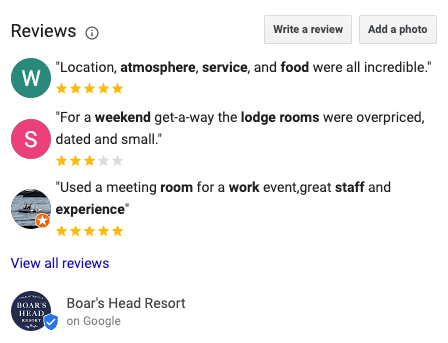
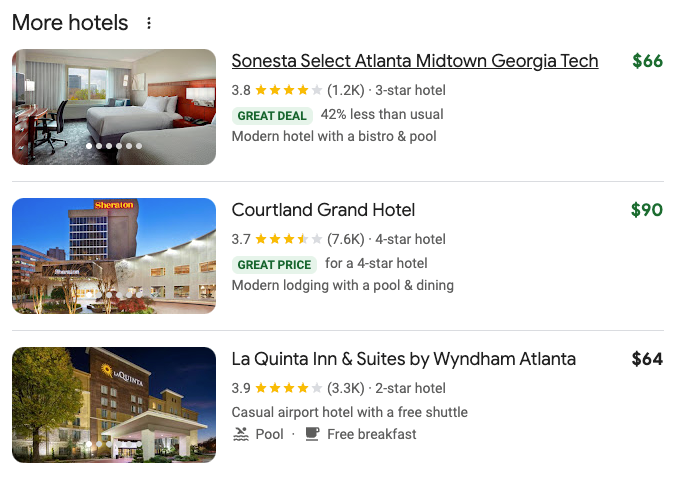
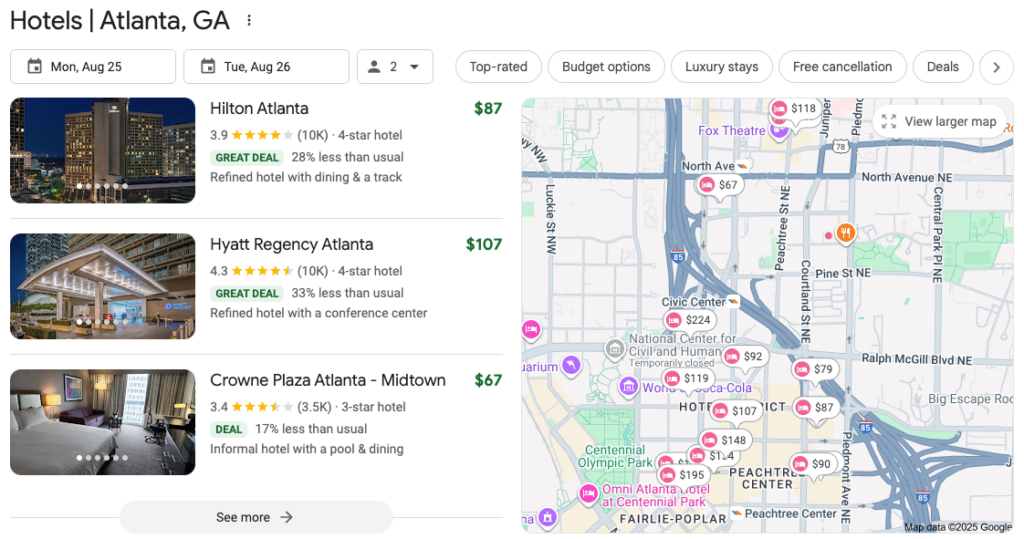
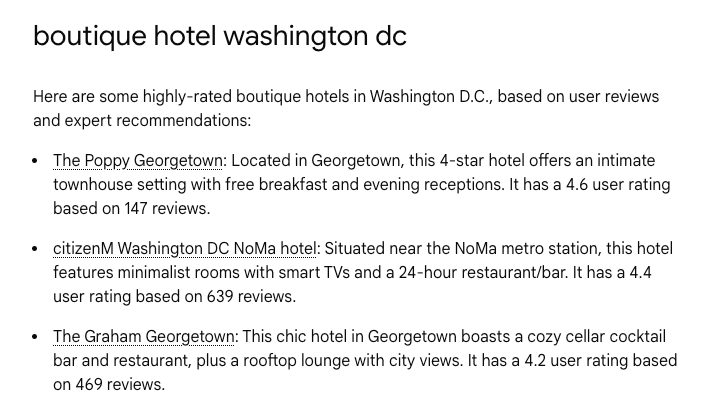
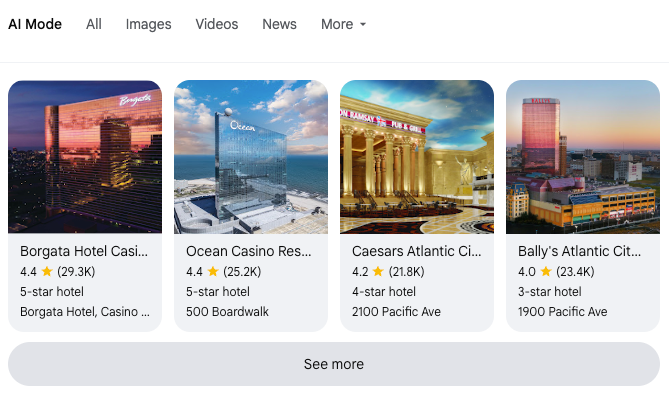
Businesses with higher ratings and positive feedback are more likely to be highlighted in AI-generated summaries. Google AI Mode, for example, may categorize businesses by rating and often displays clickable Google Business Profile cards showing both ratings and the number of reviews. ChatGPT can also pull top-ranked hotels or restaurants from third-party lists and awards, helping users quickly identify highly rated options.

Here are a few examples of hotel reviews appearing within search results:

Google Business Profile

Local map pack within Google search

Local map pack within Google Maps

AI Mode results showcasing review content

AI Mode cards featuring Google Business Profile

Why more quality reviews matter for your hotel in the age of AI

Increasing the number of high-quality, relevant reviews not only improves your hotel's credibility with potential guests but also strengthens its visibility in AI-powered search results. 

According to Google’s tips to improve your local ranking on Google, local search rankings are influenced by three primary factors: relevance, distance, and prominence. 

Prominence refers to how well-known a business is, and includes factors such as the number and positivity of reviews. As highlighted in Hospitality Net’s, "From Keywords to Conversations: The Ultimate Guide to Generative Search for Hotels," guest reviews are central to AI-generated rankings and should be actively managed to improve positioning across platforms like Google Search Generative Experience (SGE), ChatGPT, and Perplexity.

How to increase your hotel’s review count

A few key strategies to increase review count include:

  • Encourage customer feedback: Ask satisfied customers to leave a review shortly after a positive interaction while the experience is still fresh in their mind.
  • Simplify the process: Share direct links to Google or industry-specific platforms in follow-up emails, receipts, or text confirmations. The easier you make it to leave a review, the more likely people are to follow through.
  • Use signage and reminders: For in-person businesses, display QR codes at checkout counters to make the process seamless.
  • Give incentives with caution: Discounts, loyalty points, or giveaways can encourage participation, but must be used carefully and always within platform guidelines to avoid penalties or flagged reviews.

How to improve your hotel’s review ratings

High review ratings are closely tied to high-quality customer interactions. Delivering exceptional customer experiences will earn positive feedback and improve your rating. Thoughtfully responding to reviews by thanking customers for praise and addressing concerns in negative reviews can also improve sentiment and overall ratings. 

Our recommendations for how to respond to Google reviews may help your hotel utilize strategic responses that boost both ratings and search visibility. 

Local SEO and review management

Local SEO extends beyond guest reviews. AI tools and large language models (LLMs) evaluate both your hotel’s online listings and guest sentiment when determining visibility. Accurate, consistent listings across platforms like Google Business Profile, Yelp, and TripAdvisor build authority, while actively managing and responding to reviews helps strengthen your presence in AI-driven results. 

Read AI in hospitality marketing to learn more about optimizing local listings.

Conclusion

Reviews and customer sentiment are more important than ever for local SEO, especially in the age of AI-powered search. Actively managing your review rating by encouraging reviews, responding thoughtfully, and using feedback to improve business operations can enhance your hotel’s credibility, improve search visibility within both traditional and AI-powered results, and influence customer choices from the very first moment of search. 

Integrating review management into your marketing strategy is essential for staying competitive in today’s local and AI-driven search landscape.

To learn more about reviews, Local SEO, or AI-powered search, reach out to GCommerce today. 

Improving AI search visibility: A practical action guide for your hotel

SHARE:

We’ve all heard it by now. AI search is the future, and your hotel’s discoverability is becoming increasingly dependent on visibility within AI search results. But what can you do about it?

Like many other marketing channels, the factors that impact AI search visibility fall under a variety of categories and optimizations, requiring a comprehensive multi-channel strategy to achieve success. But don’t let that scare you! While AI search visibility isn’t an exact science, there are plenty of things you can do to improve your hotel’s standings.

Here’s our list of the most important actions to take when trying to improve your hotel’s AI search visibility.

At a glance

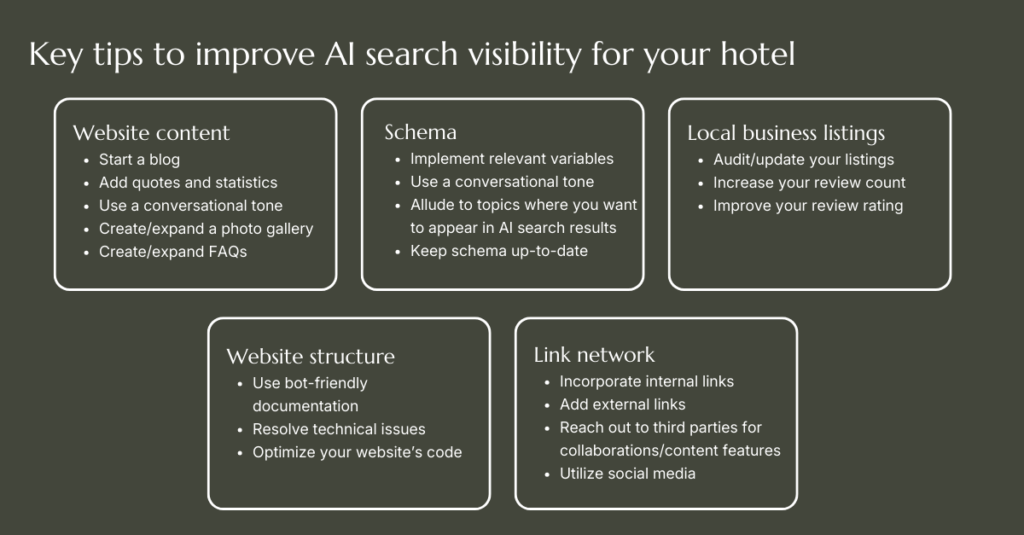
There are 5 main categories where your hotel can optimize for improved AI search visibility:

  1. Website content
  2. Local business listings
  3. Schema
  4. Website structure
  5. Link network

We’ll dive into more detail with the rest of this article, but here are our top recommendations for each category:

Website content

AI models prioritize sources with a large volume and wide variety of content. Websites that cover a range of topics, and websites with a large amount of information to source from, are more likely to appear in AI search results. 

AI models also prefer page content that is reliable and thoroughly researched. Including links, quotes, and statistics into your web content can improve your website’s credibility, and therefore your hotel’s AI search visibility.

The contents of your website matter too. AI models prefer conversational, simple language to better align with their more casual search responses. They also prioritize easy-to-digest content, with a special preference towards high-demand items such as photos and frequently asked questions. 

Here are the immediate steps you can take to improve your hotel’s website content:

  • Start a blog to broaden your website’s scope and page count.
    • Cover topics around your hotel’s offerings and special features, things to do in the area, local events, and anything else that potential guests might be searching for.
  • Add quotes and statistics to your webpages.
    • For hotels, guest reviews and third-party articles are a great source of AI-friendly quotes.
  • Incorporate a more conversational tone into your content.
    • If formal language is a strong part of your hotel’s branding, consider simplifying some sentences to emulate a more casual tone without sacrificing brand voice.
  • Create or expand a photo gallery.
    • Prioritize high-quality imagery that features the most notable and unique aspects of your hotel. This may include dining options, waterfront views, or even amenities such as a pool or hot tub. 
  • Create or expand FAQs for your hotel.
    • Develop FAQs based on actual guest feedback and your own AI searches to determine what information your hotel’s potential guests are really looking for.
    • A standalone FAQ page is most impactful and may help your hotel’s visibility in traditional search, along with AI search results.
    • It’s also beneficial to add a set of 3-5 FAQs on topically relevant URLs. For example, add a few rooms-related questions to your hotel’s “Accommodations” page or include restaurant-related FAQs on the “Dining” page.

Local business listings

When recommending businesses, AI models tend to rely heavily on local listings such as Google Business Profile. Both business information and customer sentiment from these listings are used by AI models to offer the best options to users within AI search results.

Therefore, it’s incredibly important to optimize and maintain your hotel’s local listings over time. The following tactics are likely to increase your hotel’s AI search visibility, especially when completed on an ongoing basis:

  • Audit and update your hotel’s local business listings to ensure accurate and up-to-date information.
    • Be sure to prioritize listing accuracy on the following websites:
    • Sign up for a local listings management service to add and update your business information across hundreds of websites simultaneously, including those listed above. Examples of these services include:
  • Increase your hotel’s review count across various websites. Potential ways to generate reviews include:
    • Post on-property signage asking guests to leave a review.
    • Encourage guests to leave a review within post-stay emails or receipts.
    • Provide direct review links and QR codes to make the review process seamless for guests.
    • Be cautious with incentives such as discounts, loyalty points, or giveaways based on reviews. This may violate platform guidelines or terms of service, leading to penalties for your hotel’s listings.
  • Improve your hotel’s review rating across various websites. To achieve this, try the following:
    • Respond to your hotel’s reviews. For the most significant impact, follow the best practices outlined in our article on How to respond to Google reviews.
    • Provide an easy way for guests to offer negative feedback to your hotel directly. If guests can privately address issues with your staff or on your website, this may bypass the need to post a public negative review.
    • Take negative feedback from guests into consideration, and make an effort to solve recurring issues within your hotel’s operations.

Schema

Schema variables outline your hotel’s offerings and web content in a way that’s easy for AI models to read and digest. By incorporating well-structured, clean schema into your website, you increase the chances of showing up within AI search results.

Keep the following in mind when implementing schema variables:

  • For hotels, the following schema types are most beneficial:
    • Local Business schema outlines information about your hotel, dining establishments, and other offerings such as spas and golf courses.
    • Product schema can be used to describe room types, offers, and packages.
    • FAQ schema is an important element for hotels, especially when used in tandem with an FAQ landing page on your website.
    • Article schema highlights blog posts, press releases, and third-party buzz about your hotel.
  • Where possible, incorporate a somewhat conversational tone and allude to topics where you want to improve AI search visibility. Similar to on-page content, highly relevant and easy-to-use schema variables increase your hotel’s likelihood of appearing in AI search results.
  • Make sure to keep your schema variables up-to-date with the most recent information about your hotel. 

Website structure

AI models are fairly efficient at reading website content and understanding code. However, a clean and optimized website structure reduces friction, making it easier for AI models to digest your content correctly and thereby increasing your AI search visibility.

For optimal performance within AI search results, consider these website elements:

  • Add bot-friendly documentation to your website, including the following:
    • Implement an llms.txt document, used by Large Language Models (LLMs) to find your most important and relevant content.
    • Create a sitemap.xml file outlining all URLs on your website for maximum discoverability.
    • Highlight your sitemap.xml file in a robots.txt document so it’s easy for AI models to find.
  • Resolve technical issues such as:
    • Redirect 404 pages to land on live content.
    • Update outdated and broken links to include up-to-date URLs.
    • Remove and redirect outdated webpages to ensure fresh, accurate content.
    • Minimize duplicate content across webpages, title tags, and meta descriptions.
  • Optimize your website’s code, with a particular focus on the following:
    • Utilize a clean, intuitive, sub-folder structure so navigation of your website is seamless.
    • Ensure that website elements such as title tags, meta descriptions, and H1s are placed in the correct order and location of your code.
    • Improve your website’s average page speed to reduce friction for AI models.
  • The following tools may help you maintain your website’s technical health:
    • Identify potential issues with your website’s structure using site audit and SEO crawling tools from SEMRush and Screaming Frog.
    • Yoast SEO and RankMath offer creation and management features for llms.txt, sitemap.xml, and robots.txt files.
    • The WordPress plugin Redirection can assist in cleaning up 404 pages, duplicate content, and outdated webpages.

Link network

Incoming links, outgoing links, and brand mentions associated with your hotel can improve AI search visibility by boosting website credibility, streamlining discoverability, and increasing mentions of your website within AI model databases.

To improve your hotel’s link network, consider the following:

  • Incorporate internal links to other pages from your own website.
    • For example, link to your restaurant’s landing page when discussing the establishment in your FAQ or Amenities list.
  • Add external links to outside resources where applicable.
    • Highlighting your hotel’s third-party awards, press features, and partnerships is an easy way to boost your external link count.
  • Reach out to local businesses, blog owners, news sites, or even influencers to request a collaboration or content feature which includes a link to your website or otherwise mentions your brand.
    • Oftentimes, collaborations involve both websites linking to each other, providing the extra benefit of increasing your own website’s external link count.
  • Utilize your hotel’s social media to post blogs, press features, and other links to your website. Social media links still count towards overall link building.

Takeaways

Improving AI search visibility requires a well-rounded strategy across a variety of website elements and marketing channels. While no single change is likely to move the needle on its own, a number of small optimizations working in tandem will give your hotel the best chances of showing up in AI search results.

If you want to learn more about AI search visibility or you’re ready to get started, reach out to GCommerce today. We’d love to discuss your current AI search strategy and help set up your hotel for future success.

How data platforms turn brand authority into durable AI visibility

SHARE:

In the first two posts in this series, "Why AI visibility ultimately collapses back to data" and "AI doesn’t rank hotels. It learns which ones to trust," we reframed how AI visibility actually works.

We explored why AI-driven discovery collapses back to data, not prompts or shortcuts. We examined how brand authority is inferred from patterns in that data rather than declared through content or optimization tactics.

That brings us to the most practical question in the series:

If AI visibility depends on performance-backed authority, how do hotels actually improve the performance that creates it?

Brand authority isn’t created in AI. It’s earned in marketing.

Most hotels already generate demand.

They attract travelers.
They invest in media.
They drive traffic.
They convert bookings.
They earn repeat stays and reviews.

Brand authority isn’t missing. It’s being earned every day through marketing performance.

The challenge is that this performance data lives across many systems and is rarely analyzed together in a way that leads to better decisions.

AI doesn’t need perfect data from hotels. It simply observes outcomes.

Hotels, however, do need visibility into their own performance if they want to improve those outcomes intentionally.

What a data platform actually does

A data platform does not aggregate the signals that power AI results. It does not feed AI systems. It does not act as an intermediary between hotels and discovery engines.

Instead, its role is upstream and operational.

A data platform ingests a hotel or resort’s own marketing and performance data and turns it into insight that enables better optimization decisions.

It helps hotels understand:

  • Which channels are actually driving incremental demand
  • How different media investments affect direct bookings
  • Where pricing, availability, and messaging create friction
  • Which efforts are efficient and which are quietly eroding ROI

In short, a data platform helps hotels improve what they already control.

AI benefits later by observing the results.

Optimization is the mechanism that strengthens authority

Brand authority is inferred from outcomes, not intentions.

Those outcomes are shaped by everyday optimization decisions:

  • How budgets are allocated
  • Which channels are emphasized
  • How pricing and availability interact with demand
  • How effectively direct booking paths convert

When hotels lack a unified view of performance, optimization happens in silos. Channels are judged independently. Success is measured locally. Tradeoffs remain invisible.

A data platform breaks that pattern by connecting marketing performance across channels and tying it directly to business outcomes, especially direct bookings.

This doesn’t create authority. It amplifies the authority a hotel is already earning.

Why direct bookings are the clearest signal to optimize

In an AI-driven ecosystem, direct bookings matter for more than margin.

They represent:

  • Brand preference
  • Trust in pricing and availability
  • Confidence in the guest experience
  • Reduced dependency on intermediaries

By ingesting media, conversion, and booking data, it enables hotels to:

  • See which efforts truly drive direct demand
  • Identify friction in the direct booking journey
  • Optimize spend toward efficiency, not just volume
  • Reinforce patterns that consistently lead to direct choice

AI doesn’t see optimization decisions. It sees the outcomes of those decisions.

Repeated direct bookings are one of the strongest indicators that a brand is trusted and preferred. Smarter decisions = stronger visibility.

Where AEO fits, clearly and honestly

Answer Engine Optimization (AEO) is not where authority is created. It’s where authority is expressed.

AEO helps ensure that what a hotel has earned through performance and optimization is accurately represented in AI-driven discovery environments through structured content, schema, and distribution formats.

The data platform informs AEO by clarifying:

  • What actually performs
  • What positioning is reinforced by outcomes
  • What messages align with real demand

Without this insight, AEO risks amplifying assumptions. With it, AEO reflects reality.

Optimization strengthens authority. AEO communicates it.

From optimization tactics to durable advantage

AI-driven discovery hasn’t eliminated marketing fundamentals. It’s raised the stakes on them.

Content still matters. Media still matters. Distribution still matters.

But the hotels that win will be the ones that:

  • Optimize intelligently
  • Understand their performance deeply
  • Invest in direct demand
  • Reinforce what works over time

A data platform doesn’t change how AI works. It changes how well hotels perform.

And performance is what AI ultimately learns from.

Playing the long game

AI will continue to evolve. Interfaces will change. Discovery paths will shift.

What won’t change is this: AI infers trust from outcomes. Outcomes are shaped by optimization. Optimization depends on insight.

The hotels that win in AI-driven discovery won’t be chasing visibility directly. They’ll be investing in systems that help them make better decisions, drive more direct bookings, and strengthen the authority they already earn every day. AI visibility may feel new, but durable advantage still comes from performance.

Contact GCommerce Solutions to start connecting your AI visibility with your data.

Keep Reading