In 2022, GCommerce produced a company survey to gather team member insights on its Cultural Pillars. While the primary goal was to evaluate which pillars needed to be updated in a post-pandemic world, GCommerce also found that many team members requested more education and discussion around Diversity, Equity & Inclusion.
Survey respondents were proud of the company efforts towards a more equitable workplace, but they wanted those efforts to be more formal and institutional. In response, GCommerce decided to incorporate Diversity, Equity and Inclusion into its foundational "Cultural Pillars."
The company didn't stop there. Formalizing DEI as a culture pillar was an important first step, but GCommerce was looking to make an impact, both within the company and the community.
And that is how the Equity & Advocacy Team was formed.
At the onset, the team drafted a charter to guide the goals, strategies and desired outcomes of the group. Now, the company presents a recap of the work that has been done and the outcomes it has generated over the past year.
Every year, the marketing industry eagerly awaits Google Marketing Live, Google’s annual event to showcase what’s new in the world of Google advertising. While this year seemed to focus on e-commerce and retail heavily, there were still a lot of announcements and features that got us excited about what’s to come. Discover our key takeaways from Google Marketing Live 2024 below.
By Jaylene Van Lin, Marketing Specialist
Develop ads that adhere to your brand standards
Later this year, you'll be able to supply Google AI with your brand guidelines, such as your colors and fonts, to create ads that reflect your brand across multiple formats and channels. You'll also have the option to upload sample images, enabling generative AI to produce new images that match your visual style. Furthermore, you can use the "Generate more like this" feature to create additional on-brand variants of your successful assets.
By Morgan Tuohy, Senior Marketing Strategist
Take your AI-generated creative to other platforms
While using Google’s tools to create new creative assets, you retain the rights to use those assets across other platforms, including those not owned by Google. While other platforms lag behind Google on the move to AI-generated creative assets, you can maintain brand consistency and save time by taking assets from one platform to another.
By Alex Scharpf, Search Marketing Supervisor
Don’t underestimate short-form
Google is pushing towards YouTube Shorts more than ever, and the format is growing in terms of both engagement and viewership. As Google continues to provide more in-depth ways to monetize Shorts, vertical image assets and short-form video content will become even more important in the upcoming years. And because travel-based content already has a strong presence on Shorts, skipping these assets as a hotel may leave valuable customer interactions on the table.
By Maddie Holifeild, Marketing Specialist
Google Gemini has the potential to be a powerful tool for hoteliers
While presenting at this year’s keynote, Philipp Schindler touched on the developments of Google Gemini, an AI assistant that provides access to Google AI. With a tool like this, Hoteliers can analyze large datasets to understand customer preferences and behavior patterns. This will allow hotels to deliver highly personalized marketing campaigns, offers, and recommendations like dining options, specific room types, and local attractions based on a guest’s previous stays or preferences. With AI on the rise, there is also an opportunity to enhance customer service through advanced chatbots and virtual assistants that can handle a wide range of inquiries, from booking reservations and answering questions about amenities.
By Meaghan Reynolds, Marketing Specialist
Google’s new brand profiles will help enhance hotels' online presence
Google’s introduction of new brand profiles and AI branding tools empowers businesses to showcase their unique brand identities more effectively. These tools will allow merchants to showcase and highlight key information with new and compelling visuals as well as using AI to effortlessly create engaging content. For Hotels, this is a great opportunity to feature new imagery, positive guest experiences, and videos directly in a search result. This new AI tool can allow hotels to generate new and engaging content which will help to enhance their marketing efforts and attract more potential guests.
By Alex Horrocks, Search Marketing Strategist
The Power Pair
At Google Marketing Live, the "Power Pair" strategy was highlighted, combining broad match keywords inside Paid Search Campaigns alongside Performance Max. While it's well-known that advertisers often prefer exact and phrase match keywords for higher quality traffic, Google shared data showing that Power Pair could boost conversions by 27%. As advertisers, we constantly test new strategies, but this approach might not suit smaller businesses. Paid search tends to be more effective with targeted campaigns rather than broad approaches for smaller businesses. If you decide to implement the Power Pair strategy, ensure you leverage your other tools by optimizing audiences, demographics, and bid modifiers to avoid unnecessary spending
By Lisa McGivney, Director of Marketing
Google will prioritize ads in AI overviews
The search community has long guessed that the only way Google would roll out GenAI into the live results would be if they found a way to maintain ad revenue. During Google Marketing Live 2024, they confirmed that although historically ads have only appeared above and below the overviews, they will now be testing ads within the AI Overviews. It will be interesting to see how this evolves and what type (if any) of reporting they offer to show the performance of ads within AI Overviews. We’ll be ready.
By Jael Dugdale, Metadesk Operations Team Lead
Embracing AI and intent-based searches
As AI takes center stage at Google Marketing Live 2024, the future of SEO is being reshaped. Google emphasized a shift from specific keywords to user intent, with more complex searches—often five or more words—becoming the norm. Where complex searches once required multiple steps, AI now provides comprehensive options in a single query. For example, a search for “fun places to eat in Monterey” can now yield clusters of results like reviews, sunset views, and seafood havens. Google Lens also enables easy identification of objects with a simple point-and-shoot. So, what’s next? Ads and organic search results will change, requiring SEO strategies to adapt. Beyond keywords, SEO should focus on intent-based searches, are they a seafood haven? Making sure their alt text identifies objects in images correctly, color, size, etc. providing relevant, concise content, and making sure they continue to highlight their Long-Term Sustainable Competitive Advantages (LTSCA) to stand out in future AI-driven searches.
By Kristina Webber, Marketing Specialist
First-party data is critical to advertising on Google
Having good AI requires good data. At Google Marketing Live, AI was mentioned frequently. However, having the right first-party data to fuel successful campaigns will help drive conversions more cost-effectively. To assist with this, Google announced a new feature: Measurement Diagnostics. This feature can evaluate your website and gather data by diagnosing missing data or opportunities that can be used to understand your audience through first-party insights.
By Nikki Abrego, Marketing Strategist
When will Power Pair take advantage of travel?
During the Google Live session, they introduced a game-changing feature, Power Pair. This feature combines search and performance campaigns to deliver the strongest data performance of ROI across all of Google, enhancing visual search. They demonstrated this with a retail example: a consumer snaps a picture of a suitcase, and search results populate with similar products. This got me thinking about the exciting possibilities we could explore for our clients and how this could significantly enhance our advertising strategies with hotels and travel.
Instead of taking pictures of products, users could upload an image of an aesthetic room or an environment they aspire to be in. For instance, if someone uploads a picture of a beach with a palm tree, our hotel client, The Cove, could appear in the search results with their villas providing that similar view. Or, if an image of a dark romance room aesthetic is uploaded, our client, Crossroads, could pop up with matching aesthetic suites available to book. By feeding images into Power Pair, this feature could encourage customers to book travel based on the visuals they have seen or saved on their Pinterest travel boards.
By Kaylin Long, Search Marketing Specialist
More choice for consumers means more opportunities for advertisers
People are starting to search in new ways—they’re asking more complex questions, searching with images, etc. All of these different ways that a consumer can search mean that the consumer has more choice, which means more opportunities for advertisers. Google is implementing more ways to implement shopping and metasearch-type ads that will be more relevant to our consumers. AI powered by Google will deliver the most relevant results to our consumers, bringing in more qualified leads and a higher ROAS.
Womanhood is an incredibly diverse experience, with each culture and each family having a unique approach to the journey. From quinceañeras and bat mitzvahs to Sweet 16 parties and menstruation celebrations, people from across the globe celebrate womanhood in all kinds of ways.
And GCommerce is no exception! Each member of our team comes from a different background and has a unique experience with the concept of womanhood. Here are some of the GCommerce team’s cultural and family traditions for celebrating womanhood.
Alex Scharpf
In our family, we don’t really celebrate “womanhood” any differently than “adulthood” more broadly. However, we do have some minor traditions for “motherhood.”
The entire extended family always comes together for Mother’s Day, and we make sure to write the name of every mother on a cake. (Though when your family is as big as mine is, it’s definitely a challenge!)
Once you’ve had your first child, you also get upgraded perks at family events. Your Christmas check is larger, you get to sit on the chairs that don’t fold up on you, and you get first dibs on holiday meals. None of these perks apply to the fathers in our family, so it’s really interesting that we specifically celebrate the moms.
Jael Dugdale
I come from a non-traditional family, so we don’t necessarily have a “tradition” to celebrate womanhood. However, what I am doing is passing on my experiences and the spirit of exploration and resilience to my daughter. As she begins to chart her own path, I'll be there for her through the twists and turns of life, cheering her on and empowering her to go after her dreams.
Jaylene Van Lin
Womanhood is a journey passed from my grandmother, through my mother, to me – a story of strength and growth. It starts with my grandmother being raised in the confines of a traditional household. She went on to enter a controlling and abusive marriage, a narrative that dictated her entire life.
But my grandmother always held onto hope for her daughter. She made sure my mother knew her worth, laying the foundation for a different life. While my mother still takes on many domestic duties that she feels obligated to do, her experience of womanhood is a world apart from my grandmother's. Sure, she still cooks my dad dinner every…single…night…but overall, she's treated with respect.
Maybe you know where the story is going now. Yes, my mother also wanted a better life for her daughter – me. Now, as I embrace my independence, I celebrate womanhood each day. I'm grateful for the sacrifices of the women before me, which have given me the freedom to define womanhood my own way.
Kaylin Long
In my experience growing up in The Church of Jesus Christ of Latter-day Saints, there hasn’t been any explicit celebration to acknowledge womanhood. But at certain age milestones, people in the religious community would begin to apply different gender roles to you.
At 12 years old, we become a “young woman” and begin attending a class at church that is only with other girls. At 16 years old, we are then encouraged to go on group dates (without steady dating). At 18 years old, “young women” become full-fledged women and move on to a different class, still segregated by gender, called “relief society.” At 18, we’re also expected to begin courting someone seriously with the intention of getting married. Once you’ve gotten married, you’re expected to begin having children and are expected to have as many as you and your spouse can physically support.
Kenyon Cotton
As a father of two daughters, this is a topic near and dear to my heart. In our household, I don’t like assigning gender roles to hobbies and interests. Our main focus is simply trying to build character and resilience, and instill moral values.
The result is two girls who are fully enabled to explore all facets of the human experience: sports, both organized and extreme; science, mostly in the form of bugs, animals, mud, and exploration; glamour and fashion; being a leader, a follower, or somewhere in between; being a hero and a protector and knowing how to ask for help when they need it. Both transcendence and immanence.
As I see it, one of our most important jobs as parents is to ensure that they understand that the full spectrum of possibilities is available to them as they work on figuring out how to find fulfillment and happiness, and how to provide value to the world.
Lisa McGivney
We don’t have any family traditions that I can recall, but I’m excited to start a new one this year! I’ll be going skiing with my daughter for International Women’s Day.
Sharing Traditions
Every woman is unique, so individual traditions of womanhood are equally special. Talk to your coworkers and friends, and see what their own experiences have been. You might learn something new!
In 2022 GCommerce produced a company survey to gather team member insights on its current Cultural Pillars. While the primary goal was to evaluate which pillars needed to be updated in a post-pandemic world, GCommerce also found that many team members requested more education and discussion around Diversity, Equity & Inclusion.
And that is how the Diversity, Equity & Inclusion Study Group was formed.
Now, over a year after establishing the study group, the company presents a recap of the work that has been done and the outcomes it has generated.
Price accuracy and rate parity are two of the most important factors to control when it comes to hotel metasearch. The two are not directly related but are often confused with one another, and both play a vital role in driving the most direct booking conversions. Price accuracy refers to ensuring that the rates displayed in the metasearch channel reflect the real rates in your booking engine. Rate parity refers to how often you are being undercut on rates by OTAs selling your rooms through their sites.
Price Accuracy
Did you know that price accuracy improves your metasearch conversion? Did you know it can actually lead to increased costs, higher CPCs, and less visibility if your prices aren’t accurately reflected in your booking engine? In fact, Google says your price accuracy score affects the auction positioning and advertising cost of your Google Hotel Ads metasearch listings. Ensure price accuracy while improving your conversion rate with these simple booking engine best practices:
Publish your BAR rate - Don’t get undercut by the OTAs in the listings. Make sure you always offer potential guests the best available rates.
Ensure your lowest rate is listed first - Google’s policies indicate your rate should be prominently displayed on your booking engine landing page and that the lowest rate (the rate shown in Google Hotel Ads) be the first listed rate available. It also helps ensure a smooth customer journey when the first price listed is the price they see in your booking engine.
Add any and all public promotions to your channeled metasearch rate/inventory feed - If you offer deals and discounts that the OTAs can’t match, listing those rates on your metasearch channels will give a greater incentive for guests to book direct.
Be thoughtful about how many rate types you display on your booking engine page - Guests may be overwhelmed if there are too many rates available on your landing page. The goal should be to decrease friction at all points in the booking process.
Use understandable language - Communication is always key. Make sure any callouts or text in ads are compelling and concise. Language on the landing page should match your Brand voice and be easy to read.
Rate Parity
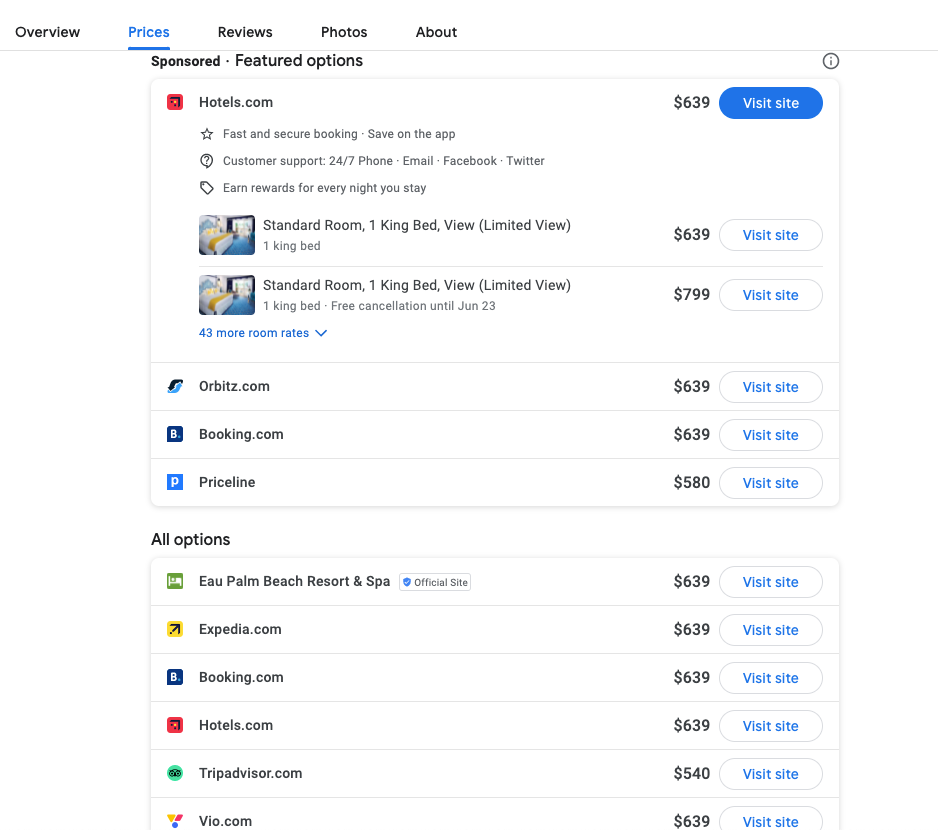
Rate parity can have a massive impact on your conversion rates for hotel metasearch, but what is it exactly? In short, rate parity means ensuring you aren’t being undercut on the best available rate. Below is an example of a hotel experiencing rate parity issue; notice how Priceline and TripAdvisor both offer rates lower than the official site.
Always be the best - OTAs are always looking for ways to beat your official site rates, trying to steal your direct bookings. Because metasearch interaction and conversion rates are driven so heavily by price, it’s vital that you offer the lowest rate.
Monitor your listings - It’s important to be aware of how often your rates are not the lowest rates being displayed. Hotels with higher instances of being out of rate parity consistently have lower performance than those whose rates are in line.
Have a strategy - A rate parity strategy is a set of policies that work together to ensure that your prices stay in parity. It may seem trivial to focus on rate parity, but it has an outsized impact on your conversion rate.
Rate parity is one of the most essential ways to increase your CTRs and conversions, while lowering your CPCs and increasing spend efficiency. After all, if your customers can get a better rate somewhere else, why wouldn’t they? We specialize in improving your metasearch conversions. Reach out to our hotel metasearch experts today at https://metadesk.pro/sign-up/
Hotel Metasearch Bid Modifications You Should Be Making
As the online travel industry grows, so does the need for metasearch optimization tools. Search engines have become increasingly complex, and there are now more players in the market than ever before. As such, you may find yourself faced with a new challenge: how to optimize your metasearch campaigns in an increasingly competitive landscape. Although we cannot bid on specific dates, there are many ways to update and customize your bids for prime optimization.
In-Market Audiences
In-Market Audiences are a useful bid modifier that can be used to target people who are looking to travel soon. This bid modifier could be combined with other modifiers, like device targeting, to get even more granular with your audience targeting.
In-Market Audiences also allows you to target people who have already shown interest in travel plans so that you’re not paying for impressions that are less likely to result in conversions.
OTA Bid Modifiers
OTA bid modifiers are a way to increase or decrease your bid on a particular site like TripAdvisor, Google Hotel Ads, Trivago, etc.. This can be useful for ensuring the highest visibility on the channels that are most likely to convert for your brand. Alternatively, you can decrease the amount you’re willing to bid (or not bid at all) on channels that have a track record of lower performance. Travel metasearch optimization is all about getting the most bang for your buck while still maintaining your presence throughout the customer journey.
Check-in Day Modifiers
Since hotels are not able to bid on specific check-in dates, the next best way to fill need periods is by adjusting your bids for particular check-in days of the week. Have strong weekend occupancy but are somewhat soft in mid-week? Increase your bids for check-ins Monday through Thursday and decrease bids for Friday through Sunday. This will allow you to be present for more searches where you need the bookings and avoid spending unnecessarily when you’re already full.
Hotel Metasearch Management Best Practices
There are some basic best practices that should be followed when managing a metasearch campaign:
Optimize your campaigns. There's a lot of room for improvement in terms of how many impressions each campaign is getting compared to others in the network, as well as where those impressions are being served (geographically).
Use in-market audiences. These are audience segments based on consumers who have recently searched for products similar to yours, so they're more likely than non-qualified searchers who didn't find what they were looking for before coming across yours on the next page down (or wherever else!). This can help get better results at lower CPCs because people have already shown an interest in what you offer by searching for travel or hotels. This means there's less risk involved since they've already expressed their intention towards booking travel previously in their research.
Adjust your bids for Check-in day, Length of stay, and/or Days to arrival. If you’re looking to encourage bookings for specific periods, the easiest way to have an impact is by increasing your bids for these variables.
There are many ways to update and customize your metasearch bid for prime optimization.
Although we cannot bid on specific dates, we can utilize in-market audiences and other bid adjustments to ensure the highest visibility with guests that are the most likely to book. It’s important to own the space for searches with the highest value to your business.
We hope this article has helped you understand how to better optimize your metasearch bid. There are a few more tips we didn’t mention here, but if you would like to learn more about optimizing your metasearch bids, then please contact us at https://metadesk.pro/sign-up/