Google Expanded Text Ads Discontinued

SHARE:

Google recently announced yet another fundamental change to their paid search advertising product - the discontinuation of Expanded Text Ads.

Right now, there are a few different ad types available on Google Ads. Each ad type is automated in some way, but Expanded Text Ads offer some of the most direct control available on the entire platform. 

Expanded Text Ads allow advertisers to choose a particular combination of headlines and descriptions to show up in a search, providing a great opportunity for very specific messaging and branding. However, creating and editing Expanded Text Ads will no longer be supported as of June 30, 2022. 

With Expanded Text Ads disappearing, search marketers will now have to focus their efforts on Dynamic and Responsive Search Ads. These ad types still allow marketers to write copy and choose messaging to some extent, but the opportunity is smaller than that of Expanded Text Ads. These more automated ad types remove the ability to choose exact combinations of copy, relying far more heavily on machine learning and other AI in the interest of improved ad performance. 

But is it actually worth it?
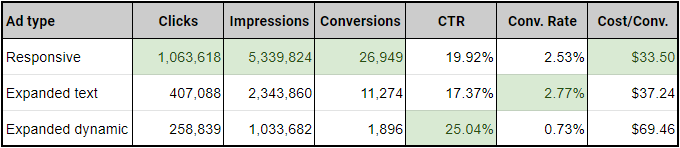
Based on this sample of our client data, it seems like more automated ad types do indeed perform better in almost every way. Even when Expanded Text Ads perform the best, they aren’t very far ahead. With this information, it’s easy to understand why Google is moving away from Expanded Text Ads. Even if the platform pushes Responsive Ads more often, the interaction rates between these two types are pretty similar. Since Google is already interested in automation, the performance of Expanded Text Ads likely isn’t significant enough to keep them around.

However, it’s impossible to predict how this decision will actually affect performance in the long run. Maybe we’ll see a massive boost for Responsive Search Ads without the added competition of new Expanded Text Ads. Maybe users will see lower returns until Google’s AI learns how to deal with the new landscape. Maybe there won’t be a significant change at all, and we’re all just overreacting. 

In any case, marketers have no control over the decision. This will be an adjustment for all of us, and reactions have been sort of a mixed bag. Here’s what our search marketing team has to say about the upcoming Google Ads update.

“New standards and best practices will emerge as the industry figures out how to manipulate Responsive Search Ads effectively. It’s just a matter of keeping up with the changing landscape.”

- Cat Jones

“I’m pretty excited about what this means for the future. Change is the backbone of marketing, and this is just another opportunity for us to flex our problem-solving skills and adapt to the unknown.”

- Alex Scharpf

“The removal of Expanded Text Ads is an exciting new challenge. Advertisers will have to explore the best ways to optimize Responsive Search Ads, allowing for more variables and opportunities for testing.”

- Mike Orrison

“I think this is just the latest in a long trend from Google. Learning how multiple Responsive Search Ads interact within a singular ad group should be something all search marketers explore and test as Expanded Text Ads are phased out.” 

- Patrick Buckner

“The only concerns I have are the lack of robust reporting and slightly less control that come with Responsive Search Ads. I'm hoping that Google will continue to build out its reporting capabilities prior to the sunsetting of Expanded Text Ads in 2022.”

- Lisa McGivney

“Responsive Search Ads have always been a means of testing new headlines and descriptions, and they’ve provided valuable knowledge as to what works and what doesn’t. If control becomes a challenge, we can still implement qualities of Expanded Text Ads in our Responsive Search Ads.”

- Alex Horrocks

“If needed, we can force Expanded Text Ads into a Responsive Search Ad by pinning specific headlines and descriptions. Unless the pinning function goes away or changes, I can't disagree. The change gives us more options and ways to test all at once; I guess we’ll see how it all goes in 2022.”

- Jael Dugdale

We can speculate about the future, but no one knows for sure what the upcoming Google Ads update will mean for the industry. This isn’t the first time Google has made a move towards automation, but every new change brings new challenges. For now, GCommerce Solutions will continue to learn and evolve in order to provide the best possible results for our clients. Contact us for more on our thoughts and plans for the future.

Improve Conversion Rates On Your Hotel's Book Now Button

SHARE:

A partner hotel with GCommerce Solutions had a Book Now button that had many other links close to it, which could have been decreasing the click-through-rates (CTR) to the hotel booking engine. With the help of the expert graphic designers at GCommerce Solutions, we designed a new Book Now button that we hoped would have a higher CTR and conversion rate.

A/B Test

Utilizing Google Optimize, we were able to create two versions of the clients homepage, one with the original Book Now button and one with our variant. We were able to split the traffic so that 50% of visitors see each version of the page. 

Results 

After about 12k total sessions, the new Variant has a Conversion Rate of 1.74%, which is a 12% increase compared to the Original.

Screenshot of transaction data in google analytics

How Significant is a 12% Increase in Conversion Rate?

This hotel has an Average Order Value (AOV) of about $810. If they drove the same number of visitors in 2019 as they did in 2020 and had the same AOV, a 12% increase in Conversion Value would have resulted in over 2,300 more Conversions and another $1.95 million in Revenue. 

Start A/B Testing With Your Website

A/B tests are the best way to gather valuable data that allows you to improve conversion rates on your website and get better returns for your marketing dollars. 

Contact GCommerce Solutions today to start A/B testing on your hotel website to improve conversion rates.

What Does Apple’s iOS 15 Update Mean For Hotel Email Marketing?

SHARE:

Earlier this summer at it’s WWDC event, Apple announced a preview of feature changes coming to it’s devices with the new iOS 15 update. While the previous iOS 14 update took aim at paid media advertising through app tracking, iOS 15 privacy updates centered its focus towards email marketing through tracking within the Apple Mail inbox. GCommerce, and the entire digital marketing industry, immediately took notice and started to analyze the potential impact this update will have on email marketing. Set to be released sometime this fall, possibly later this month, we’ve been closely following this news.

What email specific features are included in the Apple iOS 15 update?

The two features that are positioned to have the biggest impact on email marketing include the Mail Privacy Protection and Hide My Email features. 

  1. Mail Privacy Protection - Apple states that this new feature “hides your IP address so senders can’t link it to your other online activity or determine your location. And it prevents senders from seeing if and when you’ve opened your email”. This feature is included in iOS15 but is not a default opt-in. The user will have to navigate to features and take action to implement the feature. This may have an impact on adoption rate.
  2. Hide My Email - according to Apple, this feature “instantly generate(s) unique, random email addresses that forward to your personal inbox - so you don’t have to share your email address when filling out a form on the web or signing up for a newsletter”. While important, this feature does incur an additional fee to use, so it’s yet to be seen as to what the adoption rate by users will be.

What do these Apple iOS 15 changes mean for my hotel’s email marketing?

  1. It will impact open rate measurement - The Mail Privacy Protection feature will directly impact your ability to measure email open rates as well as use IP address to understand geo-location of a user which will impact your ability to use schedule send time based on IP location. Over the years Open rate has been the go-to metric to understand the initial engagement of your email’s content and subject lines. WPromote has indicated that within it’s beta tests, open rates appear to be over reported but a lot is still left to be understood when the full release happens. Revinate also indicated that “Revinate emails opened with Apple Mail are only in the single digits,” so the release should not have a “major impact on our metrics or ability to evaluate campaign engagement”. 
  2. Clicks, CTR and Revenue remain as the most important KPIs - While Open Rate may become less of a focus for email marketers, the true measure of success will continue to be placed on clicks, CTR and ultimately the revenue produced. You should focus your testing around creative, content and promotions based on these KPIs.
  3. Greater importance of robust 1st party guest profiles - If your hotel is not already using a eCRM platform such as Revinate to obtain guest preference information and tap into rich guest profile information for advanced segmentation strategies you will be missing out on methods to ensure engagement and revenue generation are maximized from your email marketing efforts.
  4. It could hurt deliverability rates - The auto-generating of unique, random email addresses by Hide My Email could result in higher bounce rates and emails sent to spam folders and is something to monitor.

What should we do now to prepare our hotel’s email marketing for the Apple iOS 15 update?

While a lot of the impact from the launch of Apple iOS 15 is unknown at this point, there are steps you can take to try and mitigate it. Most of these center around previous recommendations made in response to other privacy measures including previous updates from Apple, Facebook, Google and other tech platforms. 

  1. Prioritize collecting and expanding 1st party data and guest profiles.
  2. Focus on delivering valuable content, promotions and packaging to their target audiences. One way to continue to understand what type of content engages their audiences is to monitor and test messaging across various media types including search, social and display. 
  3. Focus testing on content components within the body of the email vs focusing on subject line open rates for success. Since we will potentially have less understanding of subject line performance, consider pulling ideas from other media channel ads such as paid search or social.
  4. Continue to build your brand awareness across all channels to encourage brand recognition and higher CTRs for all types of marketing campaigns.

Have additional questions on the recent Apple iOS 14 or 15 updates and how it impacts your hotel’s digital marketing? Please reach out to one of the experts at GCommerce, we look forward to connecting with you.

Your Hotel Has No Vacancy, What Is The Best Digital Marketing Strategy?

SHARE:
  • No vacancy sign

Many hotels are seeing a huge bounce-back in demand and occupancy this summer as travelers take advantage of openings from restrictions and take those long-awaited trips. If you are a fortunate hotel that currently is at full occupancy, what should you be doing with your marketing? Should you decrease your budgets? What type of messaging should you be focusing on? In this article we will talk about some relevant examples from the past and provide some suggestions on how your hotel can best market at times with full occupancy.

Examples From Seasonally Closed Hotels

In thinking about this, it seems very similar to the seasonal properties that GCommerce has worked with nearly since our existence. Many destination properties in the northeast, mountain locations, near the arctic circle, etc. generally close down for up to half the year. During this time, they do not accept guests and therefore they have some similarities to when guests are unable to book at a hotel that does not have capacity. Traditionally, many hotels would discontinue marketing their properties during these times, but we always strongly recommend against that. The reason is that many of those destinations have a long booking window where people do a lot of research prior to booking. This is another similarity if your hotel is at capacity. Due to increased demand and limited availability as the hospitality sector continues to recover, people are increasing their booking windows and doing more research prior to booking with some experts recommending any travel from now to 2022 should start to be planned now.

Hotels Get More Revenue When They Market With No Availability

Over the course of time, we’ve done a lot of research to see if hotels perform better when they market when they are closed. Should we be running marketing when hotels have no availability? The results below are from GCommerce clients in the years preceding the pandemic and any impacts on demand that may have caused and show years in which we marketed while they were closed compared to the previous years when they did not.

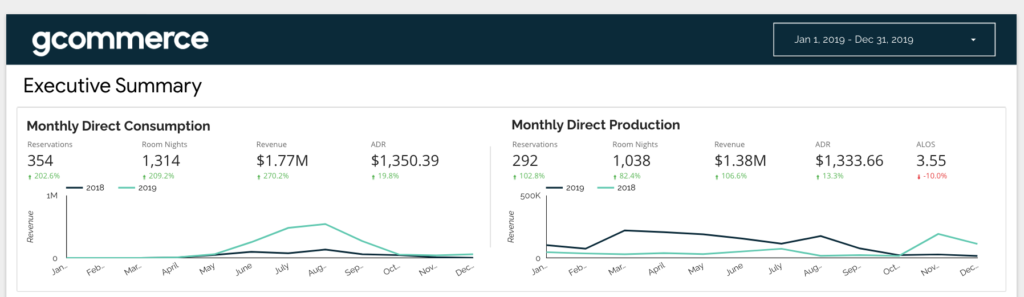
With this particular hotel, they only reduced their budget by about 30% from their high season to their completely closed season leading up to 2019. In 2018, they ran no marketing at all while they were closed. You can see the huge jump in produced revenue and how quickly they got a start to the year as people were booking early.

Screenshot of monthly data from 2019

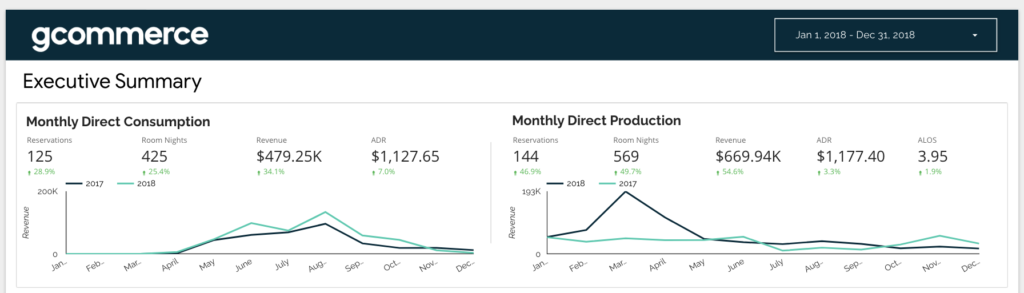
This hotel ran no marketing in 2017 but reduced their budget 50% from their high season to their completely closed season leading up to 2018. Again, we see a large jump in produced revenue at the start of the year before the hotel is even accepting guests and their consumed revenue was able to outpace the previous year.

Screenshot of dashboard showing monthly production data for 2018

How To Interpret This Data For Marketing While Hotels Are At Full Occupancy

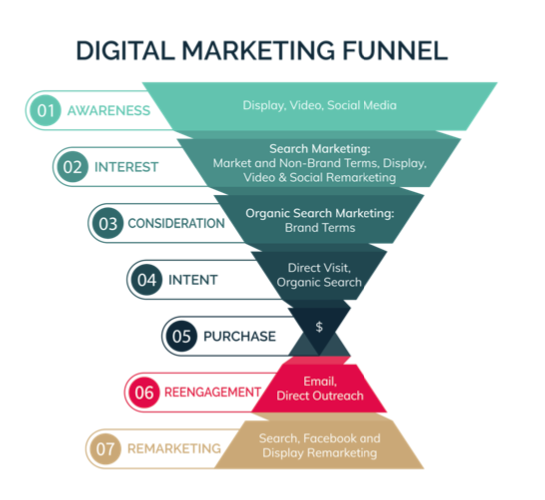
Both of these hotels had something in common in that they didn’t start accepting guests until it got warm enough for people to travel to those locations. Hotels at full capacity should have a similar idea for when they have openings. If your hotel is completely booked through the summer, but you’re in need of mid-week bookings in the fall, that is something you can start targeting with your media. If we are still 3-4 months out from the need period, your hotel guests are probably still in the awareness or interest phase. Understanding that you should be targeting that part of the marketing funnel allows you to utilize the right platform and proper messaging to try and target that audience.

Sales funnel visual

Target Hotel Guests For Future Reservations

With the example hotels above, we started our off-season marketing in November and December the year before focusing the majority of our budget on display and Facebook ads geared towards attractions in May when the hotels typically started accepting guests. As we moved through the winter, we shifted more of our budget down the funnel to paid search marketing campaigns, and remarketing campaigns to target users who had been to the website with intent and did not end up booking. With such a large start in produced revenue, the hotel quickly had most of their major weekends and the summer booked by February or March. This allowed us to completely shift our marketing back towards Display and Facebook targeting the need periods later in the fall.

By increasing our budgets year-over-year with marketing during closed periods, both of these hotels were able to completely transform their targeting and bring in substantially more direct revenue, rather than relying on Online Travel Agencies. They also didn’t have to play “catch-up” through the year by spending more during the high-demand summer months to try and fill in those demand areas later in the fall and shoulder-season.

Hotels at full occupancy are in a similar position, they have the opportunity now to either:

  1. Shut down marketing due not being able to accept reservations
  2. Shift their marketing efforts to target need periods in the future

Which one will you choose? If you picked option 2, congrats, you’re going to position your hotel for success in advanced bookings which not only help you get reservations on the books for future months but also help you achieve the goal of a lower cost per acquisition like we prove in this recent blog post on fighting OTAs for direct hotel bookings. Now, here’s where we break down a few suggested methods to helping to drive advanced purchase bookings and fill up your future need periods:

  1. Set up custom audiences targeting website visitors looking for stays during your future need periods/specific advance dates
  2. Shift more budget towards top of funnel awareness campaigns across Facebook, Display and Paid Search
  3. Promote packaging, offers and messaging geared towards travelling during seasonal or future need periods
  4. Evaluate target audiences that travel during those need periods, if you’re looking to target during the school year you might have to shift your targeting, messaging and packaging away from families and towards couples and empty nesters for example. Dive into your 1st party data to identify common themes among travelers during those need periods from previous years
  5. Utilize audience tools such as Adara to target specific in-market audiences looking for travel to your market 60 to 90+ in advance of travel dates 
  6. Set up lifecycle email campaigns through Navis or Revinate to target guests that stayed during those months in previous years
  7. Launch metasearch advertising on channels such as Google Hotel Ads and Tripadvisor, where the majority of bookings are for stays 30+ days in advance

Still thinking about cutting back on media spend? If you still decide your business needs to cut down on media spend in the short term, consider shifting some of that budget towards the production of video and image assets for use in future marketing campaigns. Video continues to drive enhanced performance across channels including Display, YouTube, Facebook and many hotels still lack quality video assets.

No matter how your hotel is performing in the short term, it is always important to consider long term goals with your marketing campaigns and budget. If you have additional questions on how your hotel can best position itself for short term as well as long term direct booking strategies, please reach out to GCommerce. Our team of hotel direct booking experts are standing by to help.

What Hotels Should Know About Cookieless Tracking & Google Analytics 4

SHARE:

We’ve recently written about Google’s latest iteration of Analytics and important things hotel’s should know about Google Analytics 4 (GA4). In this post, we will go into a bit more detail on how the change to cookieless tracking might impact your hotel’s digital marketing efforts.

What are Cookies and Why Do They Matter?

Cookies are small pieces of data stored on your computer by the web browser. What they aren’t isn’t so important as to what they are used for, which is to track individual users. By dropping a unique cookie or pixel onto your browser, a website can then track behavior outside of your website.

Are Cookies An Invasion of Privacy?

This is the big debate currently being waged and many people would say yes. Legislations like Europe’s GDPR, California Consumer Privacy Act, recent updates to Apple’s IOS to block more 3rd party tracking are all efforts to protect user’s individual privacy by making it harder to identify those individuals. At the heart of this debate is cookieless tracking. While cookies are not banned nor illegal, a lot of browsers, plug-ins and software help to block cookies and there is evidence the cookies are becoming a less viable way to track users.

What does this mean for Google’s Universal Analytics?

Google’s current and most popular iteration of Analytics, Universal Analytics, uses first-party cookies to determine a number of variables within their tracking. Already, digital marketers are reporting gaps in data based on people that are actively blocking cookies and tracking. Within our own data, we have noticed certain instances where traffic from California has decreased, while traffic from locations not tracked has increased. This change is very likely indicative that California’s privacy laws are having an impact on our ability to track.

Why is Google Analytics 4 A Solution To A Cookiless World?

Despite what the name suggests, GA4 isn’t actually more robust tracking, it is actually less tracking on individual users. This is because GA4 is not tracking every pageview. Rather than rely on cookies and javascript variables to track every pageview, GA4 is tracking based on specific events that are built and established. Google then applies advanced models to fill out data for traffic and behavior. What Google Analytics 4 lacks in individual tracking it makes up for with the robust tools of their machine learning algorithms. The need for something like GA4 comes from the new privacy laws and public awareness around data collection.

What Should Your Hotel Do About Google Analytics 4?

As we discussed above, changes to the way users view their privacy will make Universal Analytics less and less reliable as time goes on. The earlier that your hotel starts to utilize GA4, get familiar with it and start to utilize data from it, the further ahead of the curve your hotel will be when Universal Analytics comes to a point it is no longer recommended to utilize. Also, your historical data will not automatically carry over from Universal Analytics. Your historical data will only go as far back as the 1st day that you start using GA4.

How To Get Started With Google Analytics 4?

After my father got a debilitating injury trying to build a retention wall in our backyard at the ripe-young age of 56, he decided it might be better to trust the experts. In this situation, we would also recommend utilizing an expert to help install GA4 for your hotel’s website. The truth is, GA4 is a completely novel way of tracking that does not rely exclusively on individual user data. Instead, it relies on event signals that are built and established based on the functionality and goals of your website.

Google Analytics 4 Tracking From GCommerce

If you’re interested in having the experts at GCommerce help establish GA4 tracking and reporting for your hotel website, contact us today!

Hotel Takeaways From Google Marketing Live 2021

SHARE:

What is Google Marketing Live?

Last week, (May 27th) Google had their Marketing Live event. For those that are unfamiliar with the event, these generally feature some updates from Google that are worthwhile to pay attention to. Here, we will review some of the top takeaways for hotels from Google Marketing Live 2021.

Google Hotel Ads Shared with Text Ad Feeds

This was probably the announcement from Marketing Live that will have the most impact for hotels. Prior to this update, Google Hotel Ads (ads you see with the ability to adjust dates stayed) and Text Ads (ads you see on the results page of Google) were entirely separate. Now, Hotel Ads can be featured within Text Ads. This is a clear signal that Google is investing more into Hotel Ads and attempting to increase exposure and visibility for this channel. If your hotel is not currently using Google Hotel Ads, you could be missing out on an opportunity where OTAs will capture the valuable direct bookings in this space.

What Does Google Hotel Ads in Text Ads Mean for Hotels?

There are many things to speculate about in terms of competition, ad volume and performance. For example, if you are not on Google Hotel Ads, will that impact your quality score or CTR if you are not sharing pricing data with Google text ads? Will this increase in price data impact CTRs for hotels? Will it increase search volume as more people “price shop”? Will it decrease volume on actual Google Hotel Ad searches as more people find pricing info directly in their search results? 

While there is a lot that we can guess, the obvious reason for Google putting Hotel Ad data in Text Ad results to promote bookings through that channel. We are not entirely sure how this new feature will work yet, but generally with more exposure comes higher potentials for costs. GCommerce will certainly be evaluating this feature for our metasearch clients. Stay tuned to our blog as we should be posting updates on these changes from Google and impacts we are seeing from these announcements.

 Vacation Rentals Now Showing in Google Hotel Ad Results

Google has previously had different filtering options where you could see results based on hotels, vacation rentals, etc. With this new update, Google is now including vacation rentals right in the results for Google Hotel Ads. In the past, generally when we have seen the competition within a given channel increase, either the cost of that channel increases or we lose the ability to capture as much of the market share as we previously could. By adding in vacation rentals to Google Hotel Ads, this could increase the volume and competition that hotels are competing against. The good news is that 68% of Business Travelers still prefer hotels along with 40% of Leisure Travelers, so perhaps this addition will allow users that do not wish to stay at vacation rentals to more easily hone their searches to the types of hotels they are searching for. This development means that it will be important for hotels to be more savvy with their ad targeting to ensure they are capturing the most qualified audiences. 

Expansion of 1st Party Customer Match Data

For those that are unfamiliar with Customer Match, this allows you to upload customer email lists and then remarket to those audiences within Google’s suite of ad services. If you have been following the changes with 3rd party cookies/data and the discussion around data privacy, this one will seem like a natural progression. Google is expanding the rules around uploading 1st party data, making it easier for advertisers to target these users. 1st party data is different from 3rd party data as it is information that you are collecting directly from your customers (email, website, forms, etc) rather than from a 3rd party service (Facebook, LinkedIn, etc). 

Google Ads Insights Page Now Includes Demand Forecast

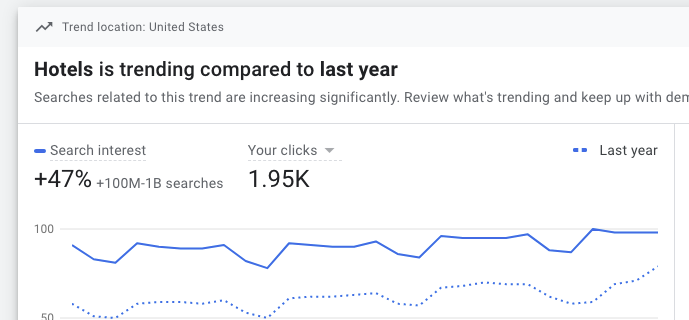
This could be helpful for hotels looking at when to increase or decrease their advertising based on demand; Google now offers a demand forecast with their Insights Trends. As we discussed above, increased demand generally either means increases in costs or less visibility. Knowing when these demand increases are likely to happen can help you plan and forecast spend for better returns.

Screenshot of Google Ads Insights page

Google Ads Image Extensions

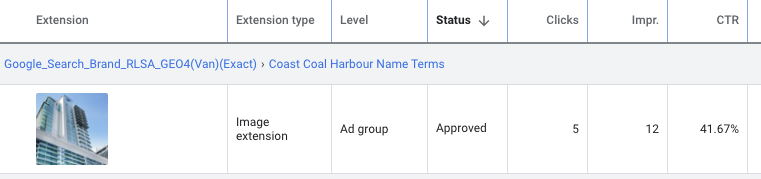
Google Ads image extensions were previously in Beta for most customers and GCommerce has been testing these with our clients where they are available. Initial results show that Image Extensions have higher CTRs than any other extensions other than Location Extensions. After the Google Marketing Live announcement, Image Extensions will be rolling out for all accounts. 

Screenshot of Google Ads Image Extension

Target Return on Ad Spend Bid Strategy Now Available For Google Video Ads

As advertising becomes more reliant on Artificial Intelligence and data modeling, it is important to be able to test these robust tools to see which ones are most effective at improving your marketing. We have been regularly testing different bid strategies for hotel marketing and having another one for us to test with Video Ads is another tool in the kit that we can utilize to drive improved results for clients. 

Focus On The Authenticity of Your Brand Story

This seemed to be a major theme throughout the Marketing Live event. With keynote speakers that included Immanuel Acho (best selling author) and Alicia Keys (award winning musician), there was a big emphasis on how to prepare yourself for a future of commerce that includes displaying your brand story. When evaluating the increased travel demand and how hotels can market to Gen Z, we really saw this come to life. With an increased adoption of smart devices, Gen Z has an expectation that they will be able to share the experiences of their travels with their friends, family and followers. In evaluating a potential hotel, the experience that a guest can expect to have is one of the best ways that a hotel can connect with that potential customer. While there are many options in building your Brand Story, connecting the travel experience of your hotel with your guests has proven to be very effective.

Other Announcements

There were certainly other announcements and for anyone passionate about marketing with Google we certainly encourage you to watch the entire two hour event, but in our opinion, the above details are the major takeaways for hotels. While the other announcements such as increases to Product Feeds and Local Inventory Ads had us on the edge of our seats, they probably aren’t pertinent to hotels so we will skip them for this write up.

What Does All This Mean, What Should Hotels Do Now?

In all of our years in the hotel space, this is certainly the most interesting time we can remember. Never have we seen a global event that has impacted travel as we have in the last 15 months. The Covid-19 pandemic was also different in that the world has never seen such a fast potential recovery to health and the economy as we are seeing with the rapid deployment of vaccines. Already a large percentage of the United States population is fully vaccinated and very unlikely to contract or spread the virus, according to the CDC. The rebound for travel is expected to be swift and immense. The summer of 2021 is likely to see demand that we have not seen since before the pandemic and global travel could recover to levels higher than before the pandemic as early as 2023. 

As we discussed above, this increase in demand is also usually accompanied by an increase in competition and costs. While it is great to see people booking, the real question is what are hotels able to pay to acquire those bookings? As we see an inevitable return to travel, we are also likely to see a squeeze in the market and an increase in travel costs. If hotels think that their advertising costs will be exempt from those price increases, they are likely in for a different reality. 

Now more than ever, hotels need to be incredibly strategic with their marketing dollars. While it is easier than ever to reach an audience that is primed to book travel digitally, being strategic with those advertising dollars will ensure that you are able to continue to stay ahead of the competition and make up for much needed lost revenue. 

Contact GCommerce Solutions today to better understand your hotel’s digital marketing strategies after these updates from Google Marketing Live 2021.

Keep Reading