Google Hotel CPC & Metasearch for Hotels

SHARE:

In the world of online travel first came the search engines, then the OTAs (online travel agencies, i.e. Expedia) and most recently the metasearch engine websites such as Trivago and Kayak. Hoteliers are forced to evolve and utilize new online channels to be visible and compete effectively online.  But what is the most effective way for hotels to use these channels? Since the launch of Google’s Hotel CPC program, hotels must now use a combination of search engine and metasearch campaigns just to be visible throughout Google’s search engine features. What are you doing to ensure your hotel is visible and driving qualified traffic across these online channels? Let’s break down what metasearch for hotels means, where it fits into your online marketing strategy and how hotels can be successful using this marketing channel.

WHAT IS HOTEL METASEARCH?

Unlike OTAs such as Expedia, Orbitz, and Travelocity, metasearch engines don’t hold their own inventory of hotel rooms. Instead, metasearch engines pull data from other search engines to provide information to users about rates and availability. The metasearch engine will then direct the user from their website to the original source (i.e. OTA or hotel website) to book their stay. The metasearch engine will then receive a referral commission or CPC charge for sending the traffic to the hotel or airline website.

Examples of Hotel Metasearch include:

  • Kayak
  • Trivago
  • Google’s Hotel Ads
  • TripAdvisor
  • Hipmunk
  • Skyscanner

WHY SHOULD HOTELS PARTICIPATE IN METASEARCH

  • IT IS IMPORTANT FOR HOTELS TO BE VISIBLE WHERE CONSUMERS ARE RESEARCHING, FROM THE TOP OF THE FUNNEL TO THE BOTTOM. This requires a strategy that incorporates multiple channels including search engines, metasearch engines, OTAs, social media and more.  Metasearch should be viewed as another tool to gain exposure to new customers and drive conversions. Just like all tools in your hotel’s marketing strategy it should be tested and analyzed to assess if it is successful in achieving your business goals and objectives.
  • TO COMPETE WITH OTAS AND THEIR COMPETITION FOR DIRECT BOOKINGS. Similar to paid search campaigns, metasearch campaigns allow hotel’s to compete with OTAs for ad space that is critical in driving direct bookings through the hotel website. If you’re not present with ads in metasearch you are losing out on bookings to competition and OTAs. If the consumer books through an OTA you’re losing out on critical information needed to market to those guests in the future and increase the lifetime value of the guest.
  • VOICE ASSISTANT TRAVEL SEARCH IS CURRENTLY POWERED BY METASEARCH. Voice assistants, such as Alexa and Google Home, are the newest channel for search powered exposure to consumers. Currently, these devices are partnering with metasearch engines such as Kayak to provide hotel, flight and travel search results. The metasearch and OTAs are going to be the first to provide a way to enter this channel. My prediction is that if you want your hotel to be present in these voice assistant searches you’ll need to be visible through metasearch channels.
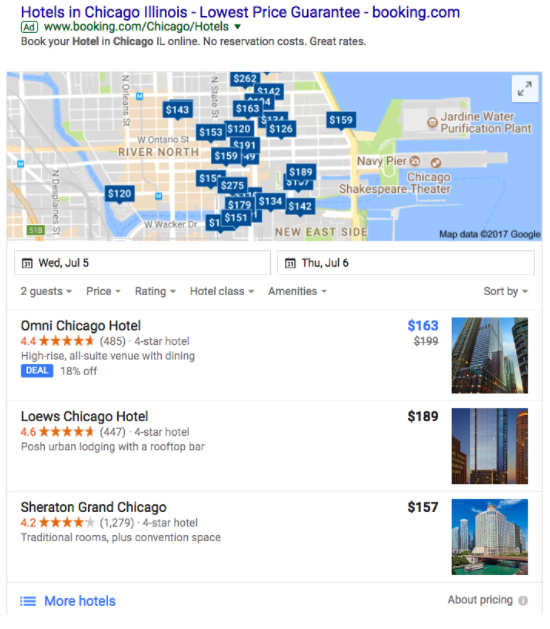
  • LOCAL SEARCH IS MOVING TOWARDS A PAY-TO-PLAY MODEL. Google is continuing to monetize search results, the most recent changes being seen in local search within the Google My Business listings and map pack. Just a couple weeks ago Google changed their map results to show rate cards directly on the map, as shown below:


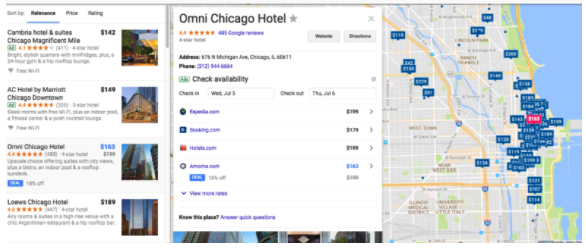
Here’s another view, taken directly from inside Google Maps:
Screen-Shot-2017-08-15-at-3.52.07-PM

In the above screenshot, you can see two different ways Google’s monetized the local search results for hotels. The first is the ads on the far right for Cambria Hotel and AC Hotel. These ads are managed directly through Google Adwords paid search campaigns. The second is shown in the details view for Omni Chicago Hotel, which are the OTA channels displaying with rates – these ads are populated through Google’s Hotel CPC program. Google’s Hotel CPC program is a form of metasearch and managed separately from Google Adwords paid search campaigns.

HOW CAN HOTELS PARTICIPATE IN METASEARCH?

Hotels can participate in Metasearch directly through their Google Hotel partner booking engine providers. The Google Hotel program requires a direct API with rates and inventory feed directly from booking engine to Google. Google Hotel CPC partners include Synxis, TravelClick and more. You can find a full list here. Pricing through your booking engine is typically set up on a commission based model that charges you a percentage based on revenue from reservations driven by the campaigns. Some also charge CPCs on top of this commission. Review contracts with your booking engine partner to ensure it will be a profitable model for your hotel.

HOW CAN HOTELS BE SUCCESSFUL WITH METASEARCH?

Just like all other marketing channels and campaigns, it is important to closely monitor key performance indicators from your metasearch campaigns.

  • Work closely with your booking engine partner to ensure you are receiving reports that detail clicks, CPCs, costs, reservations and revenue attributed to these campaigns.
  • Monitor KPIs through each metasearch channel – which channels are performing best? Which ones are costing you money? Not all metasearch channels will perform the same. Make sure your booking engine partner that is managing your campaigns are shifting budget to the ones that work best for your hotel.

Have a question? We can help.
5 Perks of Using Search Keywords in Display Advertising Targeting

SHARE:

TARGET KEYWORDS IN DISPLAY ADVERTISING TO FURTHER QUALIFY TRAFFIC

While advertising efforts at many companies are siloed within the different departments, the search and marketing specialists at GCommerce have been working at a more cohesive, full-funneled marketing approach. In an effort to have our search and display campaigns work more symbiotically, we’ve been utilizing search terms in our display prospecting campaigns. While bidding on paid search terms can be quite costly, our display platform allows for the ability to target up to 10,000 keywords to include or exclude for a lower average CPM than paid search efforts. While there are many advantages of using keywords for display advertising, here are a few:

1. TARGET VIEWERS WHO HAVE SEARCHED EXTREMELY COMPETITIVE/EXPENSIVE KEYWORDS TO ASSIST PPC EFFORTS

Market terms tend to be more competitive and expensive – especially in highly – competitive markets such as Los Angeles, Miami, and New York. A hotel could blow through their entire budget trying to compete for terms such as “hotel in NYC” or “resorts in Miami.”When building a keyword list for a display network, it’s important to include these terms in your display advertising targeting, providing hoteliers the opportunity to serve a display ad to users who have searched for these terms within a recent window. If the user clicks on the display ad or visits the site later after remembering the ad, they will now fall into the “remarketing” category. After this occurs, hoteliers can serve these users remarketing ads in the form of social media, paid search, or another, more compelling and targeted, display ad.

2. TARGET MORE QUALIFIED VIEWERS

Some display efforts only encompass more surface level targeting: geo-targeting, device targeting, and content verticals (i.e. the “types” of websites you would like your ads displayed on, such as technology, sports and entertainment, and music) By using search terms in your display targeting, you can ensure you’re reaching viewers who are in the research phase of their travel journey. For example, viewers searching for “flights to LA,” “Hollywood Bowl tickets,” or “hotel in Hollywood” would be more likely to book than someone who has not searched for those terms.

3. TARGET PEOPLE WHO HAVE SEARCHED FOR YOUR COMPETITORS

Who doesn’t want the opportunity to get in front of one of their competitors’ prospective clients? Keyword targeting in display ads provides our clients the opportunity to show one of their own display ads to someone who has searched for a competitor’s name. If your ads are compelling enough, this provides hoteliers the chance to make a great first impression on someone who would have booked elsewhere.

blog_keywordsindisplay_image_3-e1501782309935

4. UTILIZE EYE-CATCHING CREATIVE BASED ON SEARCH TERMS

This is extremely helpful for very targeted and specific campaigns. For example- targeting for weddings can be difficult with traditional display efforts. Out of the million ad impressions you pay to serve, it is likely that only a fraction of those impressions were served to potential brides, grooms, or wedding planners. However, with keyword targeting, you can reach very qualified viewers searching “wedding venue in New York” with a beautifully crafted display ad showcasing the breathtaking venue.

blog_keywordsindisplay_image_1

5. EXCLUDE UNQUALIFIED VIEWERS

If you’re a luxury brand, you don’t want to waste impressions on a viewer who is searching for a the cheapest rate– and if you’re a value-focused property, you don’t want to waste impressions on viewers seeking a luxury experience. The ability to exclude search terms is just as valuable as the ability to target them, especially as hoteliers’ average cost per acquisition continues to rise.

WANT TO LEARN MORE ABOUT HOW GCOMMERCE CAN HELP YOU REACH THE RIGHT GUESTS?

Potential Changes to Google Analytics are Looming

SHARE:

% OF NEW SESSIONS MISSING | CHANGES TO GOOGLE ANALYTICS METRICS

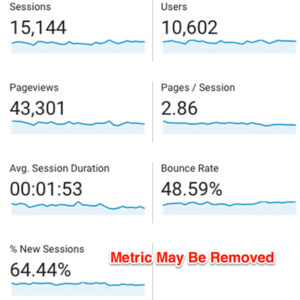
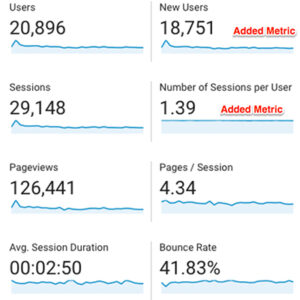
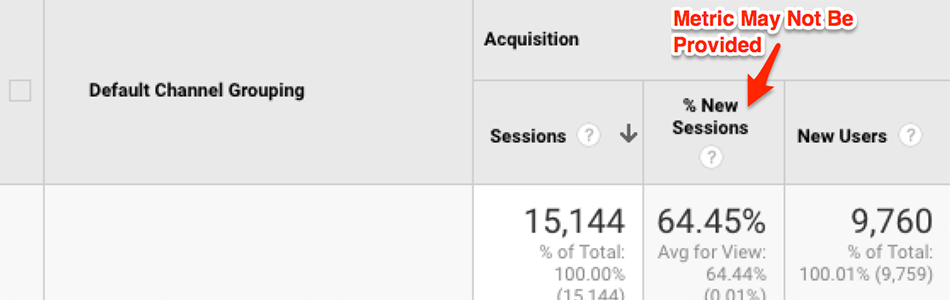
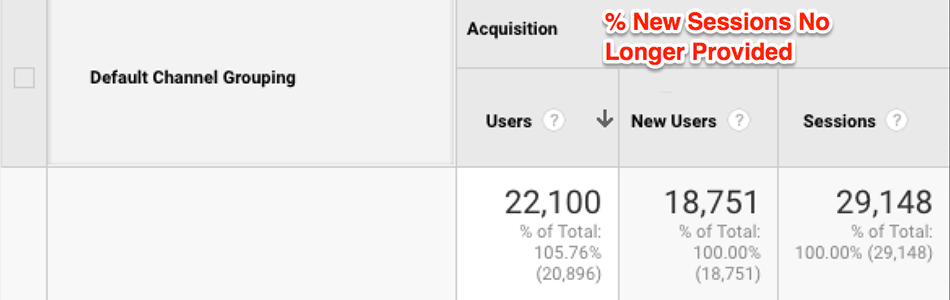
For users of Google’s Premium Analytics services, you may have noticed a slight change in the way that default metrics are being displayed. Google has removed the % New Sessions, added in Number of Sessions per User and New Users. They have also re-ordered the metrics to show Users and New Users ahead of Sessions.

CURRENT VIEW, SESSIONS FIRST:

2017.04_Blog_Image_Copy_Left_2_AnalyticChanges

NEW VIEW, USERS FIRST:

2017.04_Blog_Image_Copy_Right_1_AnalyticChanges

CURRENT VIEW, SESSIONS FIRST:

chart

NEW VIEW, USERS FIRST:

2017.04_Blog_Image_Copy_Bottom_2_AnalyticChanges

% New Sessions can still be viewed in Custom Reports, Dashboards, and Segments or as a Secondary Dimension on most reports within Google Analytics.

We were unable to find any documentation from Google that they are updating the default views in Analytics. Representatives from Google Analytics would not confirm nor deny any changes, however, a support specialist was able to share over the phone that Google has internal documentation showing that this change is rolling out to all Google Analytics accounts over the next few months. This representative let us know that Google is moving to a focus centered more around Users, rather than Sessions, which is reflected in these updates.

Just last week, Google made an announcement that they would be extending Remarketing List Audiences across devices. They have also made numerous changes over the last few years in the way that ads can be remarketed. It seems that the move to a stronger focus on Users in Google Analytics is an effort to better track and target individual users with ads through Google’s Ad services across all devices, through multiple platforms and channels.

If Google is rolling out other changes with this one, it is yet to be seen. However, we expect Google to continue to advance their tracking, reporting, and advertising to be more user and audience focused with greater opportunities to remarket and segment individual users across devices and through multiple channels within Google’s extensive advertising network.

Guerilla Marketing Through Facebook Advertising

SHARE:

To some, April represents a race against the clock and scrambling to file taxes. To others, it equates to tax rebates and impromptu purchases. To hoteliers, it symbolizes struggle: the struggle to capture lost revenue resulting from mud season; the slow wait for the snow to melt and trails to dry. The solution? Connect consumers and their new-found disposable income with hoteliers looking to put heads in beds. The results of seasonal transitions are thoroughly understood by GCommerce. As residents of a resort town working with multiple hotels and resorts who must face the challenges of operating around seasonal traffic, we understand the trials and tribulations associated with putting heads in beds during these downturns in traffic. To ensure low cost-per-acquisitions (CPAs) and high return-on-investments (ROIs), hoteliers must ensure their marketing efforts are efficient. The ability to advertise on a cost-per-click (CPC) or cost-per-1000-impression (CPM) model, with both costs well below that of display advertising or media buys, allow hoteliers to deliver on the aforementioned objective. To date, GCommerce has seen an average ROI of 40-to-1 on Facebook Advertising campaigns.

FACEBOOK ADVERTISING: BUILDING YOUR NEXT GUERILLA MARKETING CAMPAIGN

Step 1: Match Need Periods to Upcoming Events

To the Tivoli Lodge, an iconic mountain town property, summer and winter mean high occupancy and a high ADR. Spring and fall however, equate to lower occupancy and a struggle to capture minimal market share. Crossmatching need periods with local events, those that put heads in beds, allow properties to combat seasonal lows.

Step 2: Determine Interest Surrounding Upcoming Events

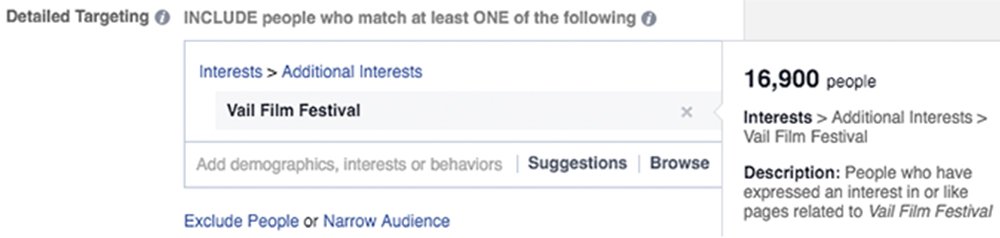
Once a comprehensive list of upcoming events has been identified, determine what, if any garner enough buzz to be identified as an Interest on Facebook. Using Facebook’s Detailed Targeting tool, we’ve identified that the following Vail events garner enough traffic to build a campaign around – Vail Film Festival and Bravo! Vail Music Festival.

2017.04_Blog_Image_Copy_1_FacebookGuerrillaMarketing

Step 3: Create an Informative Landing Page

A successful landing page will educate site visitors, providing thorough details about the event, and engage your audience, beautifully illustrating the experience that awaits.

Step 4: Develop Ads with Relevant Imagery and Copy

An eye-catching, vibrant image is a must. As our attention spans dwindle, it is imperative to capture the attention of those scrolling through their news feeds. Similar to your landing page, the ad should provide event details, yet focus on selling the experience to come rather than the product at hand. Your words must send your reader into a daydream, allowing them to imagine themselves at the event, as well as the experience they’ll have while staying at your property.

2017.04_Blog_Image_Copy_3_FacebookGuerrillaMarketing

Step 5: Launch Your Campaign!

Satisfied with your landing page? Do your ads provide engaging imagery and captivating content? If your answer to both is yes, then you’re ready to launch your campaign! GCommerce recommends the utilization of conversion tracking through Facebook and custom URLs developed through Google’s URL Builder to track key data via Analytics. Challenged with need periods resulting from seasonal transitions? Look to Facebook Advertising to execute guerilla marketing efforts by targeting local events and attractions as a way to increase awareness, drive qualified traffic to your site, and capitalize on your new-found prospects. Questions? Concerns? Allow us to help launch your next campaign!

insert

A/B Testing: Why and How We Do It

SHARE:

If you’ve worked with any form of digital marketing, the phrase “A/B Testing” is bound to have come up at least once during your experience. In short, A/B testing is a tool used to figure out the best digital marketing strategies for your business through testing different variables. A/B testing is frequently used with many different channels including email, social, website, and display. Variables can be related to copy, imagery or even user experience functionality. For instance, a popular A/B test includes testing out different subject lines for the same email to see which drives more engagement. A/B testing allows you to single out what the most compelling aspects of your digital marketing are, which can help drive strategy and successful returns.

HOW TO A/B TEST

1. DEFINE YOUR GOALS AND HYPOTHESES

The first step to a successful A/B test is to understand two major things: your business goals and the goals of your buyers. If you don’t know why you’re A/B testing in the first place, it’s difficult to pin down the right variables to test. Understanding who your buyers are and what they want helps you understand where tension may be occurring in your messaging. Is your offer in line with what your customers want? Is your copy consistent with your landing page or imagery? Are customers understanding what you’re trying to say? These are a few common pain points in digital marketing that can be used to not only understand what you should test, but what metrics and hypotheses are important to your test.

Hypotheses are used to provide a sound foundation for your A/B test. Kevin Ho at Wishpond provided a simple framework for developing a quality A/B testing hypothesis:

ABHypothesisImage1-300x166

Using this framework can help develop strong A/B testing hypotheses in-line with your goals and objectives. Use these hypotheses to guide your metrics and test development to always bring it back to the bottom line.

2. DEVELOP YOUR TEST

Once you understand these important pieces of information, the next is to develop your content. The name “A/B Test” is an allusion to the fact that you are creating two different versions of one piece of content (Version A/Version B) and only making changes to a single variable. Common variables are email subject lines, landing pages, a call-to-action button, or even the image associated with your content. You will then distribute these two versions to your sample.

ABTestingDiagram1-300x166

In order to keep your data clean and informative, you should only run one test per campaign. This is to make sure that any increases or decreases can be directly attributable to the single variable that you are testing. For instance, if you decide to A/B test your copy and your imagery, how do you know which one impacted your engagement? The example below illustrates the testing of one variable for a hypothetical Facebook ad, the image. Notice the copy, link and CTA remain the same.

Untitled-2

3. TEST, TEST, TEST

A/B tests are not done overnight, you want to make sure you are generating enough traffic and engagement to justify any decisions you are going to make regarding future marketing initiatives. Therefore, it is important to let A/B tests run anywhere from a few days to a few weeks in order to make sure that results are substantial enough to take confident action. However, it is also important to make sure that you aren’t letting your A/B tests run too long because this can also negatively affect your data. Ultimately, it’s up to you to decide what the appropriate amount of traffic or length of time is, but be sure to make smart decisions about when enough data is truly enough.

4. ANALYSIS + DECISION MAKING

The goal of A/B testing is to obtain actionable data about your marketing tactics. What this data looks like and whether or not you consider it actionable is up to you and the goals of your business, but typically you eliminate the lower performing variation or use the data to inform a new A/B test. Your data will either prove or disprove your hypotheses or be found inconclusive. Either way, this data should be used to optimize your digital marketing efforts through reducing inefficiencies by obtaining a thorough and clear understanding of what your customers are looking for.

SUMMARY

The goal of any business is to increase its bottom line and A/B testing allows you to do this by optimizing your marketing strategies. It’s important to understand why and how A/B tests are used in digital marketing in order to remain informed on what messaging and experiences your customers are looking for. While there are endless amounts of variables to test, following the above advice can help you craft an effective A/B test and increase your digital marketing returns.

The Key to Effective Digital Marketing: Delivering Great Content

SHARE:

“Content” is the trendy new word that’s been sweeping the digital marketing space for the last few years. Hundreds of webinars and thousands of blog posts have mentioned the topic, continually hitting home on how important it is to not only deliver good content but deliver great content. But to understand how to deliver great content, it’s important to understand what “content” is.

Content is every post, picture, piece of copy, or story you are trying to tell through your marketing efforts, it is everything you share with your audience. Rebecca Lieb likened content to the “atomic particle of marketing.” There is no marketing without content, regardless of channel. Creating effective and engaging content is the best digital marketing strategy you can adopt and is the foundation for digital marketing success.

IT’S NOT ABOUT YOU

Perhaps the first and most important thing to understand about delivering great content is this: it’s not about you. Content marketing is about your audience. In another post, we talked about boosting engagement with email marketing campaigns. One of the suggested steps is to ask yourself “Who am I targeting and what interests them?” This applies to any form of content marketing. If you aren’t considering who you are trying to market to and what they want, your content is going to fall flat. That being said, it’s still important to maintain your voice.

In a webinar from Skyword, one of their first steps to good content marketing is understanding your “why?” When we say “why”, we are referring to why you’re creating content in the first place. What do you want to give people? What do you want them to know about you? Why do you want them to read your content? One of the best content marketing campaigns of 2016 belonged to Deadpool. Everything from pre-release to post-release was crafted with the singular purpose of conveying to the reader that Deadpool was in no way, shape, or form, your regular superhero movie experience. Below is one of the many movie posters created for the box office hit.

Deadpool was, at its core, a satirical superhero movie with heart. In a world inundated with superhero after superhero, audiences were clamoring for something different and that’s exactly what Marvel gave them with Deadpool and it was their “why” for their content marketing strategy. Understanding your why is key to developing good, actionable content because it serves as a constant reminder of what you want your audience to know about and learn from you while still keeping them at the heart of your campaign.

Untitled-21

LEVERAGE YOUR ENVIRONMENT: DIGITAL AND PHYSICAL

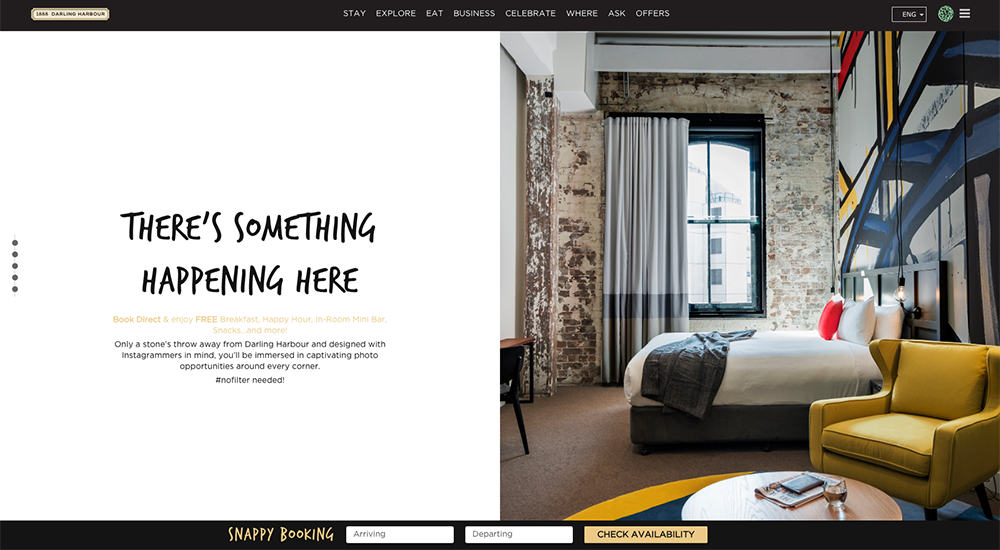
So now that you know why you’re delivering content, how do you create or find it? There is a multitude of ways to create engaging content, but perhaps one of the easiest and most effective ways to do this is through leveraging your environment, both digital and physical. The 1888 Hotel in Sydney, Australia rebranded itself as an “Instagram hotel” using its creative and eye-catching interior to develop Instagram devoted spaces and using the Instagram photos and experiences of its guests to adorn its walls, website and social media feeds. Here is one of its website homepage modules promoting Instagram-worthy interiors:

Blog_GreatContent_Image_3

Utilizing hashtags, trending topics or even local and world news and events are all fair game for delivering great content. Find out what your audience is talking about and join the discussion. But remember that content isn’t just external, your guests, employees, and property-at-large are having unique experiences every day.

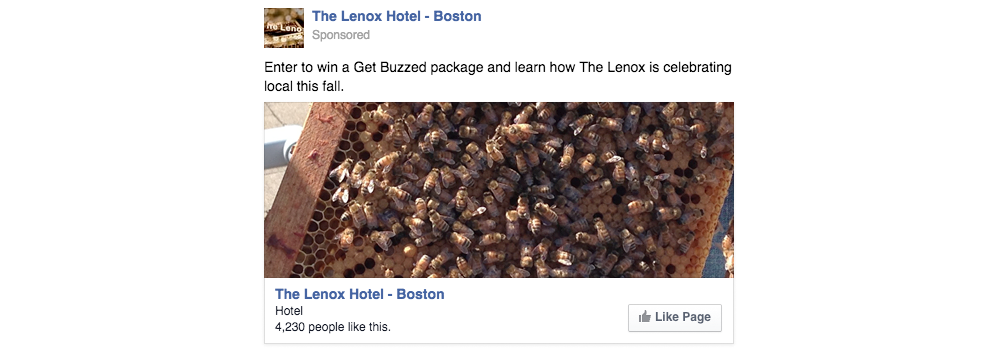
In 2014, The Lenox Hotel in Boston welcomed 120,000 new tenants to their property: bees. Yes, you read that correctly, they welcomed a colony of bees. The bees were brought in to produce honey that would be used for signature drinks and dishes created at The Lenox’s restaurant and lounge. Rather than just put up notices, GCommerce and The Lenox teamed up to rally behind the bees, creating bee-themed stay packages and content campaigns to generate buzz about the hotel’s unique news. This not only won them a Silver Award at the 2014 Adrian Awards but significantly increased their following and engagement for their email and social channels.

Blog_GreatContent_Image_4

This goes to show that great content is located all around you, both digitally and physically. To hear more about what’s going on around you, think about installing a suggestion box, creating an email account, or reminding guests and employees to share their stories as they interact with your brand.

CREATE STRONG HEADLINES

People definitely judge books by their cover, at least when it comes to content marketing. We’ve talked before about how important email subject lines are to email marketing campaigns and that extends to just about every piece of content marketing you do. Copyblogger released the following statistics about content headlines and what they mean for engagement:

  • 80% of people will read your headline
  • 20% of these people will read the rest of your content

With statistics like that, it’s clear that your headlines matter. So what can you do to make sure that you are creating strong headlines? Studies showthat headlines should stay in the 8-12 word range and be specific without being too gimmicky or sensational. In a world where clickbait is becoming increasingly popular and infamous, don’t deceive the reader with your headline, but don’t give it all away either. Try and utilize keywords as well, optimizing for SEO and social.

MEASURE, MEASURE, MEASURE

Digital marketing is all about generating actionable data and this should be no different in your content marketing strategy. One of the ways to do this is through conducting a content audit. This audit can be everything from metrics across content marketing campaigns to the quality of individual posts. Which campaigns or posts are seeing the most engagement and why? Is your content accurate and trustworthy? Is it linking to authoritative sources? Is it fresh? These are all questions that you should be asking yourself about your content. As George Santayana said, “Those who cannot remember the past are doomed to repeat it.” So remember your content, why it did or did not perform, and understand how you can use that data in the future.

SUMMARY

Effective content marketing is the key to digital marketing success. Content affects everything from your search rankings and engagement to brand awareness and repeat conversions. Understanding your “why” and your audience sets the stage while leveraging your environment can provide fun, informative and engaging content for those following your brand. Just be sure to audit your content to obtain actionable data about the health of your content marketing program.

Keep Reading