How hotel groups can unlock portfolio-level benchmarking
The challenge of fragmented data
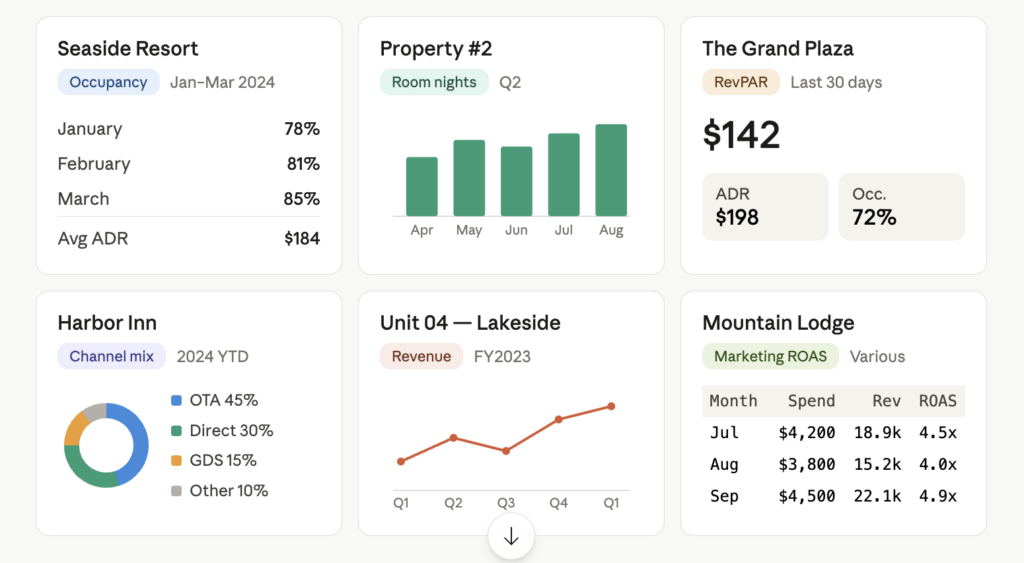
Hotel ownership groups and asset managers are awash in data. Every property produces reports on occupancy, bookings, marketing, and revenue. But because each property tracks and reports differently, it’s nearly impossible to compare results in a clean, consistent way.
The reality is that most reporting still happens at the property level. While useful, this creates blind spots when owners need to see the big picture.
Why portfolio benchmarking matters
Portfolio-level benchmarking changes the conversation from individual performance to collective insight. With a unified rollup, owners can:
- Spot outliers — Identify top performers and struggling properties instantly.
- Compare consistently — Measure ADR, RevPAR, ROAS, and direct booking share apples-to-apples.
- Reallocate resources — Direct capital, staffing, or marketing investment where it will drive the greatest impact.
- Build accountability — Ensure each property is held to consistent benchmarks, not arbitrary local standards.
A practical example
Imagine a 10-property portfolio. Eight hotels are delivering a healthy marketing ROAS, but two are significantly underperforming. With rollup benchmarking, those underperformers don’t get hidden in averages — they’re flagged for immediate attention. Owners can investigate if it’s a budget issue, a market dynamic, or an operational gap.
Meanwhile, standout properties become models of best practice. If one property is generating exceptional direct bookings, owners can replicate that approach across the portfolio.
From reactive to proactive leadership
With portfolio-level data, ownership groups move from reactive reporting to proactive strategy. Decisions about where to invest, where to intervene, and how to grow are backed by transparency.
For hotel groups, the future is clear: portfolio-level benchmarking is no longer optional. It’s the foundation of profitable growth.
Stop guessing. Start knowing.
Managing performance across multiple properties and channels shouldn't require hours of manual reporting or a tolerance for blind spots. GCommerce Rollup APIs give hotel operators and technology partners a single, unified view of their data: clean, structured, and ready to act on.
The Multi-Property Rollup API aggregates performance across your entire portfolio, so you can compare results by region, brand, or management group, all in one place. The Channel Rollup API brings paid search, metasearch, display, and social into a single schema, making it easy to evaluate true ROI and spot budget shifts across every media type.
Both APIs connect directly to the BI tools and dashboards you already use, backed by real-time endpoints, normalized data models, and two decades of hospitality data expertise. Integrate once. Scale everywhere.
Contact us today to get started with your portfolio-level benchmarking.
Frequently asked questions about portfolio-level benchmarking
Portfolio-level benchmarking is the practice of rolling up performance data from every property in a hotel group into a single, standardized view. Instead of reading each hotel’s report in isolation, owners and asset managers can compare metrics like ADR, RevPAR, ROAS, and direct booking share on a consistent, apples-to-apples basis. This turns a stack of disconnected property reports into one clear picture of how the whole portfolio is performing.
Property-level reporting is useful for day-to-day management, but it creates blind spots at the ownership level because each hotel tends to track and format its data differently. One property might report occupancy in a table while another leads with RevPAR or only tracks channel mix, often across different date ranges. That inconsistency makes true comparison nearly impossible and lets underperformers hide inside portfolio averages until the problem is already costing money.