Smarter campaign structure for stronger cyber sale results
Cyber season is no longer just a nice-to-have on the hospitality marketing calendar. It's one of the highest-stakes promotional windows of the year, and the gap between a well-structured campaign and a loosely assembled one is growing wider.
For Cyber 2025, we ran a structured test across a consistent group of hotel and resort clients to answer one question: Does building Cyber promotions inside existing campaigns outperform launching net-new ones?
The results were clear, and they have real implications for how hospitality brands should think about campaign architecture heading into 2026.
The strategy shift: Building inside what already works
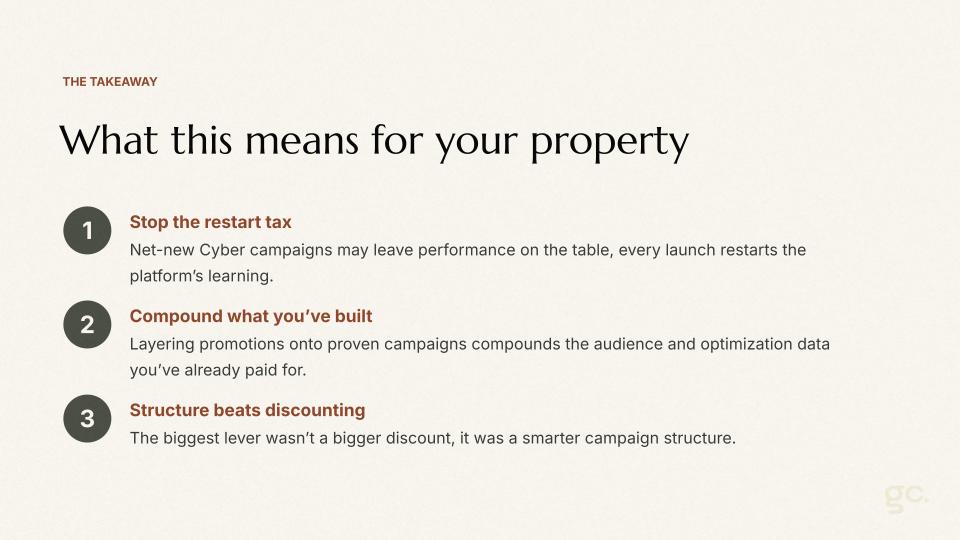
In 2024, most Cyber campaigns followed a familiar playbook: launch a separate, net-new campaign for the promotional window. It's a logical approach. Isolated campaigns let you control budgets, tailor messaging, and track results cleanly. But they also come with a hidden cost.
Every new campaign starts the learning phase from scratch. Platforms like Meta need time to optimize delivery, which is a disadvantage when your sale window is measured in days, not weeks.
For Cyber 2025, we flipped that model. Instead of launching new campaigns, we added new ad sets inside existing, always-on campaigns. The goal was to carry forward the historical performance data, audience signals, and optimization momentum that those campaigns had already built. According to Meta's own guidance on campaign learning, campaigns that exit the learning phase deliver more stable and efficient results. We wanted to start there, not work our way back.
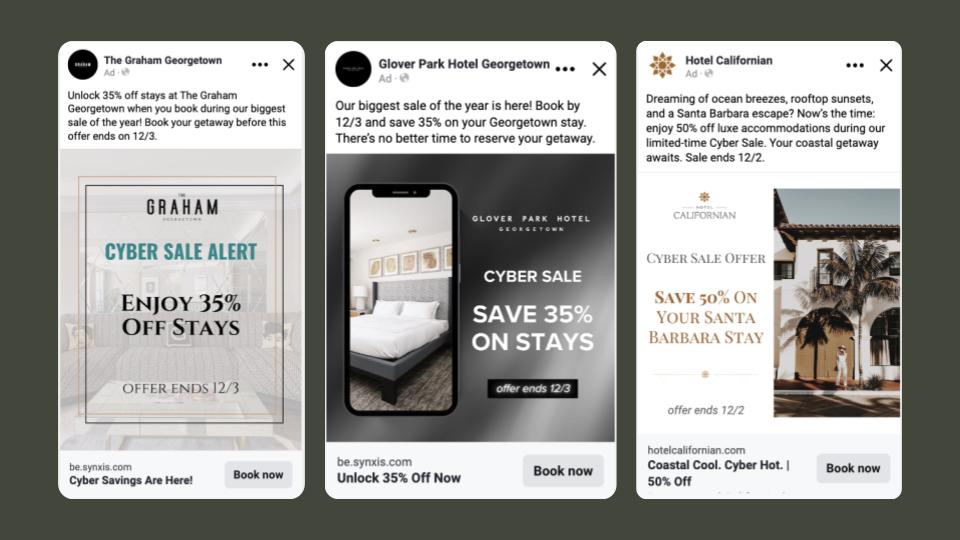
What the numbers actually showed
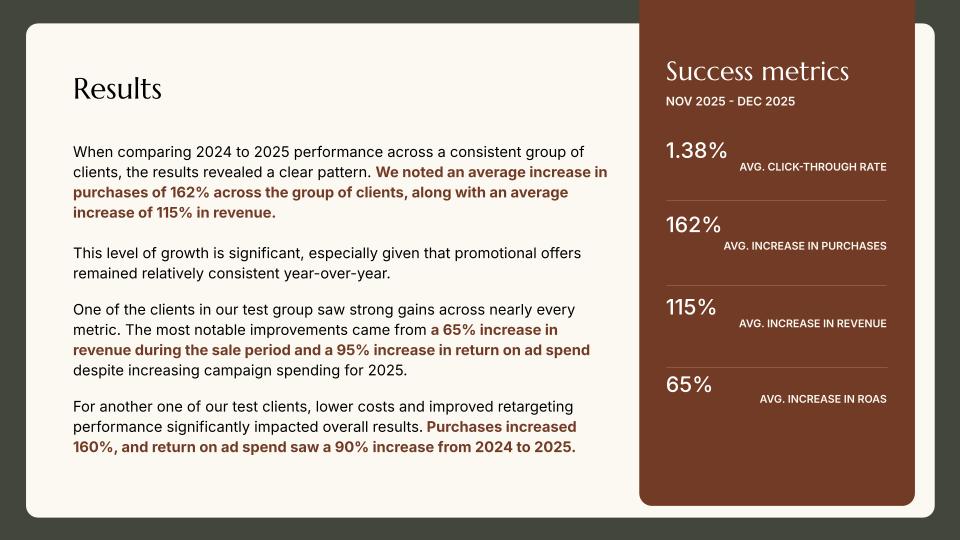
The results across our test group were significant. Purchases increased 76% year over year. Revenue grew 78%. And this happened while promotional offers remained largely consistent between 2024 and 2025.
The efficiency story was just as strong:
- Prospecting cost per thousand impressions (CPM) dropped 35%
- Retargeting CPM dropped 39%
- Combined CPM across both audiences decreased 38%
Reaching more people at a meaningfully lower cost, while converting more of them, is the kind of outcome that moves the needle for a property's overall paid media return.
Individual property results reinforced the pattern
One property in the test group saw a 65% revenue increase during the sale period alongside a 95% lift in return on ad spend (ROAS), even after increasing overall campaign spending in 2025. Another saw purchases jump 160% with a 90% improvement in ROAS. These aren't edge cases. They represent what becomes possible when campaigns start optimized instead of having to earn it.
Lower click-through rates, better results
One of the more counterintuitive findings: click-through rates declined across the group, yet performance improved. This is consistent with what research from Nielsen has long argued: click-through rate is a weak proxy for advertising effectiveness. Campaigns became more efficient at reaching the right users at the right time, and those users converted.
The takeaway for hospitality marketing teams is worth internalizing. Optimizing for clicks during a short promotional window can actually work against you. The platform rewards campaigns that demonstrate delivery efficiency and conversion intent, not engagement metrics alone.
What to keep in mind before restructuring your Cyber campaigns
These results are strong, and context matters. A few variables influenced this test that any team should account for:
- Several 2025 campaigns ran longer than their 2024 counterparts, which likely contributed to higher overall totals.
- Some properties shifted their offers from a flat discount to "up to X% off," which can influence how users perceive and respond to the promotion.
- A handful of clients moved from animated creative in 2024 to static imagery in 2025.
Campaign structure is a meaningful lever, and it's not the only one. Creative quality, offer strength, audience targeting, and budget strategy all shape outcomes. The structure creates the conditions for efficiency. Everything else determines whether you take full advantage of it.
This aligns with findings from Boston Consulting Group's work on marketing personalization and data activation, which consistently shows that leveraging existing behavioral data outperforms cold-start targeting when promotional windows are compressed.
What this means for your 2026 Cyber strategy
If your team is already planning for Cyber 2026, the campaign architecture conversation should happen now, not in October.
A few practical steps worth building into your planning process:
- Audit your always-on campaigns and identify which have the strongest historical performance signals. These are your candidates for housing Cyber ad sets.
- Plan your creative and offer strategy early enough to build and test before the promotional window opens.
- Set clear performance benchmarks against your 2025 results, and track CPM alongside ROAS, not just click volume.
- Build enough flexibility into your budget to scale what's working during the sale window without restarting a new campaign mid-flight.
Cyber season rewards preparation. The properties that saw the strongest results in 2025 weren't improvising their structure in November. They built a foundation that let the platform work for them.
Ready to build a smarter Cyber strategy?
Campaign structure is one of the most underutilized levers in hospitality paid media. If your team wants to stress-test your current approach, rebuild your Cyber architecture ahead of 2026, or just understand what's driving your CPM costs, we'd love to dig into it with you.
Reach out to the GCommerce team at gcommercesolutions.com and let's talk about what a stronger Cyber season looks like for your property.
Frequently asked questions about cyber campaign structure
It can, with some caveats. The core advantage of building Cyber promotions inside existing campaigns is access to historical performance data and established audience signals. If a property has never run paid campaigns before, that foundation doesn’t exist yet. For first-timers, the priority should be launching always-on campaigns well ahead of the Cyber window so the platform has time to learn and optimize before the promotional period begins. The structure works best when there’s something worth building o
There’s no universal threshold, but campaigns that have fully exited the learning phase and have consistent delivery and conversion data make the strongest candidates. Generally, a campaign running for at least 60 to 90 days with steady performance gives the platform enough signal to work from. The more conversion data the campaign holds, the better positioned it is to optimize quickly when a new ad set goes live inside it.
Offer changes don’t eliminate the structural advantage, but they do add a variable worth tracking closely. A meaningfully different offer, whether in discount depth, booking window, or terms, can shift user behavior in ways that make year-over-year comparisons harder to interpret. The campaign still benefits from existing audience data and delivery efficiency. Just build your benchmarks around the new offer rather than assuming prior-year conversion rates will carry over directly.