The ultimate hotel guide to seasonal paid search marketing

SHARE:

Seasonal paid search marketing is a great way to meet your hotel’s shifting objectives throughout the year. However, it can also be somewhat complex, making it tricky to ensure the best outcome for campaign performance through seasonal marketing.

If you’re interested in seasonal paid search but unsure where to start, this guide is for you. We’ll answer frequently asked questions about seasonal paid search advertising and provide advice to get you started with your hotel or property.

Should my hotel use seasonal paid search advertising?

Though seasonal paid search marketing can come with a number of benefits, a seasonal ad strategy doesn’t make sense for every hotel. An occasional ad copy refresh is always a good idea, but for some hotels, the time spent on consistent seasonal updates would be better used towards other optimizations. 

Seasonally shifting demand drivers

Seasonal paid search advertising is best used when your hotel has shifting demand drivers. This could include seasonal draws such as skiing, yearly events in the area, or even amenities such as an outdoor pool. Weather and climate can also act as a seasonal demand driver. For example, tropical climates may be equally appealing year-round, but travel in a location with clear seasonal divides may see fluctuations with those weather changes.

Season-dependent hotel demand drivers

Certain hotel demand drivers can also provide a compelling reason to implement seasonal paid search advertising. Hotels prioritizing year-round outdoor adventures, for example, may want to call out the unique experiences available during each season. For a hotel located near a large arena or stadium, drawing more attention to location may be a smart move when the relevant sports are in-season. Even a shift in business mix could be a reason to add seasonal paid search advertising, gearing language more towards a business or leisure audience, depending on the month.

Booking trends don't always match demand drivers

Most hotels have slight differences in seasonal demand, but this isn’t always the result of a unique demand driver. Though booking volume often fluctuates, seasonal paid search marketing is most effective when the reasons for those bookings change. If guests are drawn to your hotel for somewhat consistent reasons throughout the year, a seasonal paid search marketing strategy may not be necessary for your hotel. 

Does my hotel need seasonal paid search marketing all year?

Deciding when to run seasonal paid search advertising comes down to your hotel’s unique demand drivers. Depending on the reasons that your guests book, your hotel may benefit from seasonal ads for a few weeks, a few months, or the entire year.

Year-round messaging for year-round demand drivers

If your hotel has ever-changing demand drivers with unique draws across all seasons, you may find success with year-round seasonal rotation. Since features vary across winter, spring, summer, and autumn, it can be beneficial to call out shifting experiences throughout the year. Hotels based on outdoor adventures are a great example of this. Winter sports, spring hikes, summer water activities, and autumn colors all have a unique draw, so individual paid search advertising for every season may be beneficial.

Seasonal messaging for peak seasons

On the other hand, hotels with demand drivers falling into one “peak” season may only need seasonal paid search advertising during that period. Ski resorts, for example, may only need seasonal callouts during the snowy months. While spring, summer, and autumn have some unique features, tailored ads might not be necessary during those times since the main seasonal demand driver is contained to the winter months.

Maintain messaging during the off-season

However, it’s important to remember that demand drivers may not completely disappear during the off-season. Though paid search advertising is most effective when focusing on demand drivers from the current season, many guests plan their stay months in advance. Because of this, it’s smart to provide some level of visibility for all seasonal demand drivers throughout the year, regardless of how often your hotel rotates dedicated seasonal messaging.

Should my hotel simultaneously run evergreen paid search advertising?

The answer to this question once again relies on your hotel’s particular demand drivers, as well as your marketing objectives. 

Performance considerations

Running simultaneous seasonal and evergreen messaging offers more to work with for paid search advertising platforms, which could help performance. A wider variety of ad copy creates more opportunities for a platform to tailor your hotel’s ads, optimizing paid search campaigns to reach your target guests. A higher number of assets could also mitigate ad fatigue, as the same copy is less likely to appear multiple times to the same user. 

However, multiple paid search ads create more moving parts in an account, potentially increasing the time required for campaign management. Balancing multiple ads can complicate your hotel’s paid search marketing strategy, sometimes making it difficult to identify key optimization tactics or diagnose performance changes down the road. 

Significance of demand drivers

Another factor in the decision to run evergreen ads is the significance of your hotel’s seasonal demand drivers. In cases where seasonal features are a core draw for your hotel, it may be beneficial to run seasonal ads exclusively. For example, if the vast majority of guests book to see a basketball team located near your hotel, abandoning evergreen ads during basketball season may be the right choice.

Conversely, if most guests book your hotel for a feature that’s available year-round, such as a downtown location or high-end service, then evergreen ads are an essential component of your paid search marketing that should not be removed. Seasonal ads are still a great way to call out additional benefits and experiences available throughout the year, but running these ads alongside evergreen messaging will ensure that seasonal callouts do not detract from the primary draws of your hotel.

How unique should seasonal paid search advertising be?

Whether seasonal paid search marketing is used alone or in tandem with evergreen ads, and regardless of how often this messaging is rotated, your hotel should aim to balance unique seasonal features with year-round benefits. Though the exact mix of these demand drivers will vary by hotel, seasonal paid search marketing should always incorporate messaging related to both types.

Multi-purpose messaging

Many features of a hotel stay the same year-round, and these can be repeated in paid search advertising throughout the year. As long as they call out a consistent benefit of the hotel, headlines and descriptions can be fully or partially re-used in evergreen ads and multiple seasonal ad variations. 

Significance of changes

Even when features change seasonally, the significance of these changes affect how different each seasonal ad should be. Some hotels require complete paid search advertising overhauls to call out unique demand drivers, while other hotels only need small tweaks and slight wording changes to fit each season. 

Structural separation

However, we do recommend structurally separating paid search advertising for each season, regardless of how similar messaging is between rotations. Creating individual ad variations keeps your paid search campaigns far more organized, making it faster and easier to implement seasonal changes, compare performance across time, and analyze the effectiveness of a seasonal paid search marketing strategy overall.

Seasonal paid search advertising examples

While seasonal paid search advertising should align with your hotel’s individual demand drivers, marketing goals, and brand voice, we know that’s easier said than done. Here are a few example ads to get you started.

Example 1: Hotel in an area known for skiing

This hotel only requires seasonal paid search advertising during the winter.

Example 2: Outdoor-focused hotel

These ads call out unique experiences available during each season.

Example 3: Downtown hotel in a city with four distinct seasons

These ads are a great example of re-using assets between seasons.

Should my hotel use paid search keywords seasonally?

Regardless of your paid search advertising strategy, it’s always a good idea to utilize keywords related to seasonal demand drivers. Targeting these keywords can boost awareness and visibility, potentially driving more bookings for your hotel. 

Unlike ads, though, seasonal paid search keywords do not need to be rotated throughout the year. Even if a keyword has low volume when out of season, this will not actively harm your hotel due to the cost per click model on paid search, though seasonal keywords may not generate as many impressions, clicks, or bookings during the off-season, your hotel will only pay for what is generated, leaving no direct impact on overall account efficiency or optimization.

In fact, seasonally rotating keywords could actually cause problems on its own. Guests often plan for seasonal trips months in advance, with seasonal searches lingering through the off-season. Because of this, removing a seasonal keyword could cause your hotel to miss out on important searches and potential bookings, negatively impacting performance.

When should my hotel rotate seasonal paid search advertising?

Because seasonal demand drivers vary so widely, your hotel’s seasonal paid search schedule will depend on your particular circumstances. While most hotel seasons can be broadly divided into winter, spring, summer, and autumn, the exact dates and time periods will change based on the area your hotel serves.

When developing a seasonal paid search marketing schedule, keep your hotel’s marketing objectives in mind. Consider the following questions:

  • Do you want your hotel’s ads to focus on immediate bookings, only running seasonal ads for currently available experiences?
  • Or do you want to include a bit of lead-up before a season, making sure to account for the guest planning period?
  • Do you want your hotel’s ads to slowly transition, using a small period of overlap between seasons?
  • Or should your hotel’s ads change suddenly, with a clear distinction between seasons?

There’s no one right answer when it comes to a seasonal paid search advertising schedule. Don’t be afraid to experiment year over year or season over season, to identify what works best for your individual hotel.

Key takeaways on seasonal paid search marketing

Seasonal paid search marketing can be incredibly beneficial, but only if it’s used right. When making decisions about seasonal advertising, always consider your hotel’s individual circumstances.

  • What are the key demand drivers for your hotel?
  • What are your marketing objectives?
  • When and why do your guests book?

Your hotel is one of a kind, and your paid search advertising should be just as unique.


To learn more about seasonal paid search marketing or get your hotel started, reach out to GCommerce today.
[Webinar Recording] SearchGPT Study for Hotels

SHARE:

Learn why this emerging search experience is essential for your hotel’s marketing, ways to improve chances of visibility, and more.

In this webinar, we will cover: 

💡 An intro to ChatGPT Search
🎯 Key findings from our study
✅ A review of the experience for branded and non-branded queries
❓ Answers to FAQs including: 

- How does SearchGPT stack up against Google?

- What strategies can boost your hotel's visibility?

- How can you track website traffic from ChatGPT Search?

Download the recording below. ⬇️

  • This field is for validation purposes and should be left unchanged.

Google Business Posts for Hotels: Guidelines and Restrictions

SHARE:

Google Business posts are a powerful tool for businesses aiming to enhance their online presence. These posts, prominently displayed on Google My Business profiles, allow businesses to share timely updates, promotions, events, and other relevant information directly on Google Search and Maps. Serving as dynamic snippets of information, Google Business posts enable businesses to engage directly with potential customers, fostering engagement and driving conversions.

Understanding how to leverage these posts effectively can significantly boost visibility and attract more traffic to your business's online assets. Check out our overview on Google Business Posts for hotels below.

What are Google Business posts?

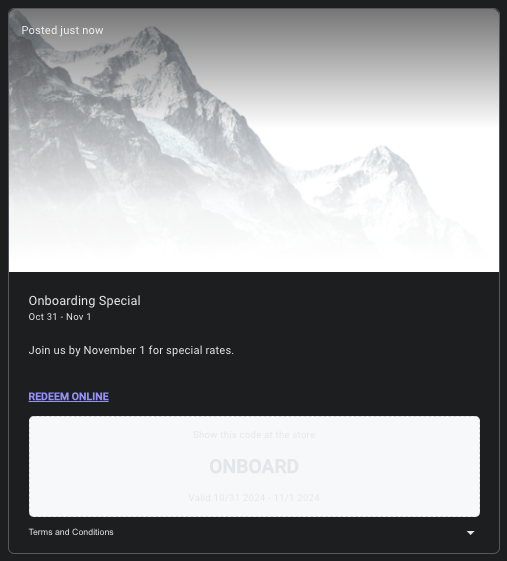
Google Business Posts can cover a variety of topics, with post types including “Events,” “Offers,” and the open-ended “Update.” These posts appear as part of your hotel’s Google Business Profile listing, showing in both Maps and the standard Google results page.

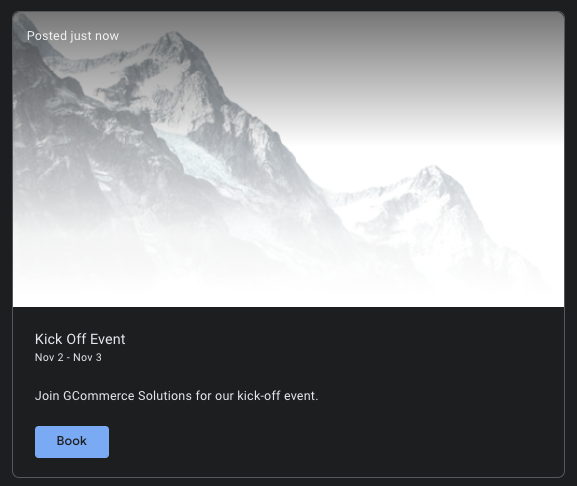
Here’s an example of an “Update” and “Events” post on the general results page. 

Every post type is a little different, but each one offers a number of optional call-to-action buttons, such as “Learn more” and “Order online,” as well as the option to add an eye-catching image of your property, restaurant, spa and more. 

To see why you should be using Google Business posts for your hotel, check out this blog post where we put them to the test.

How to post on Google Business Profile

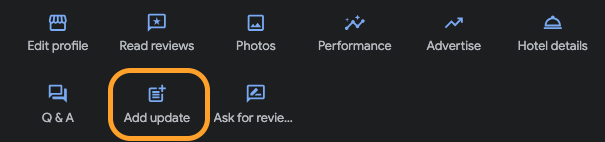
Google Business posts can be added from your hotel’s Google Business Profile by clicking the “Add update” button.

From there, you will be prompted to select your type of post. This choice should relate to the content of your post, but the restrictions on certain post types may also play a factor. 

Elements and restrictions of each Google Business post type

Update

This post type has the fewest restrictions, making it the perfect choice for all-around posts about your hotel that may not fit other types.

Must include:

  • Description (Max 1500 characters)

May optionally include:

  • Photos and/or videos (Up to 10 combined)
  • Action button such as “Learn more” or “Book” which links to a specified URL

Event

This post type is best for events with a clear start and end time.

Must include:

  • Title (Max 58 characters)
  • Start date
  • End date

May optionally include:

  • Photos and/or videos (Up to 10 combined)
  • Start and end times
  • Description (Max 1500 characters)
  • Action button such as “Learn more” or “Book” which links to a specified URL

Other restrictions:

  • Start and end times must be used in tandem. If one is added, you must add the other.
  • If times are not specified, Google will display a start time of 12:00AM and an end time of 11:59PM.

Offers

This post type is a great way to promote your hotel’s limited-time offers and specials.

Must include:

  • Title (Max 58 characters)
  • Start date
  • End date
  • Action button is automatically added

May optionally include:

  • Photos and/or videos (Up to 10 combined)
  • Description (Max 1500 characters)
  • Coupon code
  • Link to a specified URL
  • Terms and conditions (Max 5,000 characters)

Google Business posts are an easy and flexible way to promote your hotel’s events, offers, and features. While there are some format restrictions for each post type, the variety of Google Business post types available allow plenty of opportunities to post a wide range of content. And along with the evidence from our previous blog that Google Business posts may increase your hotel’s visibility, there’s no reason not to try them out.

For more information on Google Business posts, contact GCommerce.

What is Search Impression Share in Google Ads?

SHARE:

Analyzing hotel advertising campaigns can be incredibly overwhelming. Each channel has a different set of metrics, and keeping track of what’s what can be hard. 

Search Impression Share in Google Ads is one of those unique metrics that often causes confusion. However, this metric can provide an incredible amount of insight into your hotel’s paid search campaign performance, so it’s important to understand what the metric is, how it’s calculated, and what factors can affect it.

The Google Ads auction system

Before discussing Search Impression Share, it’s helpful to understand how paid search ads are served through Google Ads.

Each time that a user searches for something on Google, the Ads platform enters all potentially relevant ads into an auction for that individual search. Paid search advertising with the best combination of bid and budget, relevance to the search, historical performance, and other factors will win the auction, appearing on the search engine results page (SERP).

If a paid search ad does not perform well in the auction, it will not appear in the SERP. However, that ad may show up another time since a brand new auction occurs for each individual instance of a search.

Multiple ads can appear in the SERP at the same time, with ads that performed best in the auction showing up highest in the list of results compared to their auction competitors. However, there isn’t enough space in the SERP for every paid search ad to show up every time. The main purpose of the Google Ads auction system is to weed out the least effective paid search ads for a specific search. Therefore, it’s important to understand how well your paid search ads compete, which is where Search Impression Share metrics come into play.

Search Impression Share

Search Impression Share measures how often your hotel’s paid search ads win an entered auction, representing the proportion of impressions actually received compared to potential impressions.

How Search Impression Share is calculated in Google Ads

Search Impression Share = Actual Impressions / Potential Impressions

Or, in other words: Search Impression Share = Auctions Won / Auctions Entered

You can think of this metric as an “actual” or “visible” percentage for paid search ads.

Search Impression Share Lost to Rank

This metric represents how often your hotel’s paid search ads lose an auction because a competitor’s ads are deemed a better, more relevant fit for the user’s search.

Factors that may affect Search Impression Share Lost to Rank:

Ad copy keyword optimization: When setting up a paid search campaign in Google Ads, adding positive keywords helps inform Google about the kind of searches that your ads should compete to show up for. These targeted keywords are not always a one-to-one match with a user’s query, but they provide a great foundation to ensure that your hotel’s ads appear in relevant searches.

However, targeted keywords aren’t always enough. Google Ads likes to see proof that your paid search ads are immediately relevant to a search and often looks at ad copy to determine relevance. Therefore, incorporating targeted keywords into ad messaging is an easy way to improve this relevance and decrease Search Impression Share Lost to Rank.

Search context: While targeted keywords are a great start regarding relevance, sometimes intent can get lost in a user’s search. Specific words and phrases often have a number of meanings, and this can get confusing without a direct line of communication to the user. For example, if a user searches for “cats,” it’s difficult to determine whether the user wants to adopt a pet, see a Broadway show, or buy heavy machinery.

Google Ads is fairly accurate in determining context to avoid serving irrelevant ads, but this doesn’t always prevent advertisers from being entered into irrelevant auctions. If your hotel’s paid search campaigns target keywords with a large variety of potential meanings, your Search Impression Share Lost to Rank may be inflated due to this broader pool of auctions in which your ads are competing.

Landing page experience: Because Google Ads can monitor ad performance beyond the click, the URL your paid search ads redirect to is just as important as the ad itself. Google Ads does not want to serve ads that provide a poor user experience post-click.

If your paid search audience routinely exits the page early, leaves without interacting with your website, or otherwise displays poor engagement, this could hurt Search Impression Share lost to Rank. Landing pages with excessively slow loading times, inconsistent reliability, and other undesirable qualities could also have a negative effect, even if these factors don’t directly impact your audience’s behavior.

Expected Clickthrough Rate (CTR): Because Google Ads wants to provide the best experience for users, the platform prioritizes paid search ads with high performance. Based on past data from your account as well as other advertisers, Google Ads can predict a paid search ad’s CTR within a specific search. 

A high expected CTR suggests that a paid search ad is highly relevant, increasing the chances of winning auctions and improving Search Impression Share Lost to Rank. However, if Google Ads does not expect a paid search ad to perform well, this could negatively impact relevance in auctions and, therefore, Search Impression Share Lost to Rank. 

Search Impression Share Lost to Budget

This metric represents how often your paid search ads lose an auction due to an insufficiently low daily campaign budget or Cost-per-click (CPC) bid.

Factors that may affect Search Impression Share Lost to Budget:

Bid strategy: Google Ads offers a variety of automated bid strategies to assist with auction bidding. These strategies inform Google Ads about the primary goal of your paid search campaigns, such as maximizing visibility or maximizing conversions, allowing the platform’s algorithm to tailor bids most effectively for each individual auction. 

Each bid strategy is incredibly unique since each goal requires a different focus. Some bid strategies, such as “Maximize Conversion Value,” may end up prioritizing a low CPC bid to keep cost down, worsening Search Impression Share Lost to Budget as a result. Other strategies, though, such as “Target Impression Share”, may put very little focus on manageable CPCs, which could actually improve Search Impression Share Lost to Budget. 

Total campaign budget: When running paid search campaigns, it’s a good idea to keep costs somewhat consistent over a given time frame. Budget should be spread out evenly across multiple hours, multiple days, or multiple months, which can impact the competitiveness of CPC bids. 

For campaigns with higher total budgets, this allows more room to increase CPC bids. As these bids increase, your hotel’s ads are less likely to lose auctions due to budgetary restrictions, decreasing Search Impression Share Lost to Budget. But, of course, the inverse is true as well. With a limited daily budget, your paid search campaigns may be more prone to under-bidding, resulting in a higher Search Impression Share Lost to Budget.

Bid adjustments: Google Ads provides the opportunity to manually prioritize the most important audiences for your hotel’s paid search campaigns. Bid adjustments work in tandem with bid strategies and other CPC settings, increasing or decreasing baseline auction bids by a given percent. Negative and positive bid adjustments primarily apply to attributes of the user performing a search, such as their demographics, interests, and hobbies, or the device type they’re using. 

Because bid adjustments are a modifier applied to a baseline auction bid, these settings can have either a positive or negative effect on Search Impression Share Lost to Budget. When using a large number of positive bid adjustments, this metric may decrease since CPC bids are more aggressive than the baseline for a large amount of auctions. Although this also means that negative bid adjustments can increase Search Impression Share Lost to Budget, since CPCs will be less competitive in those instances.

Maximum CPC settings: As part of Google Ads’ initiative to provide advertisers with more control, the platform allows for optional maximum bid settings. When added to a paid search account, these settings can ensure that CPCs remain reasonable by preventing bids from rising past a desired limit.

While these settings can help control campaign costs, it’s important to understand the potential tradeoff. If your paid search campaigns include maximum CPC settings that are less than the average price of an auction in your market, this can end up throttling your auction performance and causing an increase in Search Impression Share Lost to Budget.

Optimizing for Search Impression Share

Because each metric related to Search Impression Share results from so many factors, there’s really no baseline for what a “good” number will look like. Every business has different paid search campaign goals, unique market competition, and individual budget restraints, so there’s no “one size fits all” answer. 

Despite this, there are still a few standard optimization rules to follow regarding Search Impression Share.

1. Aim to decrease Search Impression Share Lost to Rank

Because Search Impression Share Lost to Rank deals with ad relevance, most of the factors behind this metric are relatively easy to adjust with controlled optimization, making it possible to improve account performance without re-budgeting for your advertising channels.

2. Increase campaign budgets

Once your paid search campaigns are well-optimized, Search Impression Share Lost to Budget is the next metric to tackle. While the factors behind CPCs are slightly more complex than those behind ad relevance, increasing campaign budgets allows the flexibility for higher bids, acting as a simple way to gain a competitive edge in auctions.

3. Remember metric interactions

However, Search Impression Share Lost to Rank and Search Impression Share Lost to Budget are directly proportional to each other. When added together, actual Search Impression Share, Search Impression Share Lost to Rank, and Search Impression Share Lost to Budget will always add up to 100%. So, if one metric decreases, the others will increase, and vice versa.

4. Focus on visibility

Due to this proportional relationship, it may seem like an optimization related to Search Impression Share actually had a negative effect on the account. In reality, though, improving bids or relevance simply shifts the balance in one direction or the other. Therefore, focusing on total visibility paints a better picture of general performance. As long as the actual Search Impression Share remains flat or continues to improve, it’s safe to assume that your optimization techniques are working.

In summary

Search Impression Share in Google Ads is an incredibly complex web of factors that can tell you a lot about your hotel’s paid search campaigns. If you’ve been ignoring this metric, we suggest that you take a deeper look at your own campaigns to better understand how your advertising works and how to potentially optimize them in the future.


If you have more questions about Search Impression Share reach out now.

Keep Reading