Branded Keyword CPCs Continue to Rise in 2019

SHARE:

Do you measure paid search media success by Return on Ad Spend (ROAS)? Then you should know that any increase in cost-per-click on paid search for your most qualified keywords can have a detrimental impact on this key performance indicator. The battle against the rising paid search cost-per-click is an ongoing war. At GCommerce we are constantly optimizing our account structure, bids, targeting, ad copy and more in an attempt to garner better quality scores and obtain a lower cost-per-click. Why? Because every dollar of media spend matters when trying to drive optimal revenue and return for our clients.

No matter how much we fight, over the years we’ve continued to see increases in CPCs for our clients’ paid search campaigns. When we came across Merkle’s recent Q1-2019 Digital Marketing Report it verified our internal research that across industries other advertisers were experiencing similar results.

Merkle reports that as recently as Q4 2018, paid search CPCs for Branded keywords were up 18% YOY. This was a continued spike in CPCs YOY that started back in Q4 2017.  That’s 5 straight quarters of double digit increases according to Merkle. Yikes. Luckily in Q1 2019, cost-per-click growth slowed and was only up 6% YOY.

Google Brand US Search

It’s hard to reason with a 6% increase seeming low. We know every marketing dollar needs to go further. Every increase in cost-per-click results in less clicks that can drive converting traffic to your hotel’s website. This requires you to either increase budgets to gain the same traffic as previously, or to try and capture traffic from other sources at a lower cost of acquisition.

We dove into GCommerce’s own data for the same time periods and found the following:

  • Q4 2018: GCommerce clients only saw an average increase of 5.78% for branded keyword CPCs compared to 18% YOY increase reported by Merkle
  • Q1 2019: GCommerce clients’ branded keyword CPCs only increased by 4.14% vs 6% YOY increase reported by Merkle

Our own research, along with the supporting data from Merkle, seem to show that Google is employing tactics that are raising CPCs outside of normal factors that we have seen in the past. Generally, we see increases in Brand CPC tied closest to competitors increasing their bids and spend for those same keywords. However, GCommerce Data nor Merkle Data are reporting significant changes in competitor spend that would result in these types of increases to Brand CPC.

While there are many tests, experiments and tactics we employ to fight CPCs and drive more qualified traffic to drive conversions, there are outside factors that can drive up CPCs further.  The most common being competition from OTAs. While OTAs are important partners to sell inventory quickly during need periods and offer exposure to new potential guests, these same partners bid heavily on your hotel’s branded keyword terms. What makes this even harder in the battle for direct conversions is that OTAs have large advertising budgets, allowing them to absorb higher CPCs and unexpected changes from Google compared to a small, independent hotel.

Have questions about how we can help you fight higher paid search CPCs and drive more qualified traffic to your hotel’s website? Reach out to GCommerce today.

Improve Ad Quality Score And Save Time & Money Through Google Ads Scripts

SHARE:

Google Ads Scripts may sound like a foreign language to some, scare others, and cause others to feel uncomfortable but I’m here to tell you that there is nothing to fear! Google Ad scripts are useful tools that can be used for every industry from hotel digital marketing to ma and pop shops doing their own PPC. These scripts automate tedious processes and tasks that sometimes take an unreasonable amount of time. This automation allows search specialists to focus on what’s most important and ultimately saves time and money for our clients.

What are Google Ads Scripts?

Google Ads Scripts are JavaScript based codes that anyone can implement in order to automate certain functions within Google Ads. These functions can include:

  • Sending keyword performance reports on a regular basis to a given email
  • Pausing underperforming ads based on set qualifiers. This report can then be automated to send to any given email containing the ads that were paused
  • Finding errors that could cause your ads to underperform, become disapproved, lead to a 404, and more. You can then set it to notify you if it happens to find something wrong
  • There are other scripts that can perform a multitude of tasks

These scripts help search specialists to work faster and more efficiently as well as improve their quality of work because they can always have eyes (a script) on things that they can’t always check due to time constraints.

Google Ads

Scripts increase efficiency, but how?

  • Automated reports: normally, a search specialist must go into Google Ads in order to pull reports that help them to identify how a given property is doing. In fact, they probably have to go through multiple tabs to get a good picture of what is happening with the account. This can take a lot of time. By setting up a script, they can receive automated reports which provide all of the information necessary, all in one spot. This saves time for search specialists because they don’t have to set up the reports, download them or make other modifications
  • Automated report delivery: search specialists can automatically send these reports to clients thus saving them time because they don’t have to manually send the reports
  • Ease of comparison: order is kept consistent since all of the metrics are the same on each report. This allows you to compare past data with ease. It also makes it easy to look at because they are standardized reports which you will get used to over time
  • Automated tasks and processes: as mentioned before, scripts can be used to automate a multitude of processes and tasks. These could include anything from error scanning your ads to pausing underperforming ads. This increases efficiency because the search specialist doesn’t have to make those changes manually but still gets notified of any changes that take place just in case they need to review them
Efficiency

Why should you be using scripts?

By using scripts, search specialists are able to spend less time setting up reports, checking for broken ads, pausing underperforming ads and more meaning that they are able to work more on what is most important. This ultimately saves you money and increases the quality of your ads thus helping you to drive more reservations and more revenue. Our team of search specialists are constantly looking for new scripts to increase productivity, save time and ensure budget is being spent efficiently.

Looking for more information on scripts? Here are some of our favorite resources:

Reach out to our team for more information!

Increase Revenue Contribution from Google Ads with Qualified Audiences for Remarketing

SHARE:

Many people around the Boston area have spent the last few months basking in the glory of a World Series Championship that the Red Sox brought home after a hard fought 4-1 victory over the Los Angeles Dodgers.

Here at GCommerce, we’ve been evaluating the results of some experimental paid search campaigns that we ran along with The Lenox Hotel to increase the awareness that the hotel is within walking distance of Fenway Park. Not only is this an incredible boutique hotel in the Back Bay of Boston, it’s also the best hotel to stay at if you’re in town for a Red Sox Game.

It was our job at GCommerce job to come up with a strategy that would most efficiently target their intended audience. The Lenox Hotel had pages on their site dedicated to content around Red Sox Game’s and the close proximity to Fenway Park. We decided to use Remarketing Lists for Search Ads in order to best reach our target audience.

For those not familiar with Remarketing, do you ever look at a product or service online, and then it seems like ads for that product or service follow you around forever? That is Remarketing.

The basic idea is that someone will come to your website, you drop a pixel on their browser that then feeds that individual ads about the page that they looked at. While this is a great tool for marketers to capture users, it generally misses out on 2 main topics

  1. Just because someone came to your site, how do we know what type of content they are looking for?
  2. Just because they visited a certain page, how do we know they didn’t “accidentally” click to get to your page or site?

Both of these things kind of go together. Have you ever accidentally clicked on an ad or link? Just because someone ends up on a page of our site, does not mean they intended to be there.

With Google Tag Manager, we can put qualifications around our audiences to help eliminate those that came to our site without the intent of reading content. The way we do this is with 3 different steps or qualifications for a user to enter our “audience list” that we then serve ads to:

  1. A user must first visit on one of the Red Sox or Fenway Park pages in order to be qualified for this audience list.
  2. Next, the user must scroll at least 25% of the way down the page. If you look at most pages on the Lenox Hotel’s website, they have a very efficient head navigation and absolutely beautiful imagery. With both of those elements in place, we can gather a better idea about intent if we can measure someone’s scroll depth while also eliminating those that “accidentally” ended up on the page.
scroll depth
  1. Next, the user also had to look at booking dates between June and Sep 30th (we later extended the date range as the Red Sox made their way through the playoffs).
Audience screenshot
  1. Finally, if a user was qualified in all of these areas, they were also eliminated from the list if they ever hit the “confirmation” page to signal a booking was completed.

Last year, we ran a very similar campaign effort, however, our Remarketing Audience List only consisted of people coming to the Lenox Hotel’s website, and it did not include these further qualifications. Luckily, this gives us a really good baseline to compare it to.

So how did this these qualified audience paid search campaigns perform in comparison to last year’s remarketing campaigns?**

Our remarketing lists for paid search ads in 2018 brought in 178% more Transactions as measured through the attribution on Search Ads 360 (12.5 vs 4.5):

transaction screenshot

This advanced remarketing list for search campaign was a great test and discovery for us here at GCommerce. We plan to take use this data for future success in remarketing campaigns for The Lenox Hotel and our other Paid Search clients.

Contact us today to discuss how Remarketing Lists for Search Ads can help your hotel!

**Full disclosure, the Red Sox were eliminated from the 2017 AL Division Series against Houston and their final home game was October 9, 2017. In the 2018 season, their final game at Fenway was October 24th, so there were an extra 15 days that the campaign ran in 2018 vs 2017.

How GCommerce's Programmatic Bidding Strategies Benefit Our Hotel Clients

SHARE:

If there is one thing that is absolute in the hospitality internet marketing world, it’s that we must constantly be testing, analyzing, implementing changes (or not) based on test data, and testing some more.

GCommerce utilizes programmatic bid optimization for paid search marketing, which is now a must in a world of constant changes and bid management. Programmatic bidding allows bid adjustments throughout the day and uses data based on previous days data. For an individual to be able to delve into the performance and history of a specific keyword would take hours to be able to optimize an account of 100+ keywords, multiply this by 10 or more clients a day and there is now no time for other important client optimizations.

Programmatic bidding is not just a set-and-forget machine learning tool. If you use programmatic bid optimization you must make sure that you are making the most of it and getting the best results possible for clients. How do you do this? Test. Analyze. Implement (or not). Test Again.

Earlier this year, I ran a test on a sample of clients using a different bid strategy model to see if client performance could benefit from it. It wasn’t that the current automated bid strategy wasn’t working, it was based on the idea that we always want to improve our results, therefore we test different theories and strategies.

This particular test yielded some pretty significant results:

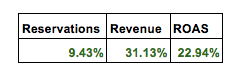
Due to the seasonality of our clients, the best data to gather is to compare year over year with a significant amount of time. Using a date range of 6 months of data, here is what we found:

  • Average CPC’s increased 1%
  • Reservations increased 89%
  • Revenue increased 100%

When comparing to GCommerce’s entire hospitality paid search marketing portfolio, here is what we found:

  • Average CPC’s increased at a much lower rate
  • Reservations increased at a much higher rate
  • Revenue also increased at a much higher rate
Programmatic bidding strategies performance

Rising CPC’s are a constant battle in the paid search marketing world. At GCommerce Solutions, our hospitality internet marketing teams are constantly optimizing paid search campaigns to help decrease this metric as best as we can. After reviewing performance across GCommerce’s entire portfolio, I found that, on average, GCommerce clients experienced an increase of 4% in average CPC’s during the same time period. This leads to a conclusion that our clients and the hotel industry continue to see ever-increasing rise in CPC’s across the board in order to compete in the SERP. But the fact that we have been able to slow it down while ramping up reservations and revenue is a huge win.

After pulling all of the data and seeing such clear results, it was obvious that it was in our clients’ best interest to switch gears on our overall strategy to best reach our KPI (key performance indicator) goals and maximize their spend. So we did.

Tropicana Inn & Suites' New Website Increases Conversion Rate and Revenue

SHARE:

Have you ever wondered just how important a website is to a business?

GCommerce launched a beautiful new website for Tropicana Inn & Suites in Anaheim, CA in October 2017. A deep focus on branding, user experience and design with a focus on conversion rate optimization had a dramatic impact on the hotel’s digital presence and bottom line.

Functionality plays a huge part in the overall user experience and performance for any website. The creative and design team at GCommerce Solutions understands this and makes sure to implement hospitality specific best practices to all of our website builds and designs.

In the case of Tropicana Inn & Suites, it was a Design Ready Architecture (DRA) build that was put together with their new branding and content initiatives. The Tropicana specific DRA that was used took into consideration keeping a user on the website and giving them all the information needed right at their fingertips.

The most important factors considered for Tropicana’s layout & design was:

  • Having a testimonial section right on the website.
    • This keeps a user on the page and provides transparency; keeping them from having to search for another website’s reviews helping to ultimately keep the user on the property’s website.
    • This shows success in the 6% increase in average session duration since the launch of the new website.
  • Highlighting the most visited pages right on the homepage to help keep the user engaged and easy navigation to find the information they require.
  • High quality and professional photography. Per Hospitality Net, after price, photography is the most important factor for travelers and prospects.

LET’S TAKE A LOOK AT THE ACTUAL NUMBERS AND HOW THE NEW WEBSITE HAS IMPACTED DIFFERENT MARKETING CHANNELS

The following results were found after comparing data from the old website vs. the new website post launch.

OVERALL WEBSITE PERFORMANCE

Overall website Performance

Lets delve deeper and review how the new website helped the individual digital marketing efforts.

PAID SEARCH ADVERTISING

Paid Search

FACEBOOK ADVERTISING

Facebook Advertisement

Well designed with user experience and conversion rate best practices in mind, a new website can make a dramatic difference in your hotel’s performance and bottom line. Your website is your online storefront, You want it to be welcoming and portray a true representation of the property’s experience. The user experience should be easy to navigate and help lead your user through the booking funnel. Such as the snap navigation and booking widget used for Tropicana Inn & Suites that affixes to the top of the browser and follows the user down the page. You want the user to be able to navigate your site from anywhere and allow them to book their room from any point of their journey.

GCommerce Solutions would be happy to help with your new website. You can submit a request for more information here or give us a call at 435-214-5301.

A Hotelier's Guide: How to Optimize for Voice Search

SHARE:

Voice search is the latest buzz in the digital marketing community. With companies like Gartner predicting that by 2020, 30% of searches will be voice, hotel marketers are eager to know if their businesses are optimized for this new channel.

While it may be the shiniest new marketing object to catch your attention – it’s important to first understand what this technology is, how it works and how it may disrupt the market in order to determine how it will (or won’t) change the way you need to approach your hotel’s digital marketing strategies.

FIRST, WHAT IS VOICE SEARCH & HOW DOES IT WORK?

When people use the term “voice search” they are usually speaking of one of two different areas –home assistants (think Google Home, Amazon Echo with Alexa) and voice search using your phone’s technology such as Siri to return results on a screen. The latter technically being defined as “dictated search”.  We’ll dive into both to make sure your best prepared for the latest disruption in search engine marketing for hotels.

HOW DO HOME ASSISTANTS WORK?

Amazon Echo/Alexa and Google Home are currently leading the market for voice assistant devices. This area of voice search is, at its core, screen-less. That means one-answer responses, not a list of responses presented in search engine results format. It wasn’t until Amazon launched its Echo Show that home assistants started to incorporate screens into their devices. Now more home assistant devices, like Google Home, are incorporating or planning to incorporate screens into home assistant devices.

HOW DOES DICTATED SEARCH WORK?

The other area included under the topic of “voice search” is search that uses voice command to pull up search engine results on a screen. This is more accurately defined as dictated search. This includes the use of Siri on your iPhone or Google Voice Search on your android or other devices. Does the use of voice dictated search change the way Google returns results?

Home assistant devices and dictated search through Siri (and other mobile devices) are two very different voice search experiences. One relies on providing a variety of results on a screen and one relies on voice responses to answer your questions. Next, let’s dive into how consumers are using voice search with each of these device types.

SHOULD HOTEL MARKETERS BE WORRIED ABOUT VOICE SEARCH?

Voice assistant device voice search has been hard for marketers to break into considering there’s limited space available for exposure with only position O returned as a result and no space for advertising like the typical SERPs provide. The lack of screens have also made it difficult for consumers to perform travel research since they depend on imagery and visiting multiple sources for information before they are ready to book. For this reason, voice assistants haven’t made a huge impact on how people book hotels and travel. There is a possibility that this will change soon as both Amazon and Google are launching voice assistants with screens to provide more options and the opportunity for advertisements, just like the standard mobile SERP. This article from Lisa Lacy at Search Engine Journal does a phenomenal job at diving into how this changes the optimization game.

People are using voice assistant devices for everything from playing music, controlling home gadgets to ordering products online.  But, how are they using these devices to plan travel or book hotels? With one-answer response capabilities provided by voice home assistants, the experience isn’t great. Maybe you’d have success using the device to book accommodations if you knew exactly which hotel you wanted to book at or if you were just looking for the nearest, last minute hotel. But in our experience testing voice assistant devices to research hotels, interacting with these devices for travel research is extremely frustrating.

HOW CAN HOTEL MARKETERS OPTIMIZE FOR VOICE SEARCH?

Let’s get down to the question that every hotelier wants to know, how exactly can hotels optimize for voice search?

The truth is, hotel marketers should be focused on a multi-device optimization strategy.  The success factors you were focused on for your overall strategy previously are the same ones that you’ll need to focus on for voice searches. Yes, the way people dictate search and the devices used changes the game slightly but you shouldn’t ignore other, more lucrative channels in favor of changing everything for voice search. A few ways to expand your multi-device strategy to incorporate more voice search specific optimization includes:

  1. Well built out and optimized FAQ pages and website content – being the content selected for Google’s answer boxes has long been touted as a solid strategy for being selected for that “position zero” spot. Hotels should focus on building out a FAQ page that answers questions about the hotel, the local area and any other common questions related to the hotel.
  2. Targeting question keywords and near search terms – a large portion of voice search is presented in the form of questions or consumers looking for local/nearby businesses. For hotels this means that they need to expand content on their site to answer questions (i.e. FAQ page) and to target “near” search terms such as “hotel near X” to qualify for these types of searches.
  3. Local Search optimization (local listings/GMB/reviews) – The capabilities voice assistants can offer for hotel related search seem to be limited to displaying hotel information in the form of local listing profiles such as Google My Business. These means your local search optimization game needs to be strong with a huge focus on encouraging guest reviews and up-to-date, accurate listing details.
  4. Using Meta Search – Currently Kayak offers the only voice command to book a hotel through Alexa, which actually books it’s inventory through Booking.com or Priceline.com. Seems like one of the only ways for hotels to be visible on voice home assistants currently is through participation on OTAs and Meta Search engines.
  5. More focus on tracking calls as conversions – other than Kayak offering ways to book hotels through voice assistants, the only other type of conversions presented for this type of search is to ask for directions or to call the hotel. As more and more traffic shifts to mobile and voice-activated search, hotels can no longer ignore that accurate call tracking solutions must be used to ensure you can optimize your campaigns and strategy effectively.
  6. Make sure your site is secure – upgrade your hotel website to HTTPS now if you haven’t already
  7. Implement Schema.org Structured Data Mark-up on your site
  8. Ensure your hotel website is mobile friendly

CAN HOTEL MARKETERS USE PAID SEARCH TO BE PRESENT IN VOICE SEARCH?

Depends on what type of voice search you’re referring to – dictated search or voice assistants. Currently there are no options for paid search ads on voice assistants search. One way to pay and be visible in this space is through metasearch (i.e. Kayak – Alexa). Since using dictated search (i.e. on Siri) pulls the same displayed SERP results as when you type your search queries this allows for the same advertising capabilities and paid text ads will be shown.

WHAT NEXT: THOUGHTS ON VOICE SEARCH & PREDICTIONS FOR HOTEL MARKETERS

Hotel marketers should keep in mind that “voice search” is just a new interface and that the same elements that were vital to success before will continue to be vital for success in voice search. Focus on schema.org mark-up, focus on making your site secure and mobile friendly and make sure local SEO is a cornerstone of your strategy and you’ll be well positioned for success with voice search.

Next, keep an eye on this evolving technology. Consumers depend on visual elements to properly research and book travel and hotels. As more voice activated home assistants incorporate screens into the mix it will offer more opportunities for hotels to participate.

Finally, the consumer demand for using AI and voice commands are going to expand to interaction with your hotel directly.  Technology such as chat bots and ways to ensure customer service expectations are being met or exceeded through any method they want to interact with will become more important

Have more questions about how voice search works and how to prepare your hotel for success? Reach out to the team at GCommerce today.

Keep Reading