How Hotels Can Best Fight Against OTAs with Paid Search Marketing

SHARE:

Coming out of the pandemic, many hotels are seeing a huge surge in demand, booking and travel interest to their markets. This can be a great thing for many properties that experienced difficulties during the pandemic. However, hotels should be very cautious about how they are acquiring guests and at what cost. Many hotel’s marketing efforts and general customer acquisition were disrupted during the pandemic. Having better control on direct bookings while lowering the cost-per-acquisition for your hotel is going to become very important as demand and markets start to get back to a new normal.

From March through May of 2020 all but a few of our partner hotels discontinued their marketing. This made sense as many hotels were completely shut down, travel was restricted, and demand was at historic lows. As the world began opening, depending on the market, some hotels started to advertise again. But it was difficult to gauge demand, cancellations were regular and spending money on acquiring guests that might not actually stay in the hotel was a difficult decision for many hotels. A worthwhile strategy for many hotels was to decrease their upfront marketing costs while increasing their contribution of bookings from OTAs. This helped mitigate some of the issues with cancellations and with decreased demand, paying commissions on booked rooms helped some hotels stay afloat without having the upfront costs of marketing.

Thankfully, it seems that we are past the worst of the pandemic. Many areas are lifting restrictions, domestic travel is seeing some all-time highs and people are looking to make up for vacations lost to quarantines. So, what about hotel’s that were attaining more guests through OTAs, should they continue that strategy?

Should Your Hotel Continue To Get Guests Through OTAs?

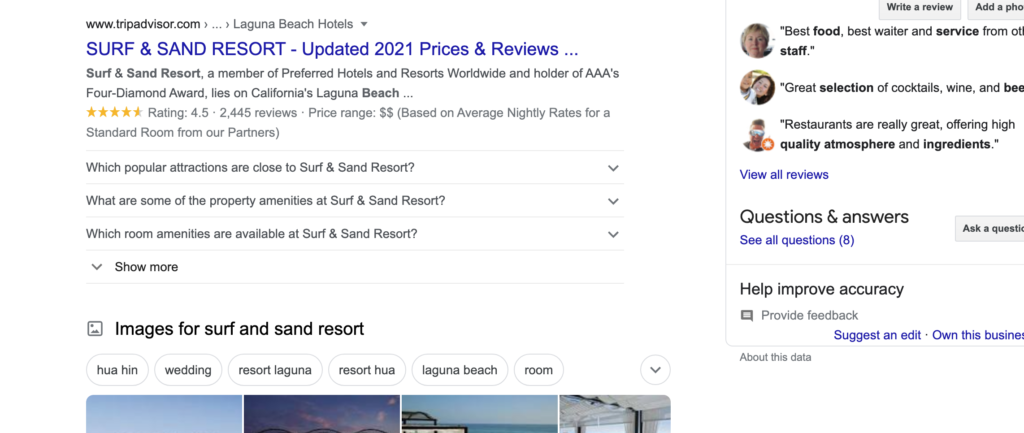
This is a question one of our partner hotels had. This hotel was in a destination market that was incredibly limited due to the pandemic and did not allow normal capacity until May of 2021. During the worst of the shut-downs, they relied heavily on OTA contributions to make up for a lack of demand that impacted their ability to advertise for their hotel. In coming out of the pandemic, they evaluated the costs between running Paid Search Marketing with GCommerce vs paying commissions to OTAs. Their findings are based on a few assumptions:

  1. We know that we bid for pay-per-click (PPC) against the OTAs for our name on Google.
  2. We can take the Room Nights (RNs) and Revenue from Jan. 2020 and deduct the commission at the approximate commission rate to see how much OTA commission the hotel might pay.
  3. We can then assume different percentages of sales that might come from PPC. If 20% of the sales are derived from the OTAs display of our name on Google, then paying $1,000 per month to GCommerce for the PPC Marketing is much more profitable for this hotel than paying commissions.
  4. Even if we were to assume only 5% of OTA sales are derived from PPC, the hotel would still come out ahead by several hundred dollars:
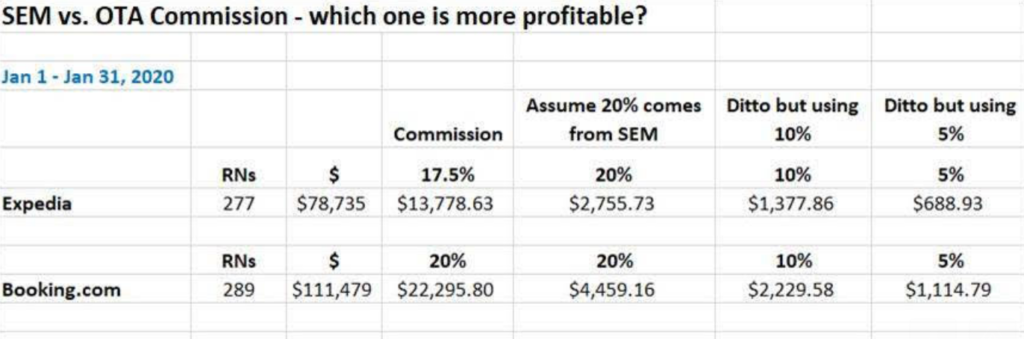
Screenshot of commissions paid to OTAs versus paid search ad dollars

Save Thousands of Dollars per Month with Paid Search Marketing for Hotels

As you can see above, this hotel is likely saving thousands of dollars each month by advertising on Paid Search Marketing. With a budget of less than $1,000 per month, GCommerce Solutions can capture a significant share of the Impressions for this hotel’s brand terms. That drives thousands of clicks directly to the website instead of to an OTA. By capturing just 1/5th of the people that were previously booking through an OTA, this hotel could be saving over $6,000 each month. That is budget that could go towards other initiatives for the hotel rather than in commissions to an OTA, not to mention all of the other benefits that come with someone booking direct (loyalty, membership programs, email/1st party data, etc.)

How Can Your Hotel Calculate If Paid Search Is A Better Return Than OTA Commissions?

By using this methodology, your hotel can take a sampling of room nights and revenue and then use the commission from OTAs to calculate how much that fee would be. Download our free template above and simply input:

  1. Room Nights into cells C5 and C7
  2. Revenue into cells D5 and D7
  3. OTA Commission into C2
  4. PPC Budget into F2

The Savings calculated in F9 will be your hotel’s monthly savings by getting direct bookings from Paid Search rather than from OTA contributions.

Contact GCommerce Solutions Today To Lower Your Hotel’s Cost-per-Acquisition

If you’re ready to start running paid search marketing for your hotel in order to lower your cost-per-acquisition and take back commissions currently being paid to OTAs, contact us today!
Navigating Apple's iOS 14 Privacy Update for Facebook Advertising

SHARE:

If you regularly pay attention to the near-constant updates about privacy laws and data protection, then you’re probably familiar with Apple’s latest iOS14 privacy update. With implementation rolled out across Facebook on April 26th, these new changes will have a significant impact across the marketing landscape far and wide.

The Apple iOS Privacy update explained

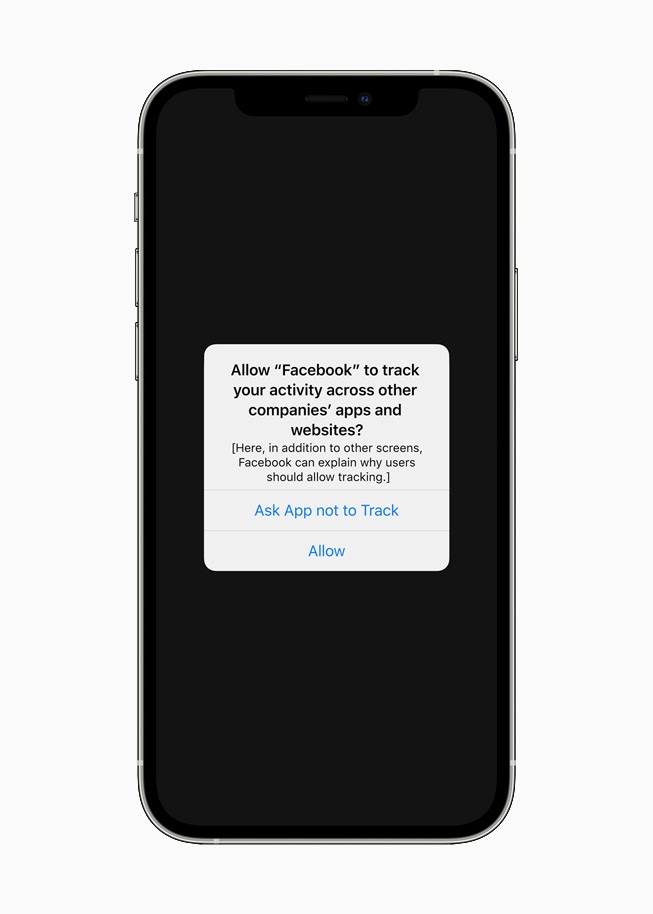
So what exactly is this update to Apple’s iOS for privacy? To make things easy we’ve broken it down into what you as hoteliers and advertisers need to know. Essentially, the biggest change for Facebook advertising for hotels is to Apple’s App Tracking Transparency Framework (ATTF). Apple will no longer allow advertisers to automatically track the Identifier for Advertiser (IDFA) tag. This in turn forces iOS users to opt-in to be tracked. When users download the iOS 14 update they will be automatically prompted to allow data tracking or not across Facebook.

Screenshot of Facebook Privacy Alert on iPhone

From Apple’s point of view this update is to provide users with more transparency and the ability to further protect their privacy and information. From the consumer perspective this also seems like a great change in further protecting your information. 

However, the fear being echoed among advertisers is that if users are prompted to accept or decline data tracking they will say no. Similar, the fear carries over to Facebook where with a large loss of data from iOS users we won’t be able to accurately measure the success of our campaigns.

The potential impact of this update could also hurt small businesses who rely on personalized ads to grow and succeed. Facebook has spoken out a number of times against this Apple update and is working to continually support and stand with small businesses.

Here’s what is changing to Facebook Advertising for Hotels

Let’s dig into what is changing within the hotel Facebook advertising landscape specifically. 

Facebook Reporting’s Attribution Settings

Prior to January 19, 2021, Facebook supported the following attribution settings:

  • 28-day click
  • 28-day view
  • 1-day click
  • 7-day click (default after prompt enforcement)
  • 1-day click and 1-day view
  • 7-day click and 1-day view (initial default from 1/19 - 4/26)

On January 19th, Facebook retired the 28-day attribution setting and changed their default setting to 7-day click, 1-day view in preparation for the iOS update. Now that the change has been rolled out, Facebook has now defaulted to the 7-day click model for any newly created campaigns. However, we do still have the ability to utilize our same 7-day click, 1-day view option.

What does changing attribution models have to do with your hotel’s Facebook campaigns? Attribution models determine how revenue is counted from a user. So depending on which model is in place, it would change the amount of revenue visible to us which could alter the ROAS.

Facebook Pixel Tracking

Currently to track conversion and revenue data for campaign performance at GCommerce we rely on Facebook pixels for all our clients. The Facebook pixel is a snippet of code added to the clients’ website allowing us to track notable actions (purchases, add to cart, page abandonment, leads, etc.) and saving that data for future use, such as with retargeting lists. 

While we are still able to use pixel tracking, Facebook has now restricted how much data we are allowed to collect. Now we can only track, or place, up to 8 pixel events per domain and they must be arranged in order of priority. For many advertisers this severely limits the amount of data they are able to collect. While this may seem detrimental, we are not as concerned at GCommerce as we will still be able to track priority conversion events such as purchase and lead data for our campaigns.

It’s also important to note that even if an iOS user opts out of tracking it does not limit how many ads they will be shown. We can still reach these users and will be able to count their actions in terms of impressions, clicks, etc. It is only if they make a purchase or take an action tracked by our Facebook pixels that we cannot track the data.

Facebook Reporting In A Post Apple iOS 14 Update World

Briefly touched on above, the way we report on data from Facebook campaigns will also change because of these updates. Not only will our data be under a new attribution window, but we also will be losing an undisclosed amount from users who have denied Facebook permission to track them. This will lead to reporting being less accurate and difficult to measure without the data of valuable, opted-out iOS users.

However, in light of recent changes, Facebook has also started including some statistical modeling into their conversion data to make up for the lost users. This is most notable when looking at campaign data starting in May, but we can see where some modeling has been used in April campaign data as well. Campaigns utilizing this feature will now be noted within the Facebook interface. In our campaigns at GCommerce we have noticed (thus far) that, for the most part, the addition of this modeled data appears similar to data collected before the update went into effect.

How GCommerce Prepared For Facebook’s Update

Although this change to Facebook advertising took effect on April 26, 2021, we’ve been preparing for this change at GCommerce since January 2021 when all the big updates were first announced. In fact, we’ve even had this on our radar for months prior to that, knowing that more data and privacy laws would be going into effect as the industry prepares for a world without 3rd party cookies.

Since January we’ve been equipping our teams with the knowledge they will need to educate and reassure our clients of what is to come. On top of that we’ve spent countless hours researching, strategizing and planning how these Facebook advertising changes will impact our current Facebook advertising, reporting and future campaign launches. By the time the update was implemented, our clients were verified and continued running with no hiccups.

Since then we’ve been working with our data team to make sure our client reporting suite, Summit, matches the new attribution models we see in Facebook and continues to reflect the success of our marketing campaigns. While Facebook continues to make quick pivots, our team is able to pivot just as quickly to mitigate any issues with our clients’ campaigns, performance and reporting.

What Will The Impact Be To Facebook Advertising For Hotels?

While we’re only a few weeks out from the initial rollout of this change to Facebook advertising, we expect to see continued changes within our campaigns in terms of targeting, audience sizes and overall reported revenue. To stay ahead of the curve, GCommerce is actively reviewing new strategies to help ease the gap in revenue with this new loss in user tracking. We are also monitoring audience sizes monthly to evaluate the true impact of the iOS 14 update and working on testing ideas for new audience segments.

The future of Facebook advertising may be unpredictable, but we are still confident in Facebook’s ability to target valuable audiences and provide a significant return on ad spend.

Should We Continue Advertising on Facebook?

This answer to this question is an absolute YES. Advertising on Facebook will still provide you with valuable returns for your hotel and give you the unique opportunity of reaching wide and niche audiences with a smaller (or larger) budget. Connect with us to learn more about Facebook advertising or the new iOS 14 update.

Every Question You’ve Ever Had About Google Hotel Ads, Answered.

SHARE:

With it’s recent global launch of free booking links, Google has shown its commitment to focusing on the growth of the Google Hotels platform. From our perspective, it seems to be a move by the search engine to motivate more hotels to participate in this channel by offering them “free” organic traffic in order to drive more ad spend through Google Hotel Ads. Regardless of Google’s motivation, if your hotel isn’t currently participating in these auctions with your own direct channel connection and campaigns, you’re forfeiting valuable direct bookings to the OTAs. A strong emphasis on direct bookings has always been the strategy we’ve employed for our hotels, but direct bookings and ownership of guest data will become even more important as we move into a cookieless world. 

Within this blog post I hope to answer every question you’ve ever had about Google Hotel Ads. If I’ve missed anything please reach out with your questions and our team will be happy to answer them for you.

Learn More About Google Hotel Ads Paid, Organic & Property Promotion Ads Below.

What are Google Hotel Ads?

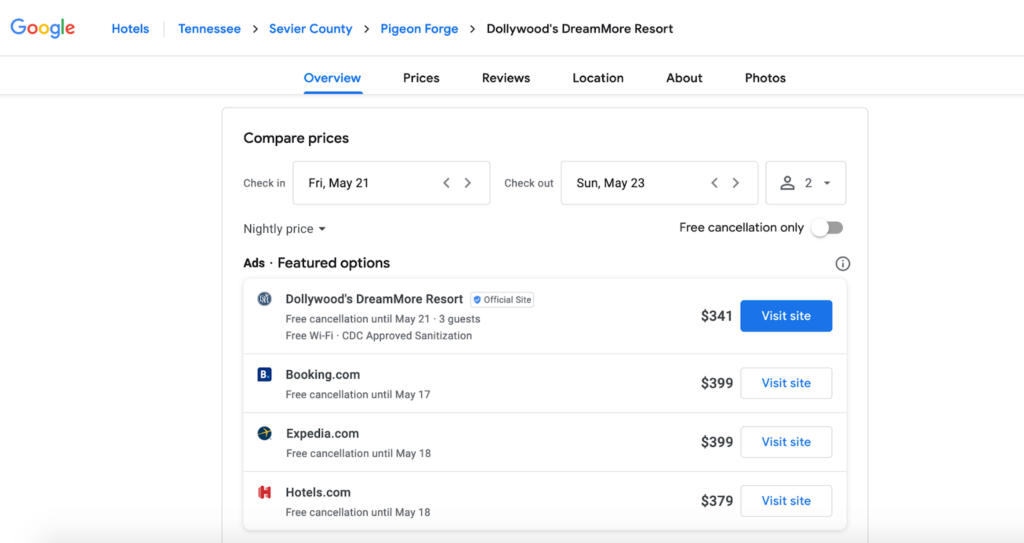
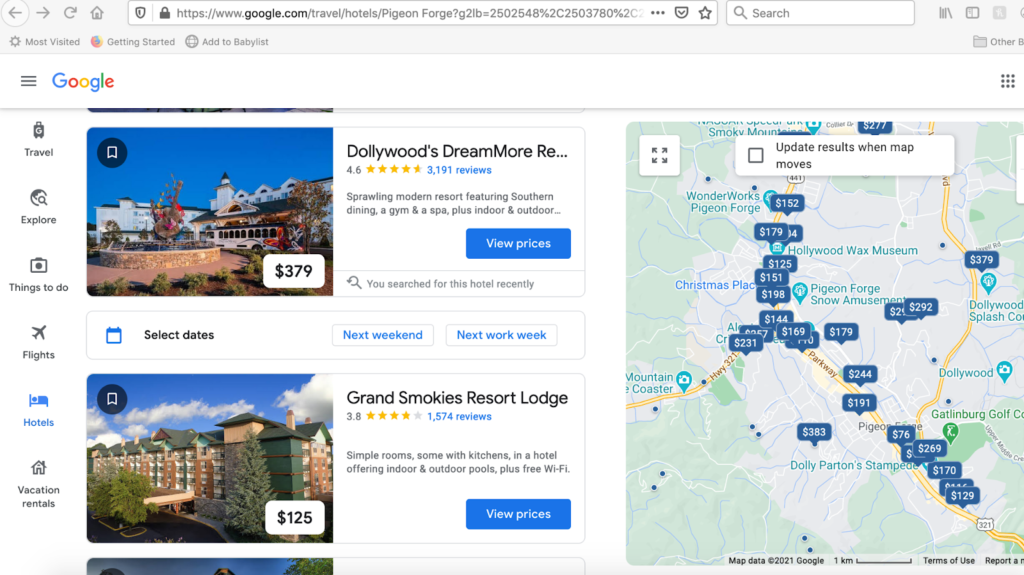
Google Hotel Ads is Google’s metasearch offering for hotels. It allows hotels to integrate a direct feed of their rates and inventory and pay for visibility within the search engine’s popular Google Travel, Google Maps and Hotel search products. 

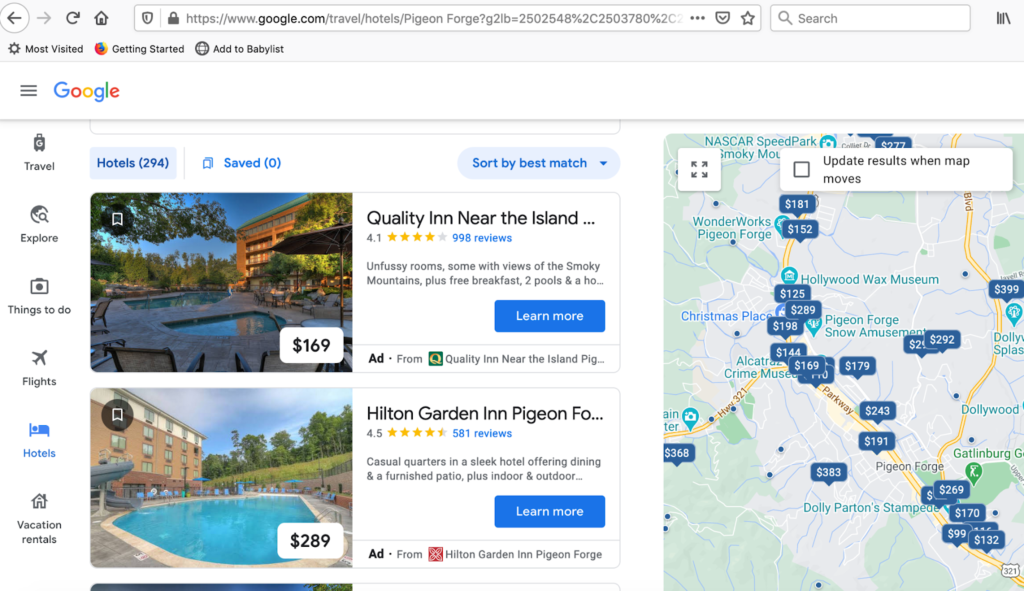
This screenshot shows Google Hotel Ads rates and inventory within Google Hotel search.

Screenshot of Google Hotel Ads in Pigeon Forge, TN

The below screenshot shows Google Hotel ads paid listings displayed for a specific hotel selected within Google Hotel Search.

Google Hotel ads paid listings displayed for a specific hotel

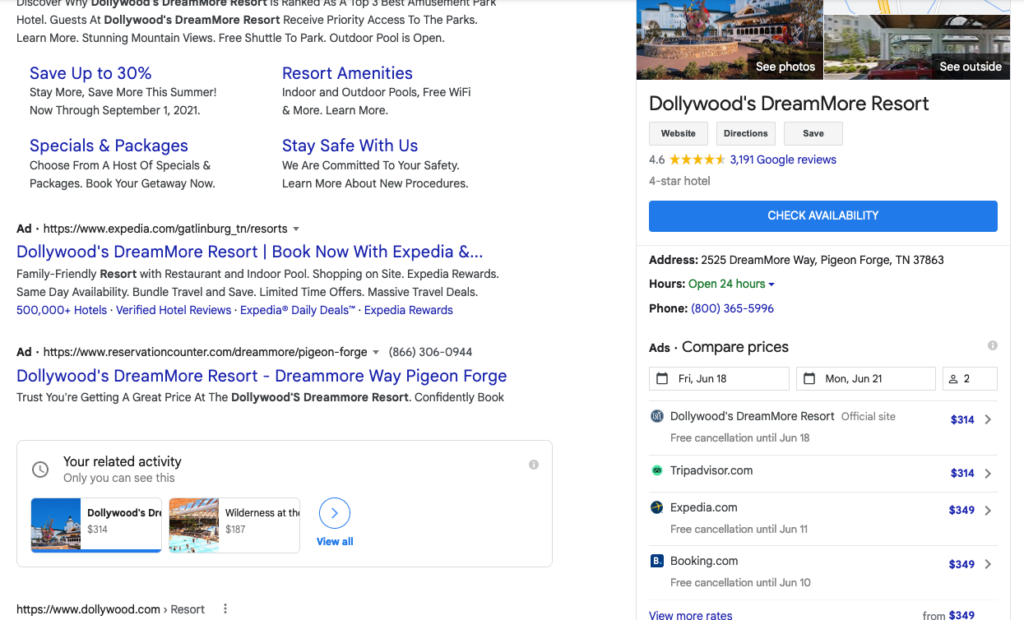
The next screenshot shows Google Hotel Ads appearing within a hotel’s knowledge panel on the main search engine results page.

Google Hotel Ads appearing within a hotel’s knowledge panel on the main search engine results page

How Can My Hotel Be Shown Within Google’s Hotel Search Products?

In order for your hotel to show rates and inventory within Google Hotel Search, Google Maps and directly in the map pack, your hotel must be set up with a direct feed of your rates and inventory to Google. This is possible through one of Google’s data integration partners pulling rates directly from your hotel’s CRS. Your hotel rates and inventory could also be shown within Google Hotel Ads from a reseller or OTA such as Expedia or Booking.com.

How Can I Optimize Performance In Google’s Hotel Ads?

The first place to start when understanding how to improve your performance on Google Hotel Ads is by setting goals for how you view success with this channel. You can use features within Google Hotel Ads to help drive awareness and traffic to your site (i.e. hotel promotion ads) but you can also use it as a powerful tool for focusing on the bottom of the funnel to drive more direct bookings. Regardless of the KPIs you focus on, here are the best ways to set your hotel up for success in Google Hotel Ads and within Google Hotel searches.

  1. RATE PARITY - I put this one in all caps because it is so important and an area where a lot of our hotel clients struggle. If your hotel’s rate is getting undercut by OTAs this means that the user is going to book with the OTA, there is no way around it. In order to be successful on Google Hotel Ads, and with any direct booking strategy, is to make sure your hotel’s rates are not higher than the OTAs. We recommend using a great rate parity tool such as the one available through The Hotels Network
  2. Price Accuracy - The rate you display in your feed within the Google Hotel Ads must match what is displayed on the landing page you send the user to. If you are not providing Google with accurate rates, you will suffer in rank and it will cost more to compete in the ad space.
  3. Landing Page Experience - Make sure the landing page you direct your visitors to from your Google Hotel Ads loads quickly and offers comprehensive information they need to complete their booking.
  4. Strategic Bidding - Make sure you are approaching your bidding strategy to focus on your goals and most important KPIs for this channel while keeping your budget in mind.
  5. Optimize Your Hotel’s Google My Business Listing - When and how often your hotel shows within Google’s hotel search for relevant searches is closely linked to how accurate and well built out your hotel’s Google My Business listing is as well as local SEO signals such as quantity and quality of reviews. Keep your listing up to date and keep encouraging your guests to leave reviews and make sure you are responding to them!

What are Google Hotel Ads Property Promotion Ads?

Google Hotel Ads’ property promotion ads have spent the last year in beta and were launched globally in March, 2021. To find these ads go to Google Travel’s hotel search for a specific location. In the below screenshot you will see the top two results listed as “ads”. Ads in this position are considered Google Hotel Ads’ Property Promotion Ad Type. These ads are best used for driving brand awareness and visibility during top of funnel hotel searches, i.e. hotels in Pigeon Forge.

Google Hotel Ads’ property promotion ads

How Can My Hotel Be Featured With A Google Hotel Ads Property Promotion Ad?

Since Google Hotel Ads property promotion ads are in a premium spot above the general hotel listings, they incur a premium charge to be featured. You can opt in for these placements but it’s important to keep in mind that this ad type is geared more towards generating brand visibility and awareness and less towards generating a great ROAS.

Google Hotel Ads Organic Listings

What Are Google’s New Organic or Hotel “Free Booking Links” Within Google Hotels?

Google recently launched an organic listings section within the previously “pay to play only” Google Hotel Ads listings. They are organic links within Google Hotel search that send direct traffic to your hotel’s or the OTAs’ websites and feature rates and room types from a direct connection to your hotel’s CRS or to an OTA such as Expedia.

Where Can I Find Google Hotel Free Booking Links?

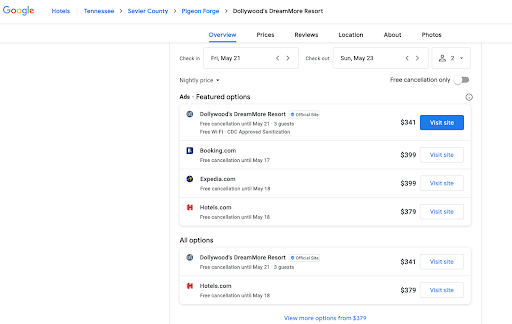
If you are viewing any place within Google that lists Google Hotel Ads, you’ll now see a section under “Ads” titled “All Options”. The listings under the “All Options” section are Google’s new free hotel booking links (see below screenshot).

Google’s new free hotel booking links

How Can My Hotel Get A Google Hotel Free Booking Link?

Google’s free booking links use the same direct feed of rates and inventory set up for paid Google Hotel Ad booking links. These booking links then direct the user to the site landing page that has been assigned within the direct feed of rates and inventory. If your hotel currently uses a connectivity partner for paid Google Hotel Ads then you are automatically enabled for the Google Hotels free booking link feature. If you don’t currently have a metasearch connectivity partner running Google Hotel Ads metasearch campaigns for you then your hotel’s official site/direct link won’t show in the organic free booking link section and your hotel’s rates and inventory will only show for free booking links for OTA partners.

How Can I Get My Hotel’s Free Booking Link To Rank Better Or Show More Often?

Similar to the main organic search results, Google Hotels’ free booking links use a variety of signals to determine which free listings to display to viewers. This includes “consumer preference, value offered to the user, landing page experience, and historical accuracy of prices provided to Google” (Google Help Center). Here are the main areas to focus on in order to optimize your Google Hotel free booking links:

  1. Make sure your hotel’s Google My Business listing is accurate and complete
  2. Make sure the rate you are sending in your data feed matches what is shown on the booking page for those dates and make sure you are sending Google the lowest rate found on your booking page
  3. Make sure you’re in rate parity and are offering the same or lower rate compared to OTAs
  4. Optimize your hotel booking link’s landing page experience for the user. This includes making sure users can find the rate and room type on the landing page, that the landing page has informative copy and that it loads quickly for users no matter what device they are using

Do I Still Need To Run Google Hotel Paid Ads If I Can Just Feature A Free Booking Link?

Technically you do not need to run Google Hotel Paid Ads to have your free booking link shown in the organic results. You will need to have a metasearch connectivity partner that can sync your hotel’s rates and inventory with Google’s platform, BUT the free organic booking links don’t always show and tend to receive much less visibility and clicks. If you were to turn off your Google Hotel paid booking links you’d be cutting off the majority of booking volume from this channel and allowing OTAs to dominate the space.

What Impact Does The Free Booking Link Feature Have On Google Hotel Paid Ads?

The launch of the free organic listing booking links section could translate to less available positions for ads, making the space more competitive and causing the cost/reservation or CPCs to increase. Just like in the main Google SERP, preference will still be given to paid ads and Google will focus on strategies to make the auction more competitive so they can further monetize the space to increase their own profits. Part of Google’s motivation behind offering the free links may be to drive more hotels to participate in the space and set up paid campaigns. 

What Should I Do Now?

If you are not currently participating in Google Hotel Ads directly with a metasearch connectivity partner, get signed up now. If you’re not active in the space, it’s guaranteed that the OTAs are and are raking in the bookings that are happening here. GCommerce offers attractive options to ensure your hotel is able to participate in this space, no matter what your budget is. Please reach out to us today with any questions or to learn more about our hotel metasearch offerings.

Why Should Hotels Bid On Their Own Brand Terms

SHARE:

At GCommerce we get asked a lot, “why should we bid on the name of our own hotel? Won’t Google users just click on our Organic result?”

This is a great question and one that gets to the core of our paid search strategies: filling the funnel and fighting back against the OTAs.

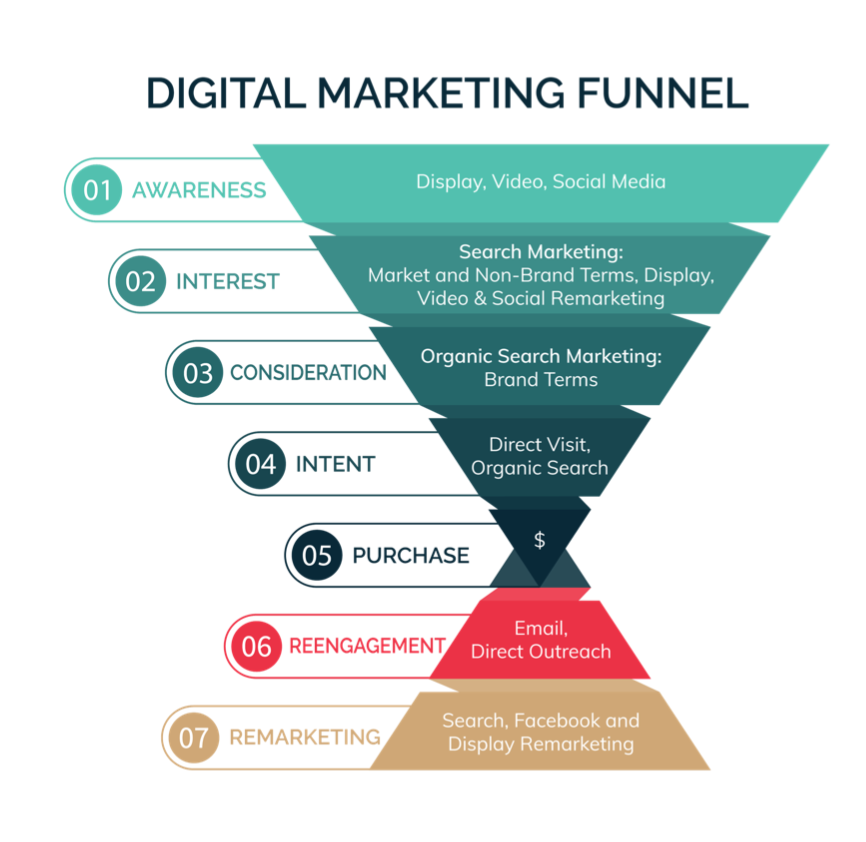
Marketing Funnel

Search marketing generally targets several parts of the funnel, the “Awareness” and “Interest” levels are usually targeted when people start to look for a place to stay – “hotels in san diego” – they don’t necessarily have an intent but are looking for what options might be available. This is a great way to target further up the funnel and look for people who might not be aware of your hotel or brand quite yet.

Once they get into the levels of “Consideration” and “Intent” they are usually searching for the specific name of your hotel. They might read some reviews, look at packages, or shop around a bit and this is the part of the booking journey that we definitely want to be present for. If we only target higher up the funnel with Market terms, we have a chance of losing that individual to an OTA or a competitor once they come back and are ready to book.

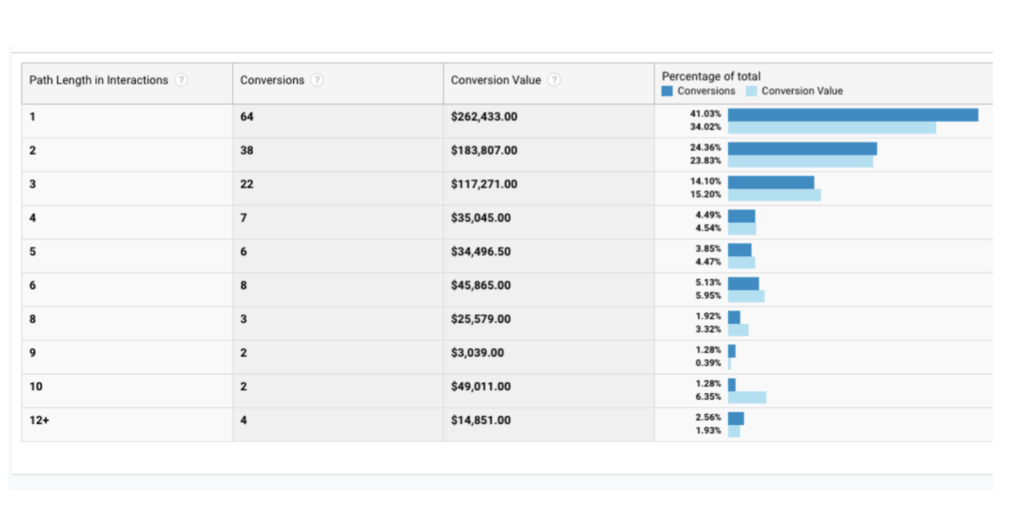
In a sampling of our client data, we can see that 34% of users have at least 3 interactions with the website and 5% have at least 9 interactions with the website prior to booking. So, it is a relatively large number of people that are coming on repeated visits to hotel websites before they end up booking.

User interactions screenshot

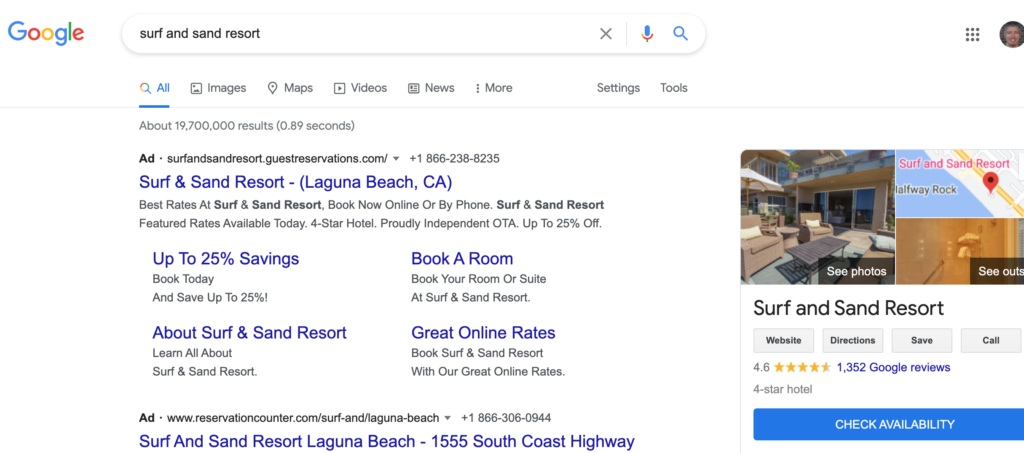
When someone searches for a hotel, they generally get a result similar to the one below. In this example, a GCommerce client is bidding on their own Name.

First Fold

Google search results 1st fold

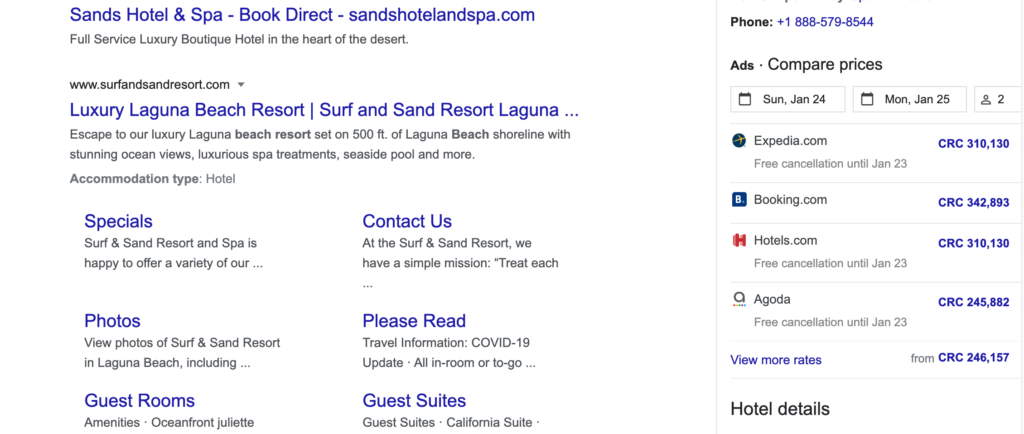
Second Fold

Google search results 2nd fold

Third Fold

Google search results 3rd fold

You can see it isn't until the 3rd fold that a user sees a result that would lead them to another website. The 2nd fold has some options for Metasearch on the right side, which we would certainly encourage hotels to participate in, but the first fold of the page is pretty much just the ad and sitelink extensions for their Google Ads. If we were to take that ad away, the TripAdvisor result would move into the 2nd fold and everything below it would move up as well. Based on data from Google Results, the 1st result on the page averages 32% of the clicks, 2nd 17% and 3rd gets 11%. Without our Ad present, we leave that space open to OTAs or other websites, taking away potential traffic to our hotel website.

CPCs for name terms on Google generally average less than $1 and we usually see relatively healthy conversion rates for those terms. By taking up that space on the Google result page, you are increasing the chances that a new visitor converts to your website rather than an OTA, where you might lose upwards of 25% of the booking in fees and commissions. The relatively small investment in advertising for your own name will help bring down the overall Cost-per-Acquisition (CPA) in relation to a commission from an OTA.

In addition to getting a higher CTR from Google users, we have also been able to track internal data that organic traffic increases with the presence of search ads. The thought here is that if you are controlling the 1st result with an ad and the 2nd result is your organic listing, then you could get 49% of the traffic with the 1st 2 results if we assume the above study true to the overall results of a page.

But what if you are one of those lucky hotels where OTAs are not bidding on your brand name? Even if there truly are no other OTAs and no other competition for your name, we would want to make sure we communicate that with whoever is managing your search accounts so that they can limit bids and lower overall costs. Without any competition, we should be able to drive CPCs very low, decreasing the overall CPA of hotel guests and providing all of the benefits listed above with even less investment. Without any OTAs, we would almost encourage hotels to run PPC at a more aggressive rate than if there were OTAs because great benefits could be realized with little cost.

To get more info on fighting back against the OTAs through paid search, contact GCommerce today!

Top 5 Reasons Your Hotel Needs Prospecting Campaigns

SHARE:

You want your hotel to make money, right? At least that is usually the main goal when it comes to most hotel digital marketing campaigns. What if we told you that the secret to driving more revenue and building your audiences up was by prospecting and targeting top-of-funnel users? 

We all know that retargeting campaigns, or campaigns serving ads to users already familiar with your brand or hotel, are the main money makers of the marketing world. However, those digital marketing campaigns would quickly run out of gas without the continued support of prospecting. While we don’t typically see a hefty number of conversions through prospecting campaigns (although a strong campaign can still see results), they are a key player when it comes to success with any digital marketing campaign.

Here are the top reasons why you should be running prospecting marketing campaigns for your hotel.

  1. Audience Refresh. The continued use of prospecting (or brand awareness) campaigns will help refresh your retargeting audiences by consistently bringing in new users. Most retargeting windows are within 30-90 days of being onsite, but if you aren’t refreshing this audience regularly, it will quickly decrease. This in turn will cause whatever users are left to be shown your ads in excess which can lead to ad fatigue, higher bounce rates, lower CTRs, more spam reports and of course, less revenue.
  2. Discover New Audience Targeting Segments. Many people shy away from prospecting because they think they already know their target audience. At GCommerce, we argue that there’s always potential to expand into new markets, geographics, demographics, and more! After all, there’s no way to see if a new targeting segment is viable if you never try it out. By steering away from the traditional targeting segments into new geographic locations or interests, we’ve often found new, responsive audiences that were previously unconsidered and thus expanding our reach and driving more revenue.
  3. Increased Traffic to Your Hotel Website. Aside from building up the run of site list, getting users to your site is a major benefit of prospecting campaigns. Our clients are always seeking out new ways to increase their site traffic with qualified visitors. Prospecting is one of the most cost-effective ways to do this, especially if you use Display and Facebook advertising as they traditionally see much lower CPCs and can run on a smaller budget compared to other channels, such as paid search.
  4. Increased Brand Awareness. Prospecting isn’t only for supporting retargeting campaigns. In fact, most people will think of prospecting in digital marketing as a tool to build brand awareness and high visibility across the web. This is especially important if you are launching a new brand or starting out on a new channel for the first time. Whenever we launch a new client at GCommerce, we tend to focus on their prospecting campaigns first so that we can build up our retargeting lists as quickly as possible and increase brand visibility at the same time.
  5. Drive More Wedding, Meeting & Event Lead Submissions. That’s right, prospecting campaigns are also great for eliciting onsite leads or on-Facebook leads. Unlike using retargeting lists, which are normally limited in size, prospecting marketing campaigns can be specifically targeted to drive quality traffic to your onsite lead form. Facebook also has great lead generation ability and allows you to re-create your form in the Facebook ad itself, allowing the user to engage with your hotel’s ad and complete the form in with less clicks. As a bonus, you can also add the users who filled out your form to your retargeting lists (win-win).

Utilizing prospecting marketing campaigns for your hotel is always important and will always be encouraged by the marketing experts at GCommerce. It’s especially important to use them right now as we’re learning how to cope with COVID-19’s impact on the industry. If you’ve had your marketing channels paused during this time and are now getting back to you regular advertising schedule, prospecting will be pertinent to your hotel’s digital marketing campaign success. 

Most likely, your retargeting lists are depleted and your normal target audiences have shifted to the drive market or similar markets. Pushing your marketing dollars toward prospecting over retargeting first will help to build up your run of site and serve your ads to the most qualified audiences rather than wasting it on an audience who isn’t looking to travel to your location or is no longer interested in your brand. 

For more information and guidance on building your prospecting audiences up, consult the experts at GCommerce today!

A Mid-Year Review of COVID-19’s Impact on Facebook Advertising for Hotels

SHARE:

As COVID-19 cases increased across the US, many hotels and resorts shut their doors to ensure the safety of their employees and community. This led to a dramatic decrease in revenue during a normally popular travel season. As bookings decreased, hotels and resorts searched for ways to decrease costs as much as possible. This resulted in many businesses and hotels across the country pausing their digital marketing efforts for a few months. Many businesses look at cutting digital advertising first in an effort to cut overall business costs, even though studies from the 2008 recession proved that hotels that kept advertising came out the strongest. 

One of the many digital marketing channels that took a hit during the current crisis is Facebook advertising. Hotels and resorts across our client roster  were forced to decrease or pause Facebook advertising spend due to lack of available marketing funds. Here’s a quick review of our Facebook ad performance year-over-year.

March- June 2020 vs 2019 Facebook Ads Performance

  • 71% Decline in Facebook Advertising Spend
  • 74% Decline in Revenue Generated from Facebook Ads
  • 54% Decrease in Impressions
  • 42% Decrease in Clicks

Although many of our clients pushed out organic posts with the goal of follower engagement while they were unable to commit as much budget to advertising, their traffic and revenue still decreased. 

Positive Facebook Advertising Performance for Hotels During COVID-19

It’s not all negative. Even with a large general decrease in performance compared to 2019, we did see positive results from our hotel clients who were able to keep Facebook advertising campaigns running. For those able to continue funding throughout the early months of the pandemic, their Facebook ad campaigns produced a 232X return on ad spend (ROAS) in May, jumping to 367X in June and 383X in July.

The increase in revenue and ROAS through the month of May can be attributed to our clients reopening and resuming their digital advertising across multiple channels, including Facebook. Many of our clients resumed or increased their Facebook advertising budgets in June leading to even greater increases in revenue and ROAS. 

Continuing to run wedding lead generation campaigns also benefited clients even with restrictions on large gatherings. One hotel in Louisville, KY received 80 leads through a Facebook Lead Generation Campaign from March to the end of June. While many weddings and gatherings have been postponed, this downtime offered a great opportunity to plan for the upcoming wedding season.

The strong performance we continue to see on Facebook advertising this summer demonstrates thepent up travel demand and consumer need or desire to get back to traveling and enjoying their summer vacations. Many properties are focusing their digital marketing efforts on their local markets and advertising a staycation experience. As travel opens up more and restrictions are lifted, hotels should look to expand audiences, but only if data supports the decision. It will be important to monitor performance to see if bookings stay strong in the next few months, or if they decrease due to the potential to exhaust the smaller, local audiences and the transition from summer to the typically slower fall travel season.

Key Takeaways From Facebook Ads Performance During COVID-19 & Beyond

While properties are focusing on their local guests and expanding their efforts to popular markets based on the decrease of travel restrictions, GCommerce Solutions recommends the emphasis for prospecting campaigns across a variety of platforms. As many properties reduced their digital marketing budgets, their online presence decreased significantly. The most important action that many hotels and resorts can take now is rebuilding their brand awareness, and engaging with potential guests. Properties who invest in a strong brand presence now will see positive results in the upcoming months. 

From May through July of this year, Facebook averaged an impressive ROAS of $350 for our clients that were engaging with the platform. Curious if Facebook was an outlier or a leader among channels, we looked at those same clients' performance on other channels during the same time period. We found that while the client's performance on PPC averaged a respectable $10.52, Facebook was by far the leader. 

In our estimation, this can be attributed to three primary factors. First, Facebook still offers micro-targeting capabilities we simply don't have access to on other digital channels. Working with our clients to understand their shifting market segmentation during the outbreak, we were able to advertise only to prospects with a high likelihood of making a purchase. Second, Facebook allows for a more rich advertising experience than other platforms. Travel is an often visual, always emotional purchase, and being able to better visually tell a story improves overall performance. Finally, advertising rates on Facebook still haven't caught up to other mediums like paid search. Marketing dollars simply go further on this medium. Because of these findings, we are reiterating to hotels and resorts that Facebook needs to be an early part of their digital advertising mix as they once again start actively marketing.

Questions about Facebook advertising for your hotel? Please reach out to one of our digital marketing specialists today.

Keep Reading