The Rise of Data Regulation & The Impact on Hotel Marketing

SHARE:

The rise of digital advertising grew from an era of limited tracking capabilities to an era of almost unlimited access to tracking user data across the web. This advancement in tracking has provided amazing opportunities to enhance campaign targeting options, narrowing targets based on user behavior and tying that tracking back to direct online booked revenue. This wild west atmosphere of digital tracking reached an apex that finally had governments and citizens around the world taking notice and growing concerned. Concepts around privacy and data took hold with the general public and political scandals, such as the ones documented in Netflix's The Great Hack. This drew attention to the need for the government to step in and help protect citizens from how their data was tracked, used and sold across the web. 

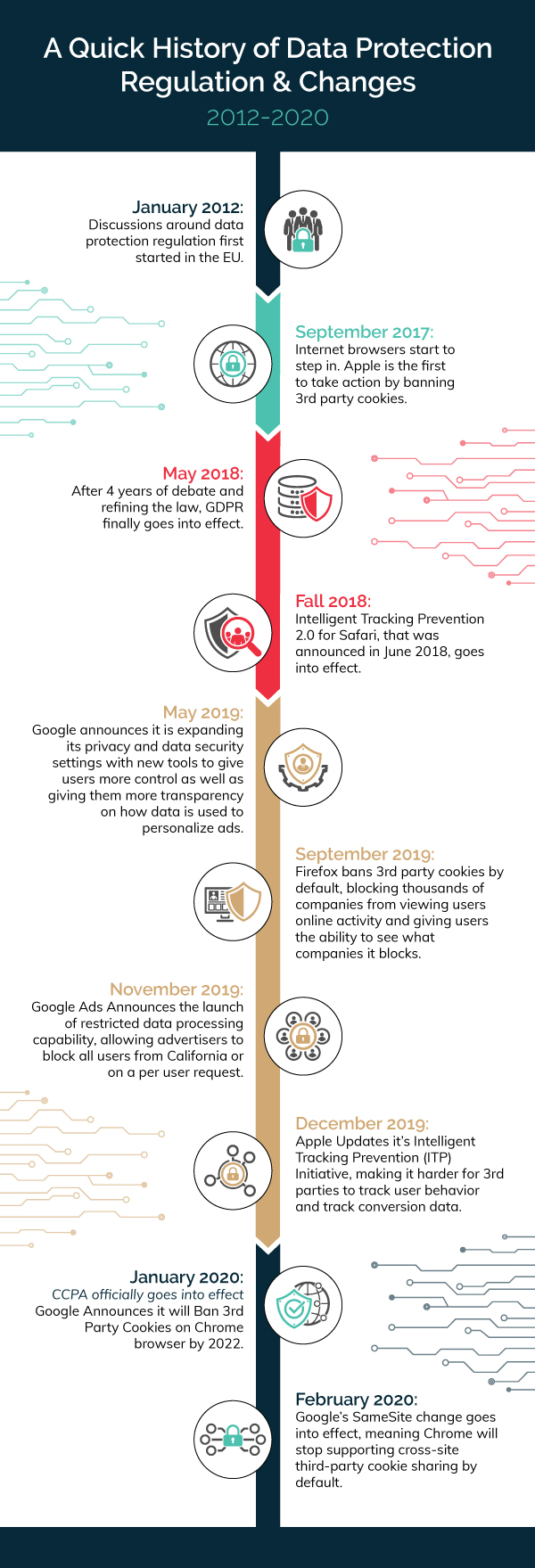
To better understand where we are and what it means for hotel marketing, let’s look back at a brief timeline of changes and regulations surrounding online data over the past decade.

What Do These Changes Mean?

September 2017: Internet browsers start to step in. Apple, whose revenues don’t rely on advertisements, was the first to take action by banning 3rd party cookies in September 2017.

https://www.theverge.com/2017/9/14/16308138/apple-safari-11-advertiser-groups-cookie-tracking-letter

May 2018: After 4 years of debate and refining the law, GDPR finally goes into effect. The first set of regulations aimed at protecting citizens from how their data is tracked, used, stored and sold.

Fall 2018: Intelligent Tracking Prevention 2.0 for Safari, which was announced in June 2018, goes into effect.

https://webkit.org/blog/8311/intelligent-tracking-prevention-2-0/

May 2019: Google announces during Google Marketing Live that it is expanding its privacy and data security settings with new tools to give users more control as well as giving them more transparency on how data is used to personalize ads.

September 2019: Firefox bans 3rd party cookies by default, blocking thousands of companies from viewing users' online activity and giving users the ability to see what companies it blocks.

November 2019: Google Ads Announces Data Processing Restriction Setting. The launch of restricted data processing capability allows advertisers to block all users from California or on a per-user request. Applying this setting turns off the ability to build and use remarketing lists for these users.

December 2019: Apple’s Update to It’s Intelligent Tracking Prevention (ITP) Initiative made it harder for 3rd parties to track user behavior and track conversion data. 

January 2020: CCPA officially goes into effect. Google Announces it will Ban 3rd Party Cookies on Chrome browser by 2022.

https://www.vox.com/recode/2020/1/16/21065641/google-chrome-cookie-ban-advertisers

February 2020: Google’s SameSite change goes into effect, meaning Chrome will stop supporting cross-site third-party cookie sharing by default.

In addition to CCPA, there are new laws and regulations on state legislature dockets across the country. How or when the U.S. federal government will take action in the form of data regulation law is unknown. The question remains, how will your hotel marketing evolve and change based on current and future changes coming to data regulation. We’ve taken some time to outline how we are viewing data regulation changes and evolving our hotel marketing to address them.

What Do These Changes in Data Regulation and Tracking Mean for Hotel Marketing?

  1. You should have already consulted your lawyer. The topics and laws surrounding data regulation and technology changes can easily get confusing. GCommerce recommends that you consult with your hotel’s consumer privacy lawyer immediately if you haven’t done so already to make sure your business is in compliance with these laws. Please feel free to check out our GDPR and CCPA guides for hotels, but understand that these are not to be used in any way as legal advice.
  2. Audience lists, such as remarketing lists, will be impacted. As more people take control of their privacy and restrict sites from using cookies to track their actions and behavior, the data behind audience lists will decline and so will remarketing audience list sizes. While we’re not seeing a huge impact on our clients yet, this might result in the decline in size for these types of audience lists which can directly impact ROAS tracked.
  3. Lean into 1st party data for audience and campaign targeting. While companies that rely on 3rd party cookies to track user behavior across the web and develop audiences will suffer, companies that hold 1st party data such as Google and Facebook stand to gain the most benefit. Since Google has so much 1st party user data through its various platforms, it can continue to offer rich in-market and affinity audience targeting opportunities through its ad platforms. GCommerce already uses these audiences to drive targeting campaigns and will continue to use audiences that provide favorable results for our clients.
  4. Our ability to track conversions will suffer. It will continue to get harder to track conversions to the same level of detail we have been used to through some browsers and platforms. The changes implemented by Firefox, Safari, and Chrome can all have an impact on this tracking. The industry is having to pivot and changes in technology that move away from cookie tracking are being worked on by large tech companies including Google. GCommerce is on the pulse of changes to pivot how we implement tracking across sites like Google Analytics to mitigate as much interruption to tracking as possible.
  5. Contextual targeting will become a greater asset. Contextual targeting options on Google and DV360 offer an alternative to audience-based targeting. Using keywords and topics allows us to craft ads and messaging to match content the user is viewing. This will continue to be a method for us to effectively market our clients and drive performance.
  6. Automation and machine learning tools can help. When cookies are blocked, it also prevents the ability to control certain campaign aspects like ad frequency. Google is investing heavily in ways to ensure the user experience isn’t impacted. One way is using machine learning within DV360, GCommerce’s programmatic solution of choice, to help prevent users from seeing your ad too many times.

The digital environment will continue to evolve as more data protection regulation emerges, forcing platforms and advertisers to adjust accordingly. While this does provide uncertainty in areas like audiences and tracking, it does provide the hope of a more secure web for us all. Please reach out to GCommerce with any questions you have in regards to our stance and preparation for these changes to the hotel digital marketing landscape.

Tropicana Inn & Suites' New Website Increases Conversion Rate and Revenue

SHARE:

Have you ever wondered just how important a website is to a business?

GCommerce launched a beautiful new website for Tropicana Inn & Suites in Anaheim, CA in October 2017. A deep focus on branding, user experience and design with a focus on conversion rate optimization had a dramatic impact on the hotel’s digital presence and bottom line.

Functionality plays a huge part in the overall user experience and performance for any website. The creative and design team at GCommerce Solutions understands this and makes sure to implement hospitality specific best practices to all of our website builds and designs.

In the case of Tropicana Inn & Suites, it was a Design Ready Architecture (DRA) build that was put together with their new branding and content initiatives. The Tropicana specific DRA that was used took into consideration keeping a user on the website and giving them all the information needed right at their fingertips.

The most important factors considered for Tropicana’s layout & design was:

  • Having a testimonial section right on the website.
    • This keeps a user on the page and provides transparency; keeping them from having to search for another website’s reviews helping to ultimately keep the user on the property’s website.
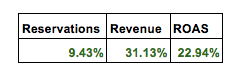
    • This shows success in the 6% increase in average session duration since the launch of the new website.
  • Highlighting the most visited pages right on the homepage to help keep the user engaged and easy navigation to find the information they require.
  • High quality and professional photography. Per Hospitality Net, after price, photography is the most important factor for travelers and prospects.

LET’S TAKE A LOOK AT THE ACTUAL NUMBERS AND HOW THE NEW WEBSITE HAS IMPACTED DIFFERENT MARKETING CHANNELS

The following results were found after comparing data from the old website vs. the new website post launch.

OVERALL WEBSITE PERFORMANCE

Overall website Performance

Lets delve deeper and review how the new website helped the individual digital marketing efforts.

PAID SEARCH ADVERTISING

Paid Search

FACEBOOK ADVERTISING

Facebook Advertisement

Well designed with user experience and conversion rate best practices in mind, a new website can make a dramatic difference in your hotel’s performance and bottom line. Your website is your online storefront, You want it to be welcoming and portray a true representation of the property’s experience. The user experience should be easy to navigate and help lead your user through the booking funnel. Such as the snap navigation and booking widget used for Tropicana Inn & Suites that affixes to the top of the browser and follows the user down the page. You want the user to be able to navigate your site from anywhere and allow them to book their room from any point of their journey.

GCommerce Solutions would be happy to help with your new website. You can submit a request for more information here or give us a call at 435-214-5301.

Hotel & Digital Marketing Analytics | Water Business Analytics

SHARE:

Psychology experts have estimated that having something like a communal water cooler will increase workplace productivity by as much as 10-15%. Experts at GCommerce will tell you it’s a huge pain when the communal water cooler stops working. Which is exactly what happened last week at our offices in Park City. It took just over 2 days for it to be fixed and in that time we used 2.5-gallon jugs as replacements. Our Reporting and Analytics specialists are always looking for new ways to measure data and we saw this as a great opportunity for some water cooler insights. While this information probably does not benefit our business in any way, we thought it would be interesting to measure out our drinking water usage in an exercise very similar to building insights for hotel websites. Here, we’d like to share our results with you:

We bought 2 different types of water, Spring Water and Drinking Water, both from Mount Olympus. We contacted the wonderful people at Mount Olympus Water for comment, they explained: “the difference between the 2 is that Spring Water is from a locally sourced spring with a natural mixture of minerals that give the water a pH balance between 6.5 and 8. Drinking Water is purified from a locally sourced tap with natural minerals added that give the water a pH of exactly 6.” The representative that commented for us said that he personally preferred the Drinking Water to the Mineral Water. I was unable to determine any difference in a blind taste test.

Table 1

Screen-Shot-2017-09-22-at-11.02.45-AM-1

As Table 1 illustrates, GCommerce employees also prefer the Drinking Water to the Spring Water, nearly 2:1. A full Drinking Water jug unopened has about 7.5 inches of water in it. The Drinking Water jug that was not fully consumed had about .4 of an inch of water left in it. Therefore, we could estimate about .2 of a gallon of water were left, or 2.3 gallons consumed. With 1 Spring Water and 1 Drinking Water empty, that gave a total consumption of 4.8 gallons of Drinking Water and 2.5 of Spring Water.

Considering this is only about half the water the office consumed, as only 1 water cooler went out, we could double these numbers and make predictions about our office drinking habits. Assuming there are 5 days in a normal workweek, we will drink about 29 gallons of water, with 22 workdays in an average month, we will drink close to 129 gallons and with 262 workdays in an average year, we will drink over 1,530 gallons of water.

Table 2

Screen-Shot-2017-09-22-at-11.03.04-AM


If that sounds like a lot of water, it sort of is. Each gallon of water is enough to take up 7.5 cubic feet of water in a swimming pool. Which means we could completely fill a pool of over 204 cubic feet with the amount of water we drink each year. Although, as an Olympic sized swimming pool is over 88,000 cubic feet, it would take us over 441 years to drink enough water to fill a pool of that size.

At this point, you might be asking yourself, why does this matter? The short answer is, it probably doesn’t, but we thought it would be interesting. What does matter are the insights that we can learn and the strategy that can be developed by tracking data. Knowing that your office of 40 people drinks enough water each year to fill a kids-size inflatable swimming pool might not help your business at all. But accurately tracking user interactions across multiple advertising platforms to build a deeper understanding of your website visitors, bring more revenue to your business while maximizing your Return On Advertising Spend is important.

Whether it’s your website’s business analytics in the office during the week or water cooler data on the weekend, your Analytics and Reporting specialists at GCommerce are passionate about accurate data and reporting insights for hotels. Contact us today to see how we can help support your website analytics.

Potential Changes to Google Analytics are Looming

SHARE:

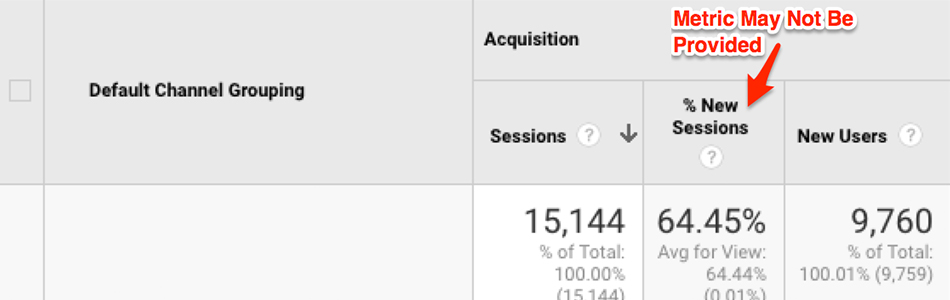
% OF NEW SESSIONS MISSING | CHANGES TO GOOGLE ANALYTICS METRICS

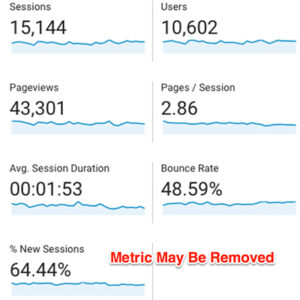
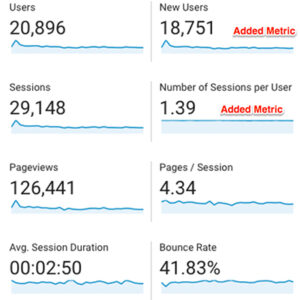
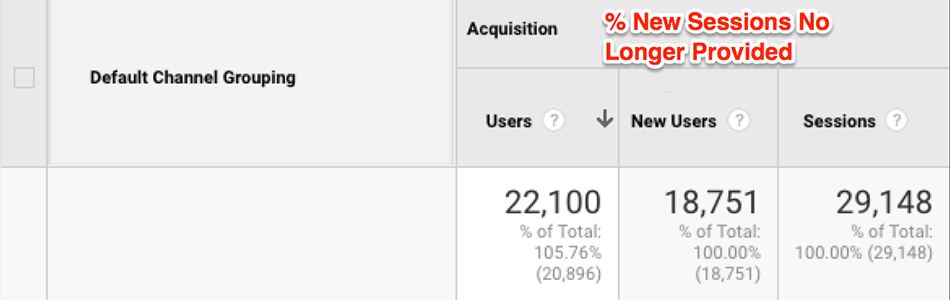
For users of Google’s Premium Analytics services, you may have noticed a slight change in the way that default metrics are being displayed. Google has removed the % New Sessions, added in Number of Sessions per User and New Users. They have also re-ordered the metrics to show Users and New Users ahead of Sessions.

CURRENT VIEW, SESSIONS FIRST:

2017.04_Blog_Image_Copy_Left_2_AnalyticChanges

NEW VIEW, USERS FIRST:

2017.04_Blog_Image_Copy_Right_1_AnalyticChanges

CURRENT VIEW, SESSIONS FIRST:

chart

NEW VIEW, USERS FIRST:

2017.04_Blog_Image_Copy_Bottom_2_AnalyticChanges

% New Sessions can still be viewed in Custom Reports, Dashboards, and Segments or as a Secondary Dimension on most reports within Google Analytics.

We were unable to find any documentation from Google that they are updating the default views in Analytics. Representatives from Google Analytics would not confirm nor deny any changes, however, a support specialist was able to share over the phone that Google has internal documentation showing that this change is rolling out to all Google Analytics accounts over the next few months. This representative let us know that Google is moving to a focus centered more around Users, rather than Sessions, which is reflected in these updates.

Just last week, Google made an announcement that they would be extending Remarketing List Audiences across devices. They have also made numerous changes over the last few years in the way that ads can be remarketed. It seems that the move to a stronger focus on Users in Google Analytics is an effort to better track and target individual users with ads through Google’s Ad services across all devices, through multiple platforms and channels.

If Google is rolling out other changes with this one, it is yet to be seen. However, we expect Google to continue to advance their tracking, reporting, and advertising to be more user and audience focused with greater opportunities to remarket and segment individual users across devices and through multiple channels within Google’s extensive advertising network.

Keep Reading